GATE MT · Chapter-wise
Manufacturing Processes
Casting, welding, forming, machining · PYQs 1990–2026 with answers & solutions
Manufacturing Processes
Casting, welding, forming, machining
224 questionsGATE 2026 · Q14
14
Which fusion welding technique results in least Heat-Affected Zone (HAZ)?
Solution
EBW has extremely concentrated energy, very low heat input per unit length → smallest HAZ. Answer: CGATE 2026 · Q38
38
Match defects: P) Edge Cracking, Q) Flashline Cracking, R) Chevron Cracking, S) Cracked Core
with processes: 1) Casting, 2) Forging, 3) Rolling, 4) Extrusion
with processes: 1) Casting, 2) Forging, 3) Rolling, 4) Extrusion
Solution
Edge cracking:Rolling(3), Flashline:Forging(2), Chevron:Extrusion(4), Cracked core:Casting(1). Answer: DGATE 2025 · Q22
22
In metal casting, which one of the following gating ratios (sprue : runner : gate area ratio) represents a non-pressurized gating system?
Solution
Non-pressurized system: gate area > sprue area (1:2:3 → expanding). Pressurized systems have gate < sprue (constricting). Answer: AGATE 2025 · Q42
42
Match casting defects in Column I with features in Column II.
Column I: P. Misrun Q. Expansion scab R. Pin holes S. Hot tearing
Column II: 1. Penetration of liquid metal behind surface sand layer 2. Premature solidification — sections not filled 3. Cracking due to contraction restraint 4. Gas evolution during solidification causing porosity
Column I: P. Misrun Q. Expansion scab R. Pin holes S. Hot tearing
Column II: 1. Penetration of liquid metal behind surface sand layer 2. Premature solidification — sections not filled 3. Cracking due to contraction restraint 4. Gas evolution during solidification causing porosity
Solution
Misrun=premature solidification(2); Expansion scab=metal penetration(1); Pin holes=gas porosity(4); Hot tearing=contraction cracking(3). Answer: DGATE 2025 · Q44
44
Front tension is applied during cold rolling of a thin metal sheet. Which of the following statements is/are TRUE?
Solution
Front tension pulls the sheet forward, reducing rolling load (B ✓) and shifting the neutral point towards the entrance (A ✓). Answer: A, BGATE 2025 · Q46
46
Which of the following statements is/are CORRECT with respect to fusion welding and solid-state welding of metals and alloys?
Solution
Pure metals have a single melting point, so no partially melted zone in fusion welding (B ✓). Diffusion bonding is solid-state (C ✓). Wide freezing range alloys show a partially melted zone (D ✓). Answer: B, C, DGATE 2025 · Q47
47
Which of the following welding processes does NOT / do NOT utilize a consumable electrode?
Solution
PAW uses non-consumable W electrode (A ✓). EBW uses an electron beam — no electrode (D ✓). GMAW and SMAW both use consumable electrodes. Answer: A, DGATE 2024 · Q26
26
Match the defects (Column I) with associated manufacturing processes (Column II):
P. Misrun Q. Earing R. Alligatoring S. Chevron cracking
1. Extrusion 2. Rolling 3. Casting 4. Deep drawing
P. Misrun Q. Earing R. Alligatoring S. Chevron cracking
1. Extrusion 2. Rolling 3. Casting 4. Deep drawing
Solution
Recrystallization driving force is stored deformation energy in dislocations. Answer: BGATE 2024 · Q35
35
The extrusion force to extrude an aluminium rod from cross-sectional area 150 mm² to 50 mm² is ________ N. (Extrusion constant = 2 MPa; Round off to the nearest integer)
Solution
Extrusion force: \(F=k\cdot A_0\cdot\ln(A_0/A_f)=2\times150\times\ln(150/50)=300\ln3\approx329.6\) N. Answer: 328–331 NMetallurgical Engineering — Q.36 to Q.65 (2 Marks Each)
GATE 2024 · Q46
46
For rolling of slabs, determine the correctness of the following Assertion [a] and Reason [r].
[a]: Grooves are made on the surface of the rolls parallel to their roll axes to achieve large thickness reduction in a short time.
[r]: Given \(\mu\) = coefficient of friction and \(\alpha\) = angle of bite, unaided entry of slab can take place only if \(\mu < \tan\alpha\).
[a]: Grooves are made on the surface of the rolls parallel to their roll axes to achieve large thickness reduction in a short time.
[r]: Given \(\mu\) = coefficient of friction and \(\alpha\) = angle of bite, unaided entry of slab can take place only if \(\mu < \tan\alpha\).
Solution
Rolling mechanics: grooves increase reduction, friction condition µ ≥ tan α for entry. Answer: DGATE 2024 · Q49
49
Which of the following statements is/are correct for joining processes?
Solution
Joining: soldering/brazing use low-melting fillers (A), friction welding is solid-state (C). Answer: A,CGATE 2024 · Q64
64
In casting, a simple vertical gating system with gate area = 2 cm², sprue height = 10 cm, mould dimensions = 40 cm × 20 cm × 10 cm. The filling time is ________ s. Given: g = 980 cm·s². (Round off to one decimal place)
Solution
Casting fill time: t = V/(A√(2gh)) = 8000/(2×140) ≈ 28.6 s. Answer: 27-30GATE 2024 · Q65
65
During arc welding, actual heat input = 200 J·mm³, current = 200 A, voltage = 20 V, weld cross-sectional area = 2 mm², heat transfer efficiency = 0.9. The velocity of welding is ________ mm·s¹. (Round off to the nearest integer)
Solution
Arc welding velocity: v = ηVI/(qA) = (0.9×20×200)/(200×2) = 9 mm/s. Answer: 9
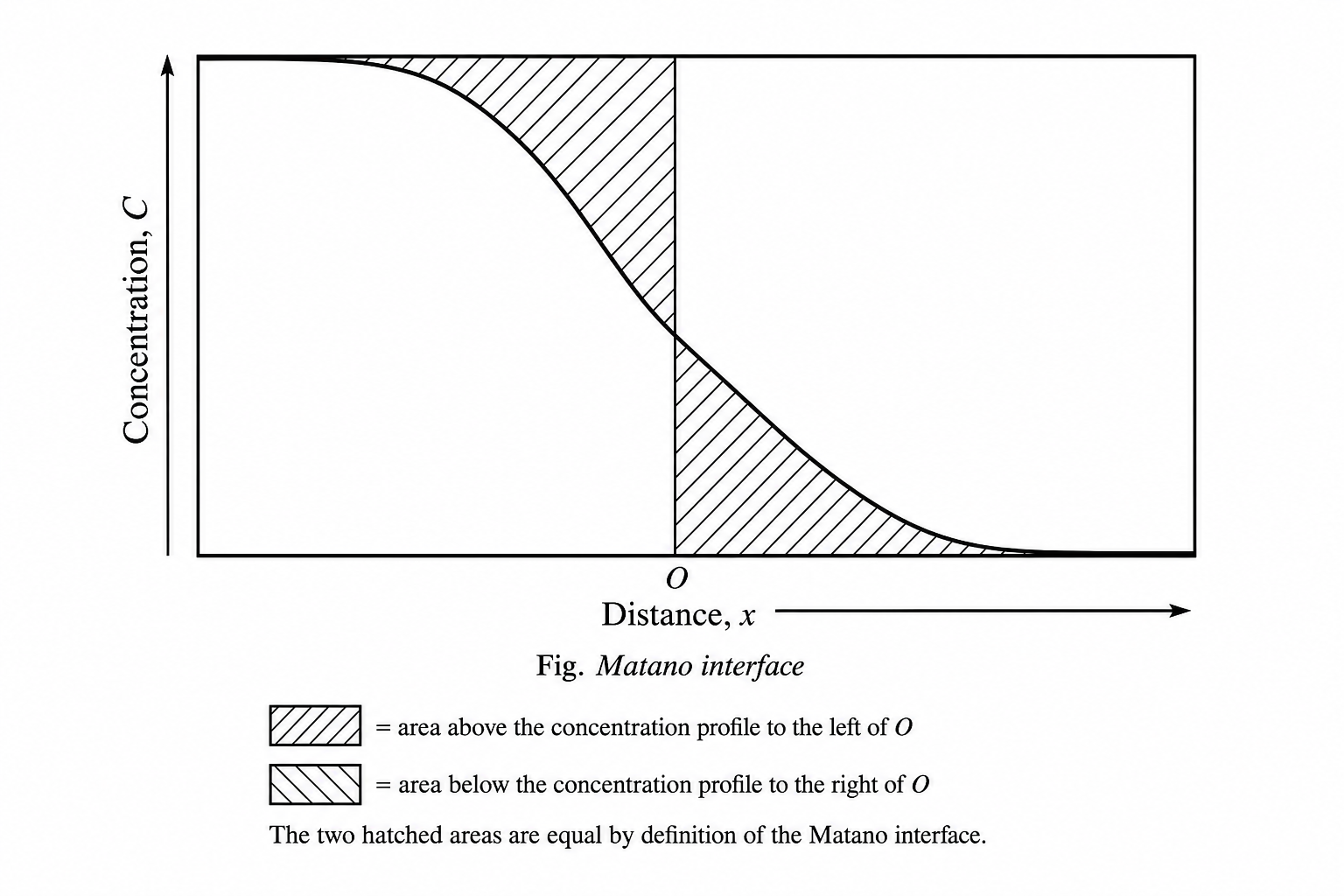 Utility: The Matano–Boltzmann analysis uses this interface as the origin (x = 0) to calculate the interdiffusion coefficient as a function of concentration from a single diffusion couple experiment.
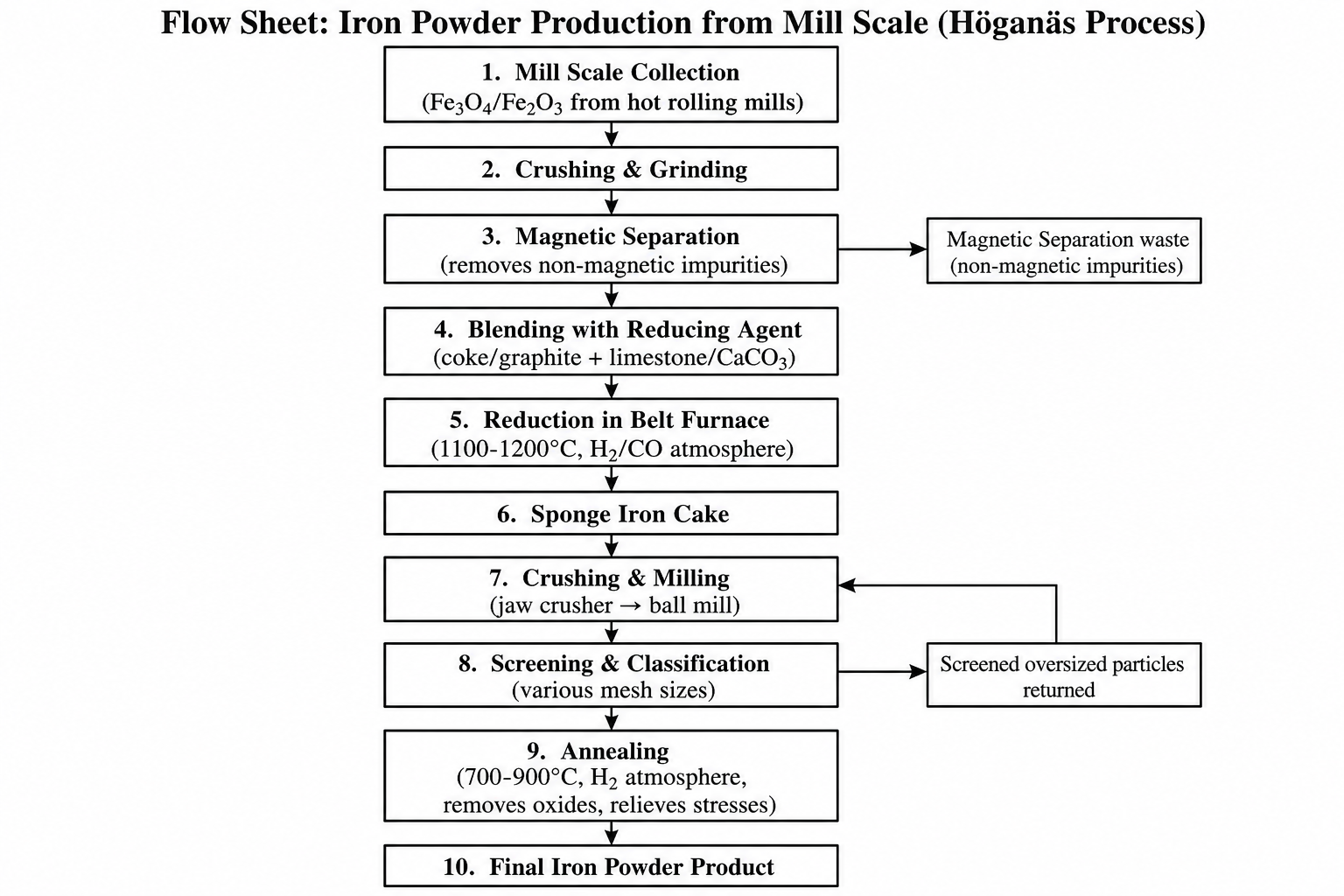 The Höganäs-type process for iron powder production from mill scale: