GATE MT · Chapter-wise
Solid Mechanics & Mechanical Properties
Stress, strain, fracture, fatigue, creep · PYQs 1990–2026 with answers & solutions
Solid Mechanics & Mechanical Properties
Stress, strain, fracture, fatigue, creep
221 questionsGATE 2026 · Q16
16
In a face-centered cubic metal, Shockley partial is:
Solution
Shockley partial: b = a/6⟨112⟩ — NOT a lattice vector (imperfect), glissile on {111} plane (mobile). Answer: DGATE 2026 · Q17
17
Deformation mechanism map is used for determining which property?
Solution
Ashby deformation mechanism maps show dominant creep mechanisms and strain rates vs. T/T_m. Answer: BGATE 2026 · Q18
18
Which dislocation dissociation reaction is feasible in FCC metals?
Solution
Check A: vectors add to \(\frac{a}{6}[0\bar{3}3]=\frac{a}{2}[0\bar{1}1]\) \(\checkmark\). Energy decreases: \(a^2/2 > a^2/6+a^2/6\) \(\checkmark\). Answer: AGATE 2026 · Q37
37
Match: P) Paris Law, Q) Schmid Factor, R) Larson-Miller Parameter, S) Portevin-Le Chatelier Effect
with 1) Creep, 2) Fatigue, 3) Dynamic Strain Aging, 4) Critical Resolved Shear Stress
with 1) Creep, 2) Fatigue, 3) Dynamic Strain Aging, 4) Critical Resolved Shear Stress
Solution
Paris Law:Fatigue(2), Schmid:CRSS(4), Larson-Miller:Creep(1), PLC:DSA(3). Answer: BGATE 2025 · Q60
60
Nabarro–Herring creep in polycrystalline Ni. \(\dot{\varepsilon}=10^{-8}\) s\(^{-1}\) at \(\sigma=10\) MPa. What stress gives \(\dot{\varepsilon}=10^{-9}\) s\(^{-1}\)? (integer MPa)
Solution
N–H creep: \(n=1\Rightarrow\dot{\varepsilon}\propto\sigma\). \(\sigma_2=\sigma_1\times(\dot{\varepsilon}_2/\dot{\varepsilon}_1)=10\times10^{-1}=\mathbf{1}\) MPa.GATE 2025 · Q62
62
A cylindrical specimen is plastically tensioned to 10% uniform elongation. Final gage-section area = 20 mm\(^2\). Initial gage-section area is ______ mm\(^2\) (integer).
Solution
Volume conserved: \(A_iL_i=A_fL_f\). \(L_f=1.1L_i\). \(A_i=A_f\times(L_f/L_i)=20\times1.1=\mathbf{22}\) mm\(^2\).GATE 2025 · Q64
64
Al alloy billet (300 mm dia.) hot extruded to 75 mm dia. at \(\dot{\varepsilon}=10\) s\(^{-1}\). Flow stress \(\sigma=10(\dot{\varepsilon})^{0.3}\) MPa. Ideal plastic work of deformation per unit volume is ______ × 10\(^6\) J m\(^{-3}\) (1 decimal place).
Solution
\(\sigma=10\times10^{0.3}=19.95\) MPa. True strain: \(\varepsilon=2\ln(300/75)=2\ln4=2.773\). Ideal work \(=\sigma\varepsilon=19.95\times2.773=\mathbf{55.3}\) MJ m\(^{-3}\).GATE 2024 · Q16
16
Match the laws with corresponding material properties:
Column I: (P) Hooke's law, (Q) Fick's law, (R) Fourier's law, (S) Darcy's law
Column II: (1) Thermal conductivity, (2) Young's modulus, (3) Permeability, (4) Diffusivity
Column I: (P) Hooke's law, (Q) Fick's law, (R) Fourier's law, (S) Darcy's law
Column II: (1) Thermal conductivity, (2) Young's modulus, (3) Permeability, (4) Diffusivity
Solution
Hooke's law → Young's modulus (2), Fick's law → Diffusivity (4), Fourier's law → Thermal conductivity (1), Darcy's law → Permeability (3). Answer: CGATE 2024 · Q25
25
Match the concepts (Column I) with phenomena (Column II):
P. Peierls-Nabarro stress Q. Cottrell's atmosphere R. Paris law S. Considère's criterion
1. Yield point phenomenon 2. Fatigue 3. Dislocation glide 4. Onset of necking
P. Peierls-Nabarro stress Q. Cottrell's atmosphere R. Paris law S. Considère's criterion
1. Yield point phenomenon 2. Fatigue 3. Dislocation glide 4. Onset of necking
Solution
FCC slip systems: {111} planes (4) × <110> directions (3 per plane) = 12 total. Answer: CGATE 2024 · Q34
34
A single crystal: slip plane normal at 60° to tensile axis; slip direction at 45° to tensile axis; critical resolved shear stress = 2 MPa. The tensile stress at which plastic deformation commences is ________ MPa. (Round off to one decimal place)
Solution
Schmid factor: \(m=\cos\phi\cos\lambda=\cos 60°\times\cos 45°=0.5\times0.707=0.354\). \(\sigma_{yield}=\tau_{CRSS}/m=2/0.354\approx5.66\) MPa. Answer: 5.5–5.8 MPaGATE 2024 · Q45
45
Which one of the following graphs represents Griffith's criterion for the growth of a crack in a brittle isotropic infinitely large plate with a center crack? (\(\Delta SE\) = strain energy released; \(\Gamma_s\) = total surface energy; \(a_c\) = critical crack length)
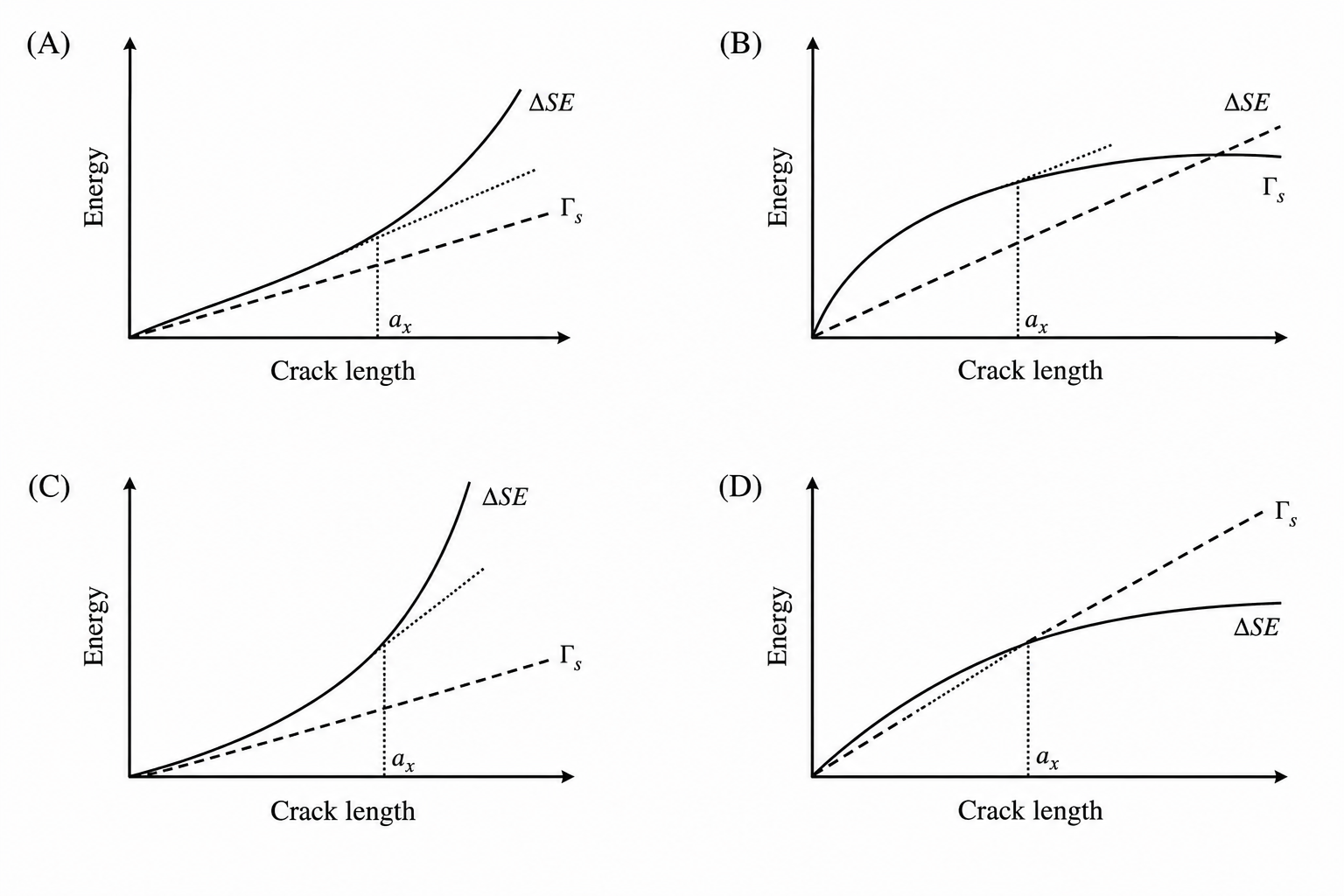
Solution
Griffith's criterion for crack growth: energy vs crack length curves showing characteristic minimum. Answer: DGATE 2024 · Q48
48
A creep test of a pure polycrystalline metal is performed in tension and the creep strain rate decreases during the primary stage. The creep mechanism is dislocation-climb-controlled. The observed decrease in creep strain rate is/are due to
Solution
During primary creep with dislocation-climb mechanism, dislocations multiply and pile up, increasing dislocation density. This raises the back-stress on gliding dislocations and reduces the creep strain rate. Answer: AGATE 2024 · Q54
54
A steel bar under fatigue loading has tensile mean stress. Ultimate tensile strength = 1000 MPa, fatigue limit under fully reversed loading = 250 MPa. Using the Goodman relationship, the fatigue limit for a mean stress of 100 MPa is ________ MPa. (Round off to the nearest integer)
Solution
Goodman relation: σ_a/250 + 100/1000 = 1, giving σ_a = 225 MPa. Answer: 225GATE 2024 · Q63
63
A large rectangular component undergoes fully-reversed cyclic loading with fatigue crack from the outer surface. Stress amplitude \(\sigma_A\) = 100 MPa, \(K_{1C}\) = 50 MPa·m½, geometric factor \(\alpha\) = 1.12. The crack length at which the component will fail catastrophically is ________ mm. (Round off to one decimal place)
Solution
Griffith: K_IC = ασ_A√(πa). Solving: a = [K_IC/(ασ_A)]²/π = 63.4 mm. Answer: 62.5-64.5GATE 2023 · Q19
19
Diamond has low
Solution
Diamond has high hardness, high elastic modulus, and high thermal conductivity, but low electrical conductivity. Answer: AGATE 2023 · Q22
22
The mechanism of creep for a single crystal as depicted in the schematic is
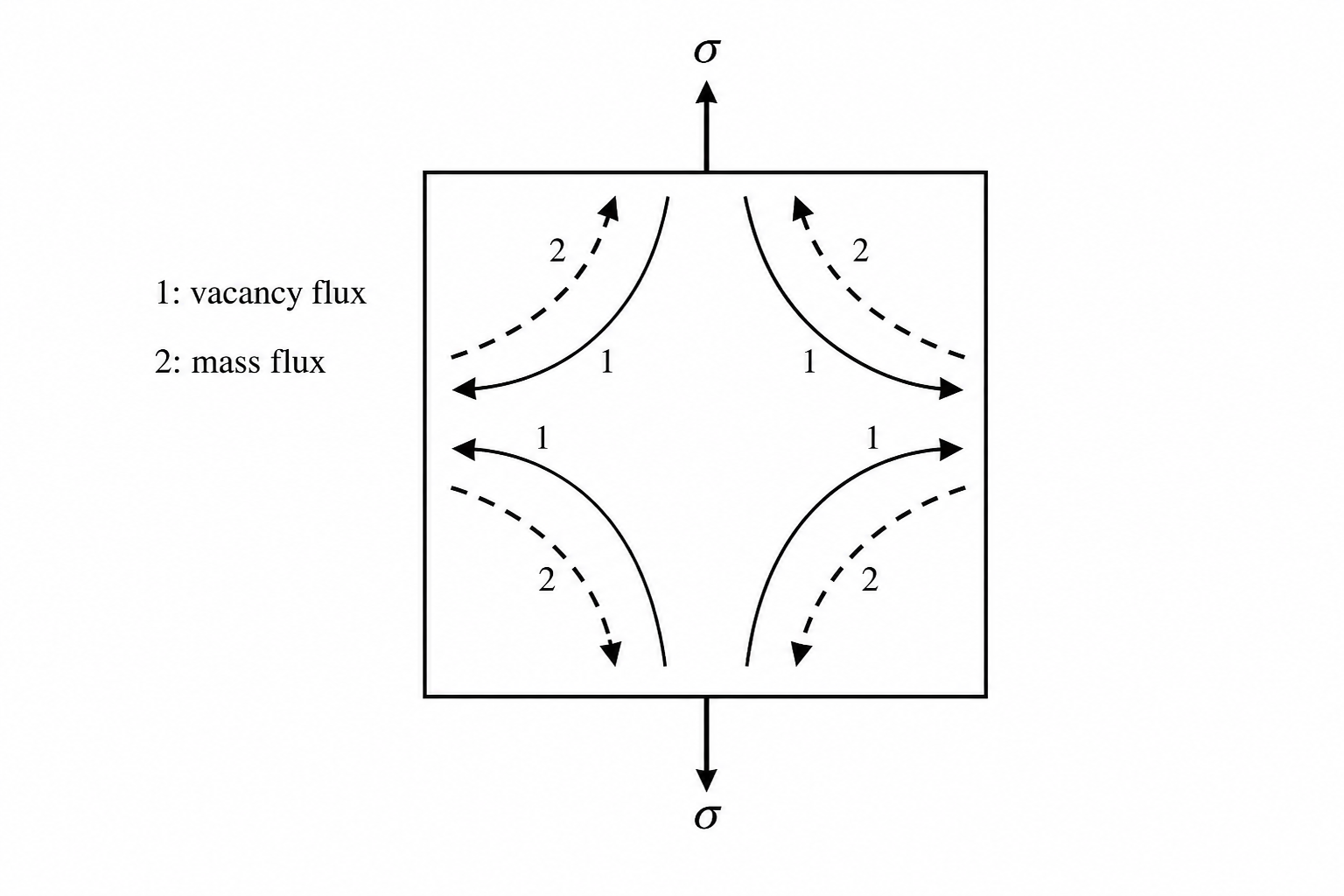
Solution
The shown single-crystal creep schematic corresponds to vacancy diffusion through the lattice, i.e. Nabarro-Herring creep. Answer: AGATE 2023 · Q27
27
Which of the following is/are responsible for reducing the high cycle fatigue life
of a component?
of a component?
Solution
Higher mean stress and rougher surfaces reduce high-cycle fatigue life; shot peening and avoiding sharp corners improve it. Correct options: A, BGATE 2023 · Q63
63
Strain hardening behavior of an alloy is given by sigma = 1100 epsilon0.3 , where sigma and epsilon
are true stress and true strain, respectively. The alloy is cold drawn to an unknown
amount of strain, followed by tensile testing. If the tensile test showed
10 % reduction in area at maximum load, then the unknown amount of strain from
prior cold work is ____________ (round off to 2 decimal places).
are true stress and true strain, respectively. The alloy is cold drawn to an unknown
amount of strain, followed by tensile testing. If the tensile test showed
10 % reduction in area at maximum load, then the unknown amount of strain from
prior cold work is ____________ (round off to 2 decimal places).
Solution
At maximum load Considere's criterion gives remaining uniform true strain equal to n = 0.3. Convert 10% area reduction to true strain and subtract from n to obtain the prior cold-work strain. Answer range: 0.18 to 0.21GATE 2023 · Q64
64
A specimen containing maximum initial surface crack of size 1.5 mm is subjected to cyclic loading with sigma_max = 300 MPa and sigma_min = 0 MPa. Assuming specimen geometric factor of 1, and referring to the given figure, the crack growth rate in micrometre cycle^-1 is ____________ (round off to nearest integer).
Given: N = number of cycles; a = crack length; R = stress ratio; Delta K = stress intensity range.
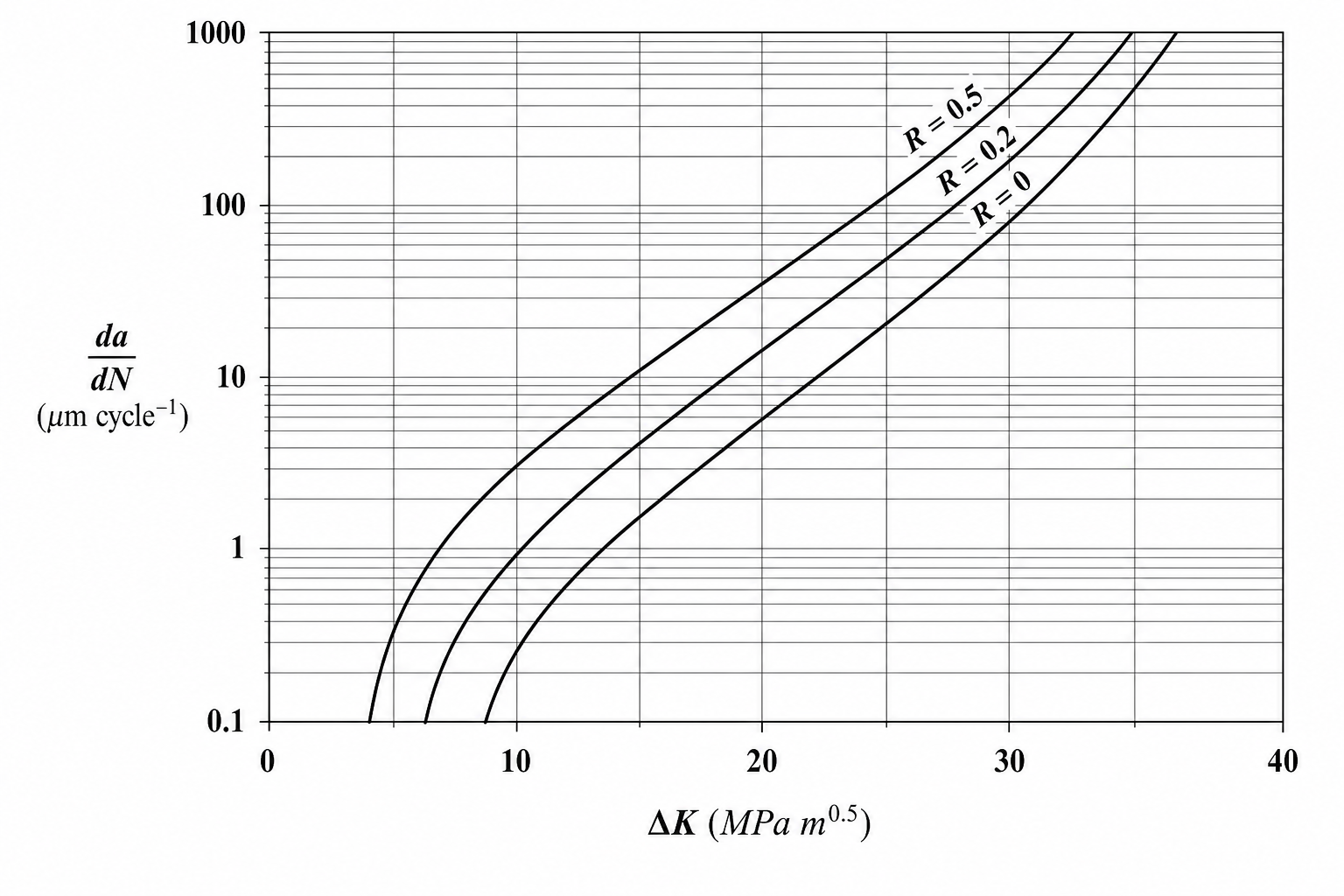
Given: N = number of cycles; a = crack length; R = stress ratio; Delta K = stress intensity range.
Solution
Compute Delta K = Y Delta sigma sqrt(pi a) with R = 0 and read the crack-growth rate from the supplied plot. Answer range: 7 to 15 micrometre/cycleGATE 2022 · Q26
26
For a material that undergoes strain hardening, necking instability occurs during
tensile testing when ___________
Given: \(\sigma\) = true stress and \(\epsilon\) = true strain.
tensile testing when ___________
Given: \(\sigma\) = true stress and \(\epsilon\) = true strain.
Solution
Considere criterion for necking in true stress-true strain form is d sigma/d epsilon = sigma. Answer: CGATE 2022 · Q29
29
With reference to the stress intensity factor, find the correct match of
nomenclature (Column A) with the mode of deformation applied to the crack
(Column B).
Column A Column B
(P) Mode I (X) Forward shear mode
(Q) Mode II (Y) Parallel shear mode
(R) Mode III (Z) Crack opening mode
nomenclature (Column A) with the mode of deformation applied to the crack
(Column B).
Column A Column B
(P) Mode I (X) Forward shear mode
(Q) Mode II (Y) Parallel shear mode
(R) Mode III (Z) Crack opening mode
Solution
Mode I is opening, Mode II forward/in-plane shear, and Mode III parallel/tearing shear. Answer: BGATE 2022 · Q41
41
Match the phenomena (Column I) with the descriptions (Column II)
Column I Column II
(P) Cottrell atmosphere (1) Decrease in yield stress when loading
direction is reversed
(Q) Suzuki interaction (2) Stress assisted diffusion of vacancies
resulting in plastic deformation in a
polycrystalline material
(R) Bauschinger effect (3) Lü ders bands
(S) Nabarro-Herring creep (4) Segregation of solutes to the stacking fault
Column I Column II
(P) Cottrell atmosphere (1) Decrease in yield stress when loading
direction is reversed
(Q) Suzuki interaction (2) Stress assisted diffusion of vacancies
resulting in plastic deformation in a
polycrystalline material
(R) Bauschinger effect (3) Lü ders bands
(S) Nabarro-Herring creep (4) Segregation of solutes to the stacking fault
Solution
Cottrell atmosphere causes Luders bands; Suzuki interaction is solute segregation to stacking faults; Bauschinger effect is reverse loading yield drop; Nabarro-Herring is vacancy diffusion creep. Answer: CGATE 2022 · Q46
46
From high temperature tensile testing, the flow stress (measured at the same
value of strain) of an alloy was found to be 50 MPa at a strain rate of 0.1 s⁻¹ and 70 MPa at a strain rate of 10 s⁻¹. The strain rate sensitivity parameter is
_______ (round off to 3 decimal places).
value of strain) of an alloy was found to be 50 MPa at a strain rate of 0.1 s⁻¹ and 70 MPa at a strain rate of 10 s⁻¹. The strain rate sensitivity parameter is
_______ (round off to 3 decimal places).
Solution
Use sigma = C strain_rate^m, so m = ln(70/50)/ln(10/0.1) ≈ 0.073. Answer range: 0.069 to 0.075GATE 2022 · Q52
52
High cycle fatigue data for an alloy at various alternating stresses is given in the figure/table. A specimen is subjected sequentially to: first 5000 cycles at sigma_a = 400 MPa, then 25000 cycles at sigma_a = 300 MPa, and finally cycles at sigma_a = 500 MPa. Assuming Miner's law is obeyed, the number of cycles to failure at the final applied stress of 500 MPa is ___________.
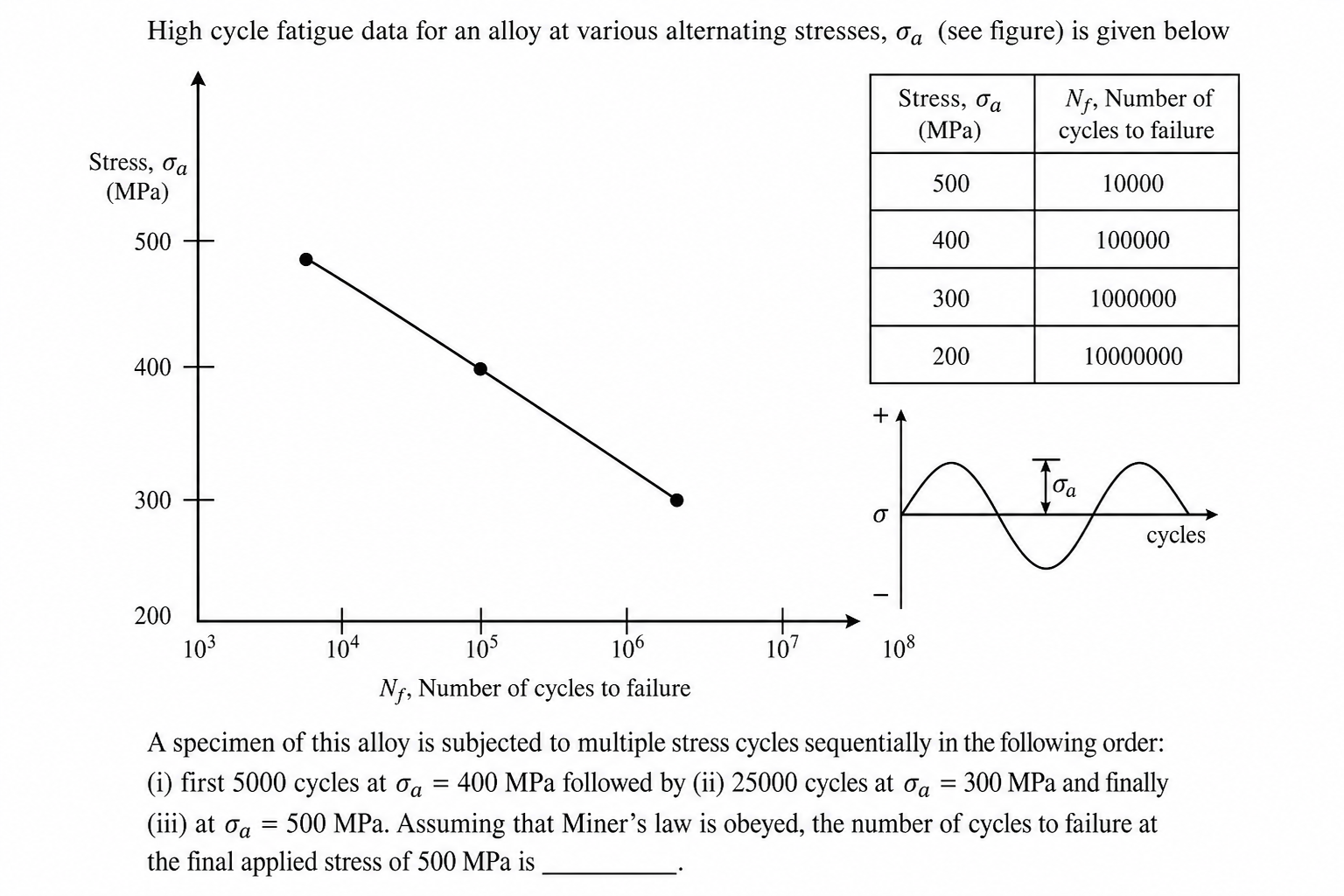
Solution
Miner's damage: 5000/10000 + 25000/100000 = 0.75, leaving 0.25 life at 500 MPa where Nf=1000. Remaining cycles = 250. Answer: 250GATE 2021 · Q17
17
For uniaxial tensile stress-strain behaviour of polycrystalline aluminium,
which one of the following statements is FALSE?
: ; : ; do
) At the ultimate tensile stress point on the true stress - strain curve, aE =0
@
which one of the following statements is FALSE?
: ; : ; do
) At the ultimate tensile stress point on the true stress - strain curve, aE =0
@
Solution
At UTS on the TRUE stress-strain curve, dσ/dε = σ (Considère criterion), NOT dσ/dε = 0. Option B claims dσ/dε = 0 on the true curve, which is false. Answer: BGATE 2021 · Q18
18
Which one of the following is FALSE for creep deformation?
The minimum creep rate is obtained in the primary stage (stage I).
Creep resistance decreases with decrease in grain size.
Coble creep occurs via grain boundary diffusion.
Nabarro-Herring creep occurs via lattice diffusion.
Organising Institute - IIT Bombay
The minimum creep rate is obtained in the primary stage (stage I).
Creep resistance decreases with decrease in grain size.
Coble creep occurs via grain boundary diffusion.
Nabarro-Herring creep occurs via lattice diffusion.
Organising Institute - IIT Bombay
Solution
Minimum creep rate (steady-state) occurs in Stage II (secondary creep), NOT Stage I (primary creep). The statement that minimum creep rate is in stage I is FALSE. Answer: AGATE 2021 · Q28
28
A body is subjected to a state of stress given by the following stress tensor:
50 0 0
0 200 O | MPa.
0 0 100
If yielding is predicted by the Tresca Criterion, the uniaxial tensile yield
stress (in MPa) of the body should be less than or equal to:
(round off to nearest integer).
50 0 0
0 200 O | MPa.
0 0 100
If yielding is predicted by the Tresca Criterion, the uniaxial tensile yield
stress (in MPa) of the body should be less than or equal to:
(round off to nearest integer).
Solution
Tresca criterion: τmax = (σmax − σmin)/2 = (200 − 50)/2 = 75 MPa. Yielding occurs when τmax = σy/2, so σy = 150 MPa. Answer: 150 to 150GATE 2021 · Q58
58
A metal plate is in a state of plane strain (¢,, = 0) with o,, = o,,#0 and
Ty = Tz = Tyz = 0. If the Poisson's ratio is 0.3, the ratio, o,,/0,, is
(round off to 1 decimal place).
(e748 <a 2
Organising Institute - IT Bombay
80
Ty = Tz = Tyz = 0. If the Poisson's ratio is 0.3, the ratio, o,,/0,, is
(round off to 1 decimal place).
(e748 <a 2
Organising Institute - IT Bombay
80
Solution
Plane strain: εzz=0. From Hooke's law: σzz = ν(σxx+σyy). With σxx=σyy: σzz/σxx = 2ν = 2×0.3 = 0.6. Answer: 0.6 to 0.6GATE 2021 · Q59
59
An infinite metal plate has a central through-thickness crack of length a
mm. The maximum applied stress (in MPa) that the plate can sustain in
mode I is: (round off to nearest integer).
Assume: Linear elastic fracture mechanics is valid
Given: Fracture toughness, K;c= 20 MPa m"?
mm. The maximum applied stress (in MPa) that the plate can sustain in
mode I is: (round off to nearest integer).
Assume: Linear elastic fracture mechanics is valid
Given: Fracture toughness, K;c= 20 MPa m"?
Solution
LEFM: KIc = σ√(πa) where a is half-crack length. With KIc=20 MPa√m and crack half-length a≈0.04 m: σ = 20/√(π×0.04) ≈ 100 MPa. Answer: 98 to 102GATE 2020 · Q12
12
The number of independent elastic constants of an isotropic material is:
Solution
An isotropic material has the same properties in all directions; only 2 independent elastic constants are needed (e.g., E and ν, or λ and μ). Answer: BGATE 2020 · Q13
13
A slip system consists of a slip plane and a slip direction. Which one of the following is NOT a valid slip system in a FCC copper crystal?
Solution
In FCC, valid slip systems are {111}⟨110⟩. For option B: (1̄11)[011] — check if [011] lies in (1̄11): dot product = 0×(−1)+1×1+1×1 = 2 ≠ 0, so [011] is NOT in (1̄11) — invalid slip system. Answer: BGATE 2020 · Q18
18
For a material to exhibit superplasticity, one of the requirements is:
Solution
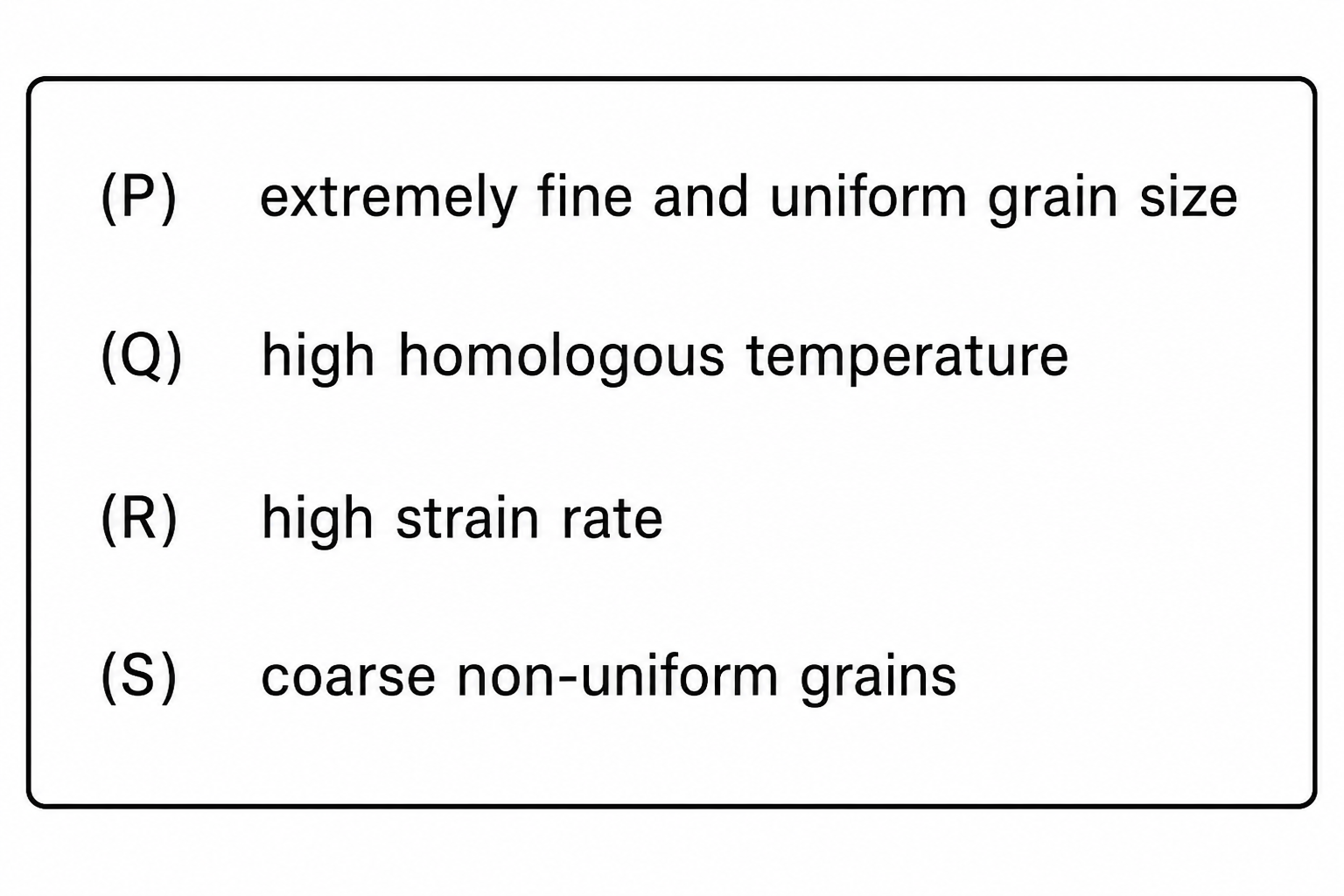
Superplasticity requires high strain-rate sensitivity (m ≈ 0.5), fine and stable grain size, and deformation near 0.5Tm. High strain-rate sensitivity prevents necking and enables large elongations. Answer: BGATE 2020 · Q26
26
The indenter used in Rockwell hardness measurements on C scale is
Solution
Rockwell C scale uses a 120° diamond cone (Brale indenter) with a 150 kgf load, suitable for hard materials. Answer: AGATE 2020 · Q47
47
Determine the correctness or otherwise of the following Assertion [a] and the Reason [r].
Assertion [a]: Low-alloy steels used for medium-temperature creep resistance often have additions of strong carbide-forming elements.
Reason [r]: During creep deformation, the particles with higher misfit with the matrix, lose coherency.
Assertion [a]: Low-alloy steels used for medium-temperature creep resistance often have additions of strong carbide-forming elements.
Reason [r]: During creep deformation, the particles with higher misfit with the matrix, lose coherency.
Solution
[a] is true: carbide formers (Mo, Cr, V) pin dislocations during creep. [r] is also true but is not the reason — carbides resist coarsening at high temperature, which is the actual mechanism. Answer: BGATE 2020 · Q61
61
The steady state creep rate of a material increases by a factor of 20 when the temperature is increased from 890 K to 980 K. The creep rate at a temperature of __________ K (round off to the nearest integer) will be 5 times the creep rate at 890 K.
Solution
ε̇ ∝ exp(−Q/RT). From 890→980 K, rate increases 20×: Q/R = ln20/(1/890 − 1/980) ≈ 327,500 K. For 5× increase: 1/T = 1/890 − ln5/327500 ≈ 1/936 K. Answer: 933 to 939GATE 2020 · Q62
62
Crack growth is being continuously measured in a test specimen subjected to constant amplitude cyclic stress with a mean stress of zero. The crack growth rate is related to the stress intensity range, ΔK as \(\dfrac{da}{dN} \propto (\Delta K)^3\), where \(a\) is the crack length and \(N\) is the number of cycles. When the crack length increases by a factor of two, the crack growth rate will increase by a factor of __________ (round off to one decimal place).
Solution
ΔK ∝ σ√(πa), so ΔK scales as √a. da/dN ∝ (ΔK)³ ∝ a^(3/2). If a doubles: rate increases by 2^(3/2) = 2√2 ≈ 2.83. Answer: 2.6 to 3.0GATE 2019 · Q26
26
During low strain rate (≤ 0.1 per second) deformation of a metal at room temperature, the one that deforms by twinning mode is _______________.
Solution
Mg (HCP) has limited slip systems and deforms primarily by twinning at low strain rates. Answer: BGATE 2019 · Q27
27
In a tensile creep test of a metal, Nabarro-Herring mechanism is favored over Coble mechanism for _________________.
Solution
Nabarro-Herring (lattice diffusion, \(\propto d^{-2}\)) dominates at larger grain size and higher temperature; Coble (grain boundary diffusion) dominates at smaller grain size and lower temperature. Answer: CGATE 2019 · Q28
28
Beach marks are commonly observed on the fractured surfaces of metals after a ________.
Solution
Beach marks (macroscopic striations) are a classic fracture surface feature of fatigue failure — they mark crack front positions during intermittent crack growth. Answer: BGATE 2019 · Q29
29
The length of internal cracks in two samples of the same glass is \(c_1 = 0.5\) mm and \(c_2 = 2\) mm. The ratio \(\left(\dfrac{\sigma_1}{\sigma_2}\right)\) of the fracture strength of the two samples is ________________.
Solution
Griffith: \(\sigma \propto c^{-1/2}\). So \(\dfrac{\sigma_1}{\sigma_2} = \sqrt{\dfrac{c_2}{c_1}} = \sqrt{\dfrac{2}{0.5}} = \sqrt{4} = 2\). Answer: CGATE 2019 · Q42
42
An aluminium single crystal is loaded in tension along \([1\bar{1}0]\) axis. Among the following slip systems, the one that will be activated first is__________________.
Solution
Highest Schmid factor for loading along \([1\bar{1}0]\) corresponds to slip system \((1\bar{1}1)[0\bar{1}1]\). Answer: AGATE 2019 · Q59
59
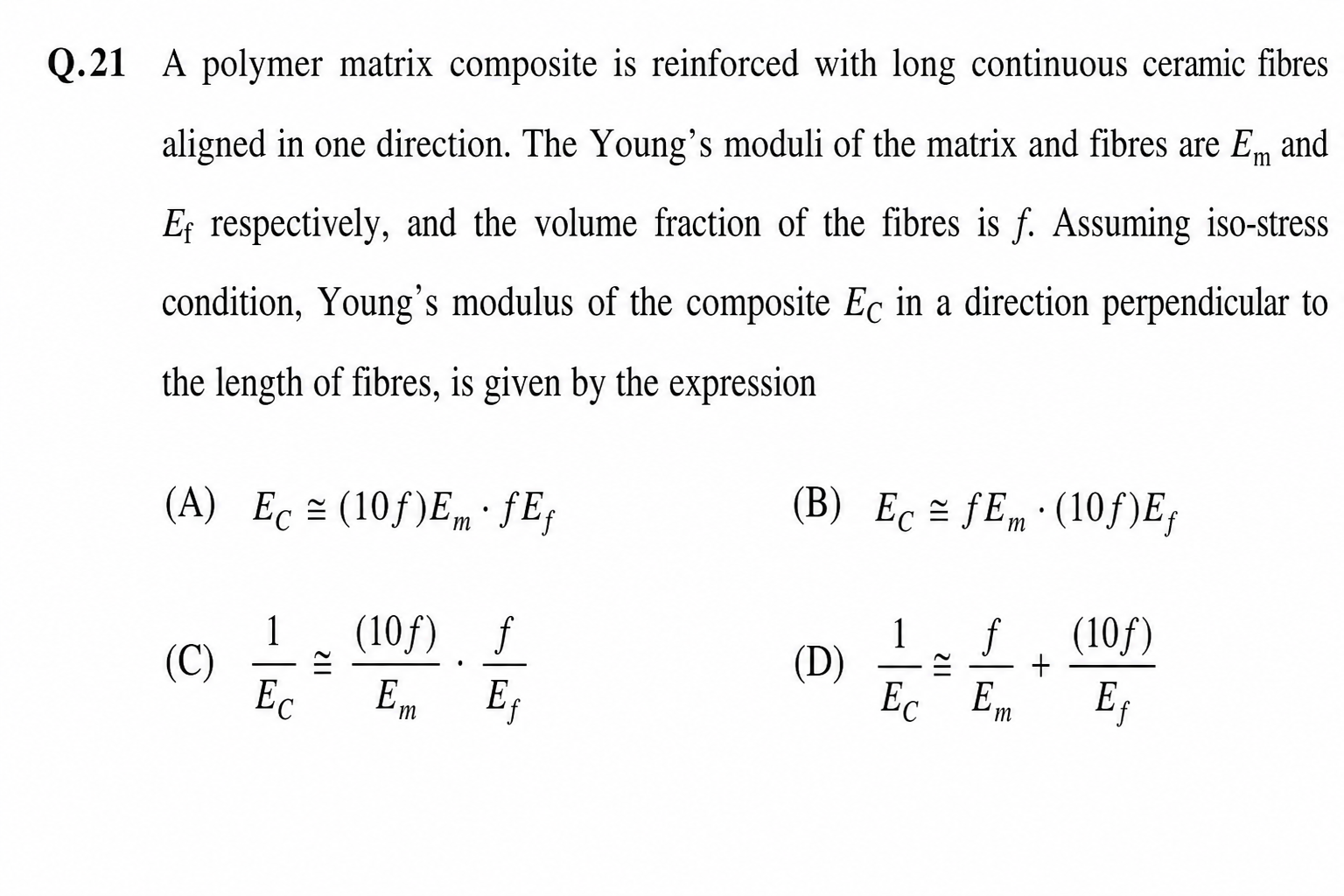
A material made of alternating layers of metals A and B is loaded parallel to the layers (isostress condition). If the volume % of B is 25%, the elastic modulus (in GPa, rounded off to one decimal place) of the material is __________________.
Given: Elastic moduli of A and B are 200 GPa and 100 GPa respectively.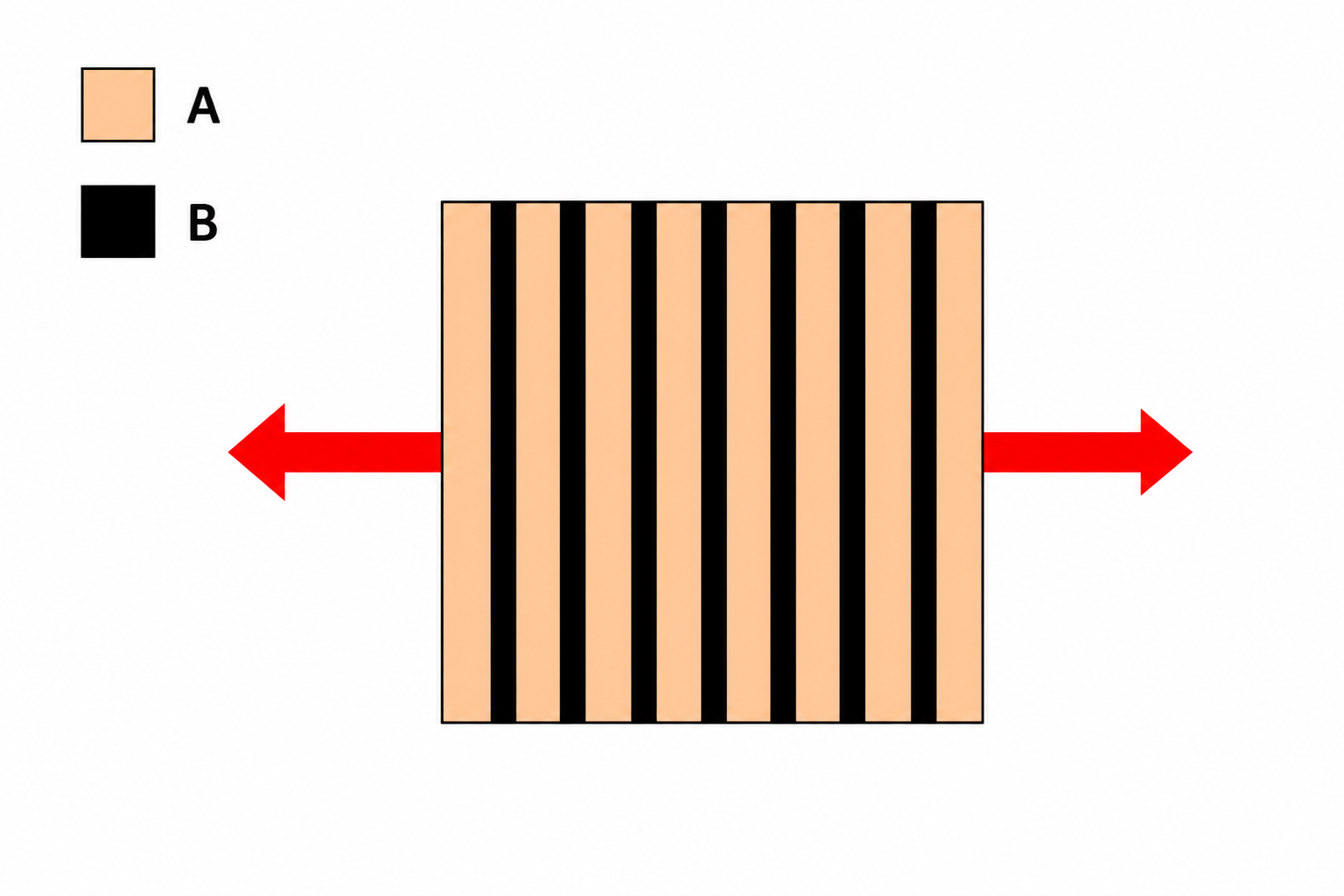
Given: Elastic moduli of A and B are 200 GPa and 100 GPa respectively.
Solution
Loading is parallel to layers → isostrain (rule of mixtures): \(E_c = V_A E_A + V_B E_B = 0.75\times200 + 0.25\times100 = 150 + 25 = 175\) GPa. However the figure shows perpendicular loading (isostress): \(1/E_c = V_A/E_A + V_B/E_B = 0.75/200 + 0.25/100\). \(1/E_c = 0.00625\). \(E_c = 160\) GPa. Answer: 155.0 to 165.0GATE 2019 · Q60
60
The S-N curve for a steel shows an endurance limit (stress amplitude) of 300 MPa. If the stress ratio \(\sigma_{min}/\sigma_{max} = -0.8\), the maximum stress (in MPa, rounded off to nearest integer) that the steel can withstand for infinite fatigue life is ____________.
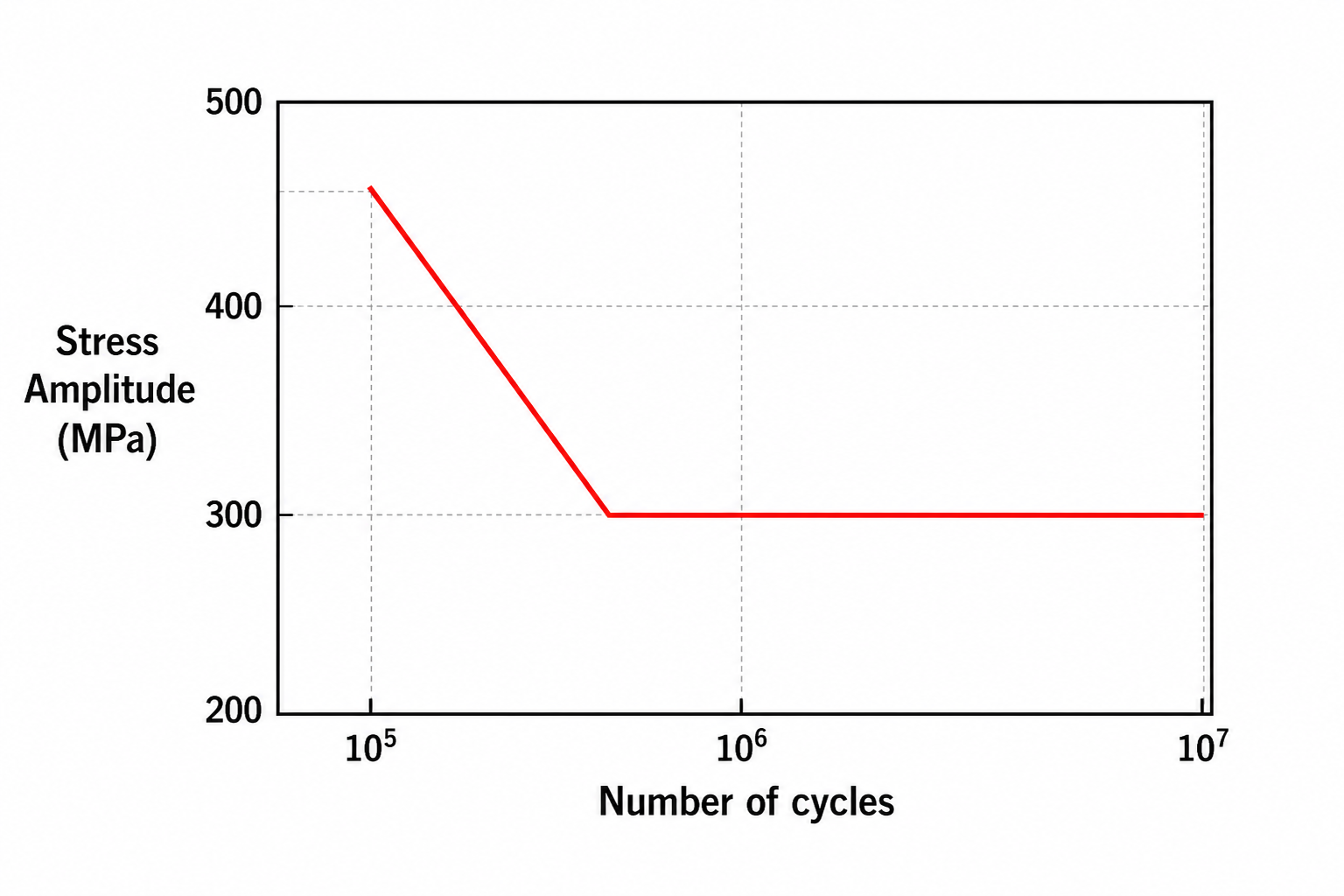
Solution
Stress amplitude \(\sigma_a = \frac{\sigma_{max}-\sigma_{min}}{2}\). With \(\sigma_{min} = -0.8\sigma_{max}\): \(\sigma_a = \frac{\sigma_{max}(1+0.8)}{2} = 0.9\sigma_{max}\). Setting \(\sigma_a = 300\): \(\sigma_{max} = 300/0.9 \approx 333\) MPa. Answer: 330 to 335GATE 2019 · Q61
61
True stress–true strain behavior of a metal is given by \(\sigma = 1750\,\varepsilon^{0.37}\) where \(\sigma\) is in MPa. The true stress at necking (in MPa, rounded off to nearest integer) is ___________________.
Solution
Necking occurs when \(\varepsilon = n = 0.37\). \(\sigma = 1750\times(0.37)^{0.37} = 1750\times0.693 \approx 1213\) MPa. Answer: 1160 to 1260GATE 2018 · Q20
20
The c/a ratio of Zn (hcp) is 1.856. Slip at room temperature occurs most easily on which of
the following slip systems in Zn:
Note: In hcp metals, the ideal c/a ratio is 1.633.
the following slip systems in Zn:
Note: In hcp metals, the ideal c/a ratio is 1.633.
Solution
In Zn with c/a = 1.856 > ideal 1.633, the basal plane (0001) is the most closely packed and (0001)⟨112̄0⟩ is the primary slip system. Answer: CGATE 2018 · Q37
37
Determine the correctness (or otherwise) of the following Assertion [A] and the Reason [R]
Assertion [A]: For a material exhibiting Coble creep, a reduction in grain size results in a
significant increase in creep rate
Reason [R]: Grain boundaries act as a barrier to motion of dislocations
Assertion [A]: For a material exhibiting Coble creep, a reduction in grain size results in a
significant increase in creep rate
Reason [R]: Grain boundaries act as a barrier to motion of dislocations
Solution
[A] is true: Coble creep (grain boundary diffusion) ∝ d⁻³, so finer grains greatly increase rate. [R] is also true, but the reason for [A] is grain boundary diffusion paths, not dislocation barriers. Answer: BGATE 2018 · Q39
39
A glass fibre of 5 micron diameter is subjected to a tensile stress of 20 MPa. The surface
energy and elastic modulus of this material are 0.3 J·m−2 and 70 GPa, respectively. Pick the
correct answer based on the information provided above:
Note: The glass fibre contains a population of flaws of different lengths.
energy and elastic modulus of this material are 0.3 J·m−2 and 70 GPa, respectively. Pick the
correct answer based on the information provided above:
Note: The glass fibre contains a population of flaws of different lengths.
Solution
Griffith critical flaw size: ac = 2Eγs/(πσ²) = 2×70×10⁹×0.3/(π×(20×10⁶)²) ≈ 33 μm. The largest flaw in a 5 μm fibre is < 2.5 μm < 33 μm, so no fracture — only elastic deformation. Answer: CGATE 2018 · Q51
51
A continuous and aligned carbon-fiber composite consists of 25 vol.% of fibers in an epoxy matrix. The Young’s modulus of fiber and matrix, respectively are \(E_f = 250\,\mathrm{GPa}\) and \(E_m = 2.5\,\mathrm{GPa}\).
If the composite is subjected to longitudinal loading (iso-strain condition and assuming elastic response), the fraction of load borne by the reinforcement is ________ (to two decimal places)
If the composite is subjected to longitudinal loading (iso-strain condition and assuming elastic response), the fraction of load borne by the reinforcement is ________ (to two decimal places)
Solution
Iso-strain: load fraction on fibre = VfEf/(VfEf+VmEm) = 62.5/(62.5+1.875) ≈ 0.971. Answer: 0.96 to 0.98GATE 2018 · Q56
56
A single crystal of aluminium is subjected to 10 MPa tensile stress along the [321]
crystallographic direction. The resolved shear stress on the (111̅) [101] slip system is
______ (in MPa to two decimal places)
crystallographic direction. The resolved shear stress on the (111̅) [101] slip system is
______ (in MPa to two decimal places)
Solution
Schmid factor τ = σ·cosλ·cosφ. [321]/(111̅)[101]: cosφ = 4/√42 ≈ 0.617, cosλ = 4/√28 ≈ 0.756. τ = 10×0.617×0.756 ≈ 4.66 MPa. Answer: 4.5 to 4.8GATE 2018 · Q65
65
The ideal plastic work involved in extruding a cylindrical billet of length 100 mm, from an
initial diameter of 20 mm to a final diameter of 16 mm is __________ (in J to one decimal
place).
The flow stress in compression is 40 MPa, and remains constant throughout the process.
initial diameter of 20 mm to a final diameter of 16 mm is __________ (in J to one decimal
place).
The flow stress in compression is 40 MPa, and remains constant throughout the process.
Solution
W = V·σf·ε. V = π×10²×100 = 31416 mm³. ε = 2ln(20/16) = 0.446. W = 31416×40×0.446 ≈ 561 J. Answer: 555.5 to 565.5GATE 2017 · Q26
26
A brittle material (Young’s modulus = 60 GPa and surface energy = 0.5 J.m²) has a surface crack of length 2 μm. The fracture strength (in MPa) of this material is ___
Solution
Griffith: σ = √(2Eγ/(πa)) = √(2×60×10&sup9;×0.5/(π×10⁻&sup6;)) ≈ 138 MPa. Answer: 95.00 to 125.00GATE 2017 · Q27
27
Both creep resistance and tensile strength of a metal can be enhanced by
Solution
Dispersoids pin grain boundaries (creep resistance) and block dislocations (strength). Fine grains hurt creep. Answer: CGATE 2017 · Q28
28
Stress required to operate a Frank-Read source of length L is approximately given by:
Solution
Frank-Read source stress τ ≈ Gb/L. Answer: AGATE 2017 · Q58
58
A steel component is subjected to fatigue: σmax = 200 MPa, σmin = 0. Initial crack length = 1 mm. Crack propagation: da/dN = 10⁻¹²(ΔK)³, where a in meters, ΔK in MPa√m. The crack length (in m) after one million cycles is ___
Solution
Integration of Paris law with ΔK = Δσ√(πa). After 10⁶ cycles, a ≈ 0.012 m. Answer: 0.009 to 0.015GATE 2017 · Q61
61
A single crystal of an FCC metal is subjected to tensile stress along [110]. Which slip system will be activated?
Solution
The slip system with highest Schmid factor is activated. For [110] loading, a/2[011](11̅1) has the highest resolved shear stress. Answer: BGATE 2016 · Q29
29
Creep resistance decreases due to:
Solution
Small grains promote grain boundary sliding at high temperatures, reducing creep resistance. Answer: AGATE 2016 · Q57
57
Fatigue S-N plot for an aluminium alloy. Piston rod subjected to (i) 1000 cycles at 420 MPa, then (ii) 1000 cycles at 300 MPa. Using Miner’s rule, the remaining fatigue life (cycles) at 250 MPa is ___
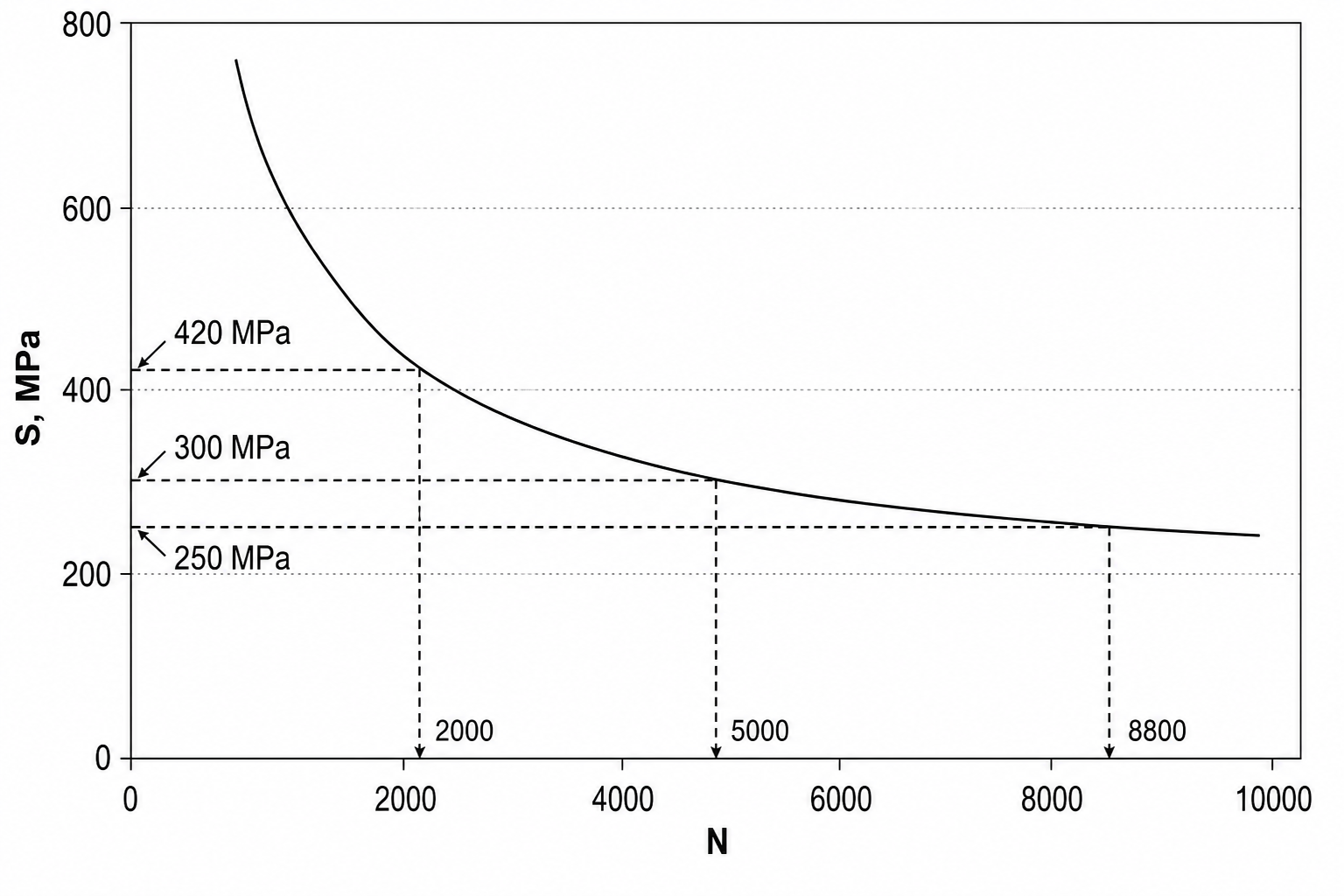
Solution
By Miner’s rule: Σ(ni/Ni) = 1. From S-N curve, compute remaining life ≈ 2640 cycles. Answer range: 2630 to 2650GATE 2016 · Q64
64
Liquid phase sintered SiC-Ni composite: γss = 0.80 J/m², γsl = 0.43 J/m². SiC grain size = 20 μm. Average intergranular neck size (μm):
Solution
cos(φ/2) = γss/(2γsl) = 0.80/0.86 = 0.93. Neck size calculated from dihedral angle and grain size. Answer: CGATE 2015 · Q35
35
In epoxies, creep resistance is enhanced by:
Solution
Increasing cross-link density restricts chain mobility, thereby enhancing creep resistance. Answer: BMetallurgical Engineering — Q.36 to Q.65 (2 Marks Each)
GATE 2015 · Q61
61
Match the fracture surface features with fracture types: P. Striations Q. Dimples/microvoids R. Flat facets with river markings S. Jagged grain-like features — 1. Intergranular 2. Cleavage 3. Ductile 4. Fatigue
Solution
Striations → Fatigue (4), Dimples → Ductile (3), River markings → Cleavage (2), Jagged → Intergranular (1). Answer: CGATE 2015 · Q62
62
Match: P. Hall-Petch Q. Nabarro-Herring R. Lomer-Cottrell S. Frank-Read — 1. Dislocation reaction product 2. Diffusional creep 3. Dislocation source 4. Grain boundary strengthening
Solution
Hall-Petch → Grain boundary strengthening (4), Nabarro-Herring → Diffusional creep (2), Lomer-Cottrell → Dislocation reaction product/lock (1), Frank-Read → Dislocation source (3). Answer: CGATE 2015 · Q64
64
Match: P. Creep resistance Q. Modulus enhancement R. Superplasticity S. Increased strength — 1. Fine-grained two-phase alloy 2. Single crystal 3. Coherent precipitates 4. Glass fibres in epoxy
Solution
Creep resistance → Single crystal (2), Modulus enhancement → Glass fibres in epoxy/composite (4), Superplasticity → Fine-grained two-phase (1), Increased strength → Coherent precipitates (3). Answer: AGATE 2015 · Q65
65
The fracture stress of a brittle material is 300 MPa at a surface energy γs = 0.9 J/m². If γs is reduced to 0.1 J/m², the fracture stress (in MPa) is ___
Solution
Griffith criterion: σ ∝ √γs. σ = 300 × √(0.1/0.9) = 300 × 1/3 = 100 MPa. Answer range: 98 to 102
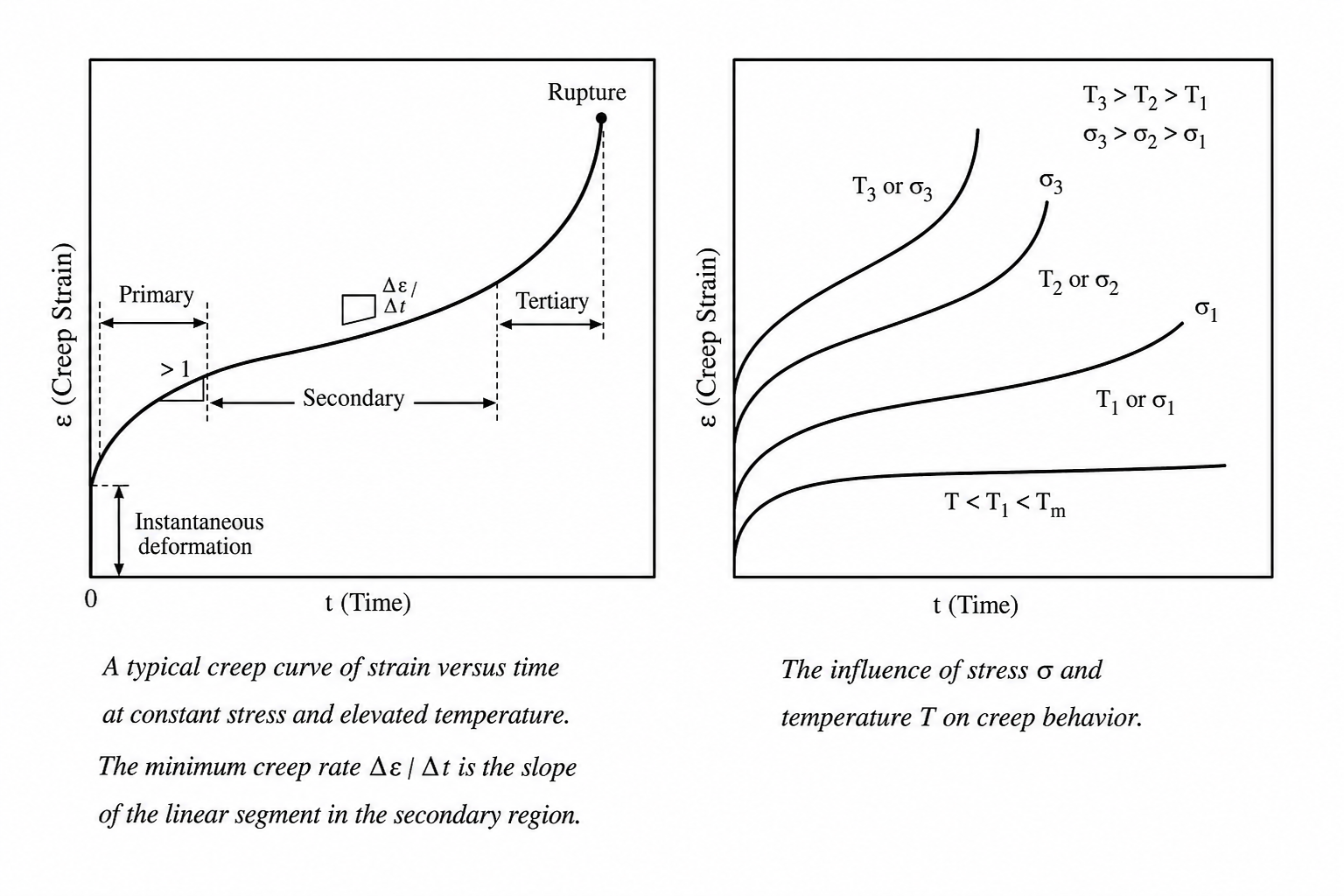 The creep curve has three stages: Stage I (Primary): Decreasing creep rate due to strain hardening. Stage II (Secondary/Steady-state): Constant creep rate — balance between strain hardening and recovery. Stage III (Tertiary): Accelerating creep rate leading to fracture due to necking, void formation, or microstructural changes. Under constant load, the true stress increases (due to area reduction), so the curve accelerates more in stage III. Under constant stress, stage III is less pronounced. For engineering design, Stage II (steady-state creep) is most critical as components spend most of their service life in this stage, and the minimum creep rate is used for life prediction.
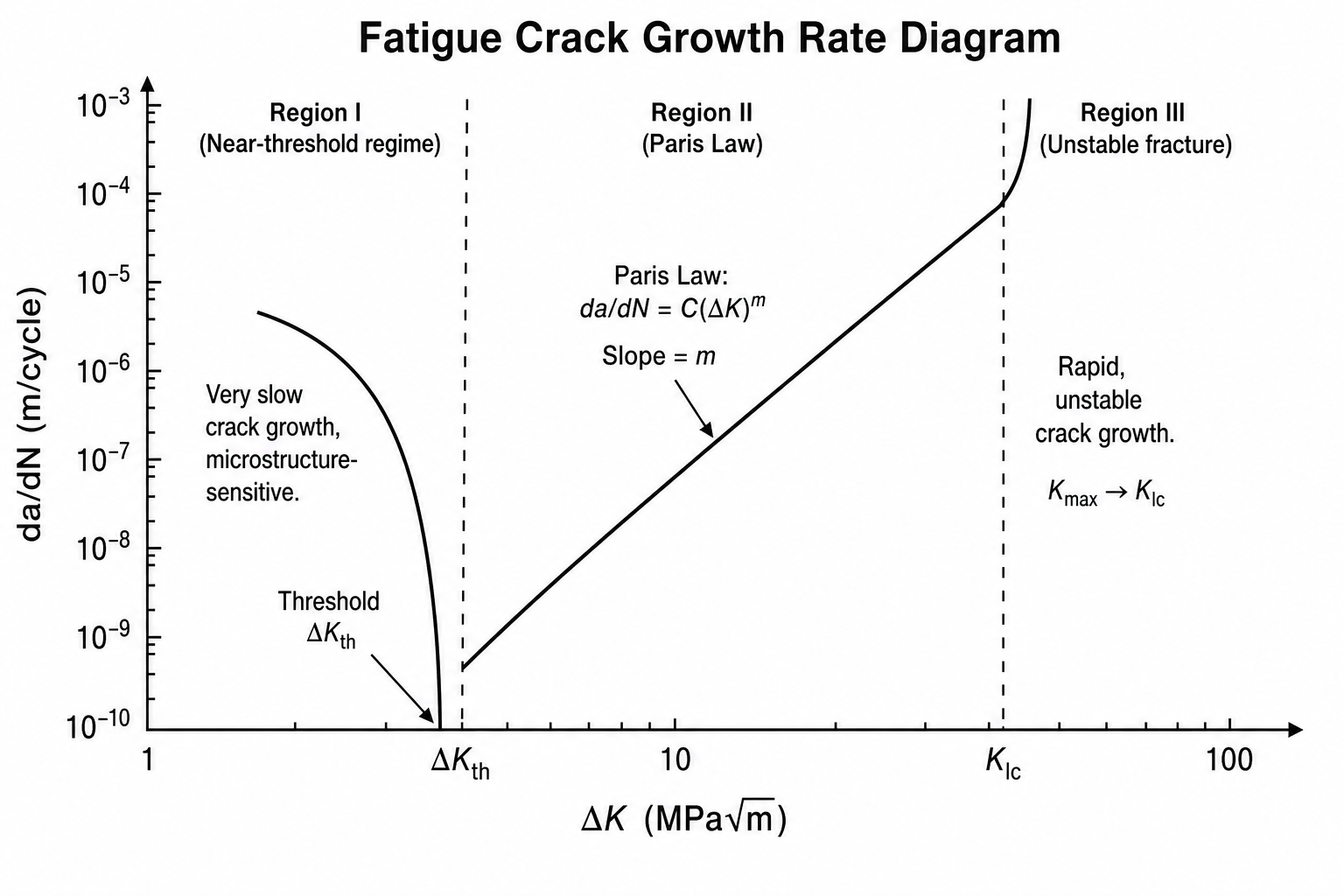 The diagram is plotted on log-log axes with ΔK on x-axis and da/dN on y-axis. Three distinct regions: