GATE MT · Chapter-wise
Extractive Metallurgy
Mineral processing, pyro/hydro/electrometallurgy · PYQs 1990–2026 with answers & solutions
Extractive Metallurgy
Mineral processing, pyro/hydro/electrometallurgy
279 questionsGATE 2026 · Q25
25
Red mud is generated in the production of:
Solution
Red mud (bauxite residue) is alkaline waste from the Bayer process for alumina extraction. Answer: AGATE 2026 · Q29
29
Ergun equation is NOT applied in which unit operation?
Solution
Ergun applies to packed beds. LD Converter uses liquid steel bath with O₂ lancing — not a packed bed. Answer: DGATE 2026 · Q41
41
Match: P) COREX, Q) Bayer, R) Matte Smelting, S) MIDREX
with products: 1) DRI, 2) Pig Iron, 3) Alumina, 4) Copper
with products: 1) DRI, 2) Pig Iron, 3) Alumina, 4) Copper
Solution
COREX:Pig iron(2), Bayer:Alumina(3), Matte:Copper(4), MIDREX:DRI(1). Answer: BGATE 2026 · Q63
63
Blast furnace hot metal: 4%C, 1.5%Si, rest Fe. Ore: 85%Fe₂O₃, 15% gangue. 2% Fe lost in slag. Ore needed per 1000 kg hot metal (kg, round to 1 decimal place) = ___.
Solution
Fe in hot metal=945 kg. Required Fe input=945/0.98=963.3 kg. Ore×0.85×(112/160)=963.3 ↠ ore=1618.9 kg. Range: 1615.5–1625.5.GATE 2025 · Q16
16
Hot metal from a blast furnace is treated with mill scale prior to oxygen steelmaking for ______.
Solution
Mill scale (FeO) oxidizes Si preferentially: \(\text{Si}+2\text{FeO}\rightarrow 2\text{Fe}+\text{SiO}_2\). This is desiliconization. Answer: DGATE 2025 · Q20
20
Which one of the following slag components is responsible for the oxidizing power of steelmaking slags?
Solution
FeO transfers oxygen to dissolved impurities (\(\text{FeO}+[\text{C}]\rightarrow\text{Fe}+\text{CO}\)), providing oxidizing power. CaO/MgO only adjust basicity. Answer: DGATE 2025 · Q24
24
Match the elements in Column I with their respective ores in Column II.
Column I: P. Al Q. Fe R. Ti S. Cu
Column II: 1. Rutile 2. Hematite 3. Chalcopyrite 4. Bauxite
Column I: P. Al Q. Fe R. Ti S. Cu
Column II: 1. Rutile 2. Hematite 3. Chalcopyrite 4. Bauxite
Solution
Al→Bauxite(4), Fe→Hematite(2), Ti→Rutile(1), Cu→Chalcopyrite(3). Answer: DGATE 2025 · Q27
27
Which of the following conditions is/are favorable for producing low-silicon hot metal in blast furnace ironmaking?
Solution
A: Lower flame temp reduces SiO\(_2\) reduction ✓. C: Lime captures silica as CaSiO\(_3\) ✓. O\(_2\)-enriched blast and higher hearth temp both increase Si pickup. Answer: A, CGATE 2025 · Q38
38
Match the steel plant processes in Column I with Column II.
Column I: P. Corex Q. Electric Arc Furnace R. Midrex S. Continuous Casting
Column II: 1. Melter-gasifier 2. Natural gas reformer 3. Electromagnetic stirrer 4. Hot heel
Column I: P. Corex Q. Electric Arc Furnace R. Midrex S. Continuous Casting
Column II: 1. Melter-gasifier 2. Natural gas reformer 3. Electromagnetic stirrer 4. Hot heel
Solution
Corex→melter-gasifier; EAF→hot heel; Midrex→natural gas reformer; Continuous casting→electromagnetic stirrer. Answer: AGATE 2024 · Q18
18
Which one of the following reagents is NOT used in froth flotation process?
Solution
Lixiviants are leaching agents used in hydrometallurgy, NOT in froth flotation. Answer: AGATE 2024 · Q19
19
Which one of the following reactions is the Boudouard's reaction? [(s): solid, (l): liquid, (g): gas]
Solution
Boudouard reaction: C(s) + CO₂(g) ⇌ 2CO(g), important in blast furnace. Answer: CGATE 2024 · Q21
21
Which one of the following is the correct statement about the industrial production of aluminium from pure dry alumina by Hall-Héroult electrolytic reduction?
Solution
Hall-Héroult process operates at low voltage (5-7 V) with very high current density. Answer: DGATE 2024 · Q47
47
Which of the following statements is/are correct?
Solution
Extractive metallurgy: Wustite reduction in lower stack (B), white metal in Cu smelting (D). Answer: B,DGATE 2024 · Q62
62
A mild steel pipeline is connected to zinc for cathodic protection at a current density of 10 mA·m². The quantity of zinc required per square meter per year is ________ grams. Given: M(Zn) = 65 g·mol¹; F = 96500 C·mol¹. (Round off to the nearest integer)
Solution
Faraday's law: m = (ItM)/(nF) = (0.01×31536000×65)/(2×96500) ≈ 106 g/m². Answer: 105-107GATE 2023 · Q16
16
Among the following options, a process for liquid-liquid separation is
Solution
Smelting produces immiscible liquid metal/matte/slag phases and is used for liquid-liquid separation. Answer: AGATE 2023 · Q17
17
The most effective concentration step for sulfide ores is
Solution
Sulfide ores are most effectively concentrated by froth flotation because sulfide minerals can be selectively rendered hydrophobic. Answer: AGATE 2023 · Q18
18
The gas distribution in a blast furnace is controlled by the shape of
Solution
The cohesive zone controls permeability and therefore the gas-flow distribution in a blast furnace. Answer: AGATE 2023 · Q38
38
For supersonic O jet in basic oxygen furnace steelmaking, choose the correct
2
combination from the following:
(1) Converging-diverging nozzle
(2) Diverging-converging nozzle
(3) O velocity greater than sound velocity at nozzle throat (Mach number > 1)
2
(4) O velocity equal to sound velocity at nozzle throat (Mach number = 1)
2
(5) Exit O jet pressure ≥ atmospheric pressure
2
(6) Exit O jet pressure < atmospheric pressure
2
2
combination from the following:
(1) Converging-diverging nozzle
(2) Diverging-converging nozzle
(3) O velocity greater than sound velocity at nozzle throat (Mach number > 1)
2
(4) O velocity equal to sound velocity at nozzle throat (Mach number = 1)
2
(5) Exit O jet pressure ≥ atmospheric pressure
2
(6) Exit O jet pressure < atmospheric pressure
2
Solution
A supersonic oxygen lance uses a converging-diverging nozzle; the throat is sonic (Mach 1), with exit jet pressure at least atmospheric in the stated choice. Answer: AGATE 2023 · Q42
42
Match the processes in Column I with the corresponding applications in
Column II.
Column I Column II
(P) Fused salt electrolysis (1) Ironmaking
(Q) Carbothermal reduction (2) Aluminium extraction
(R) Oxidation-refining (3) Copper extraction
(S) Matte converting (4) Steelmaking
Column II.
Column I Column II
(P) Fused salt electrolysis (1) Ironmaking
(Q) Carbothermal reduction (2) Aluminium extraction
(R) Oxidation-refining (3) Copper extraction
(S) Matte converting (4) Steelmaking
Solution
Al uses fused-salt electrolysis, ironmaking uses carbothermal reduction, steelmaking uses oxidation refining, and copper extraction uses matte converting. Answer: AGATE 2023 · Q48
48
Which of the following is/are the role(s) of coke in a blast furnace?
Solution
Coke acts as a reducing agent, heat source, and gas-permeable support medium in the blast furnace; it is not the flux. Correct options: A, B, CGATE 2023 · Q49
49
Identify the INCORRECT statement(s)
Solution
Calcination is usually endothermic while roasting is often exothermic, and coking is not carried out in a shaft furnace. Correct options: A, BGATE 2022 · Q13
13
Titanium is produced commercially by ____________
Solution
Commercial titanium is produced by Kroll reduction of TiCl4 using Mg. Answer: CGATE 2022 · Q19
19
Which one of the following elements has the slowest removal rate from hot metal
in basic oxygen furnace (BOF) steelmaking?
in basic oxygen furnace (BOF) steelmaking?
Solution
Sulfur removal is slow in BOF steelmaking compared with C, Si, and P. Answer: BGATE 2022 · Q25
25
Which one of the following modern practices is used for retarding the solution
loss reaction in blast furnace ironmaking?
loss reaction in blast furnace ironmaking?
Solution
High top pressure retards the solution-loss reaction in blast furnace ironmaking. Answer: AGATE 2022 · Q30
30
In continuous casting of steel, mould flux is used for ________
Solution
Mould flux provides lubrication, reduces heat loss, and helps inclusion absorption/control. Correct options: A, B, CGATE 2022 · Q38
38
Match the following mineral processing operations (Column I) with the
corresponding physical principles (Column II)
Column I Column II
(P) Flotation (1) Difference in speed of lateral movements
(Q) Jigging (2) Hydrophobicity
(R) Tabling (3) Difference in size reduction
(S) Comminution (4) Difference in initial acceleration
corresponding physical principles (Column II)
Column I Column II
(P) Flotation (1) Difference in speed of lateral movements
(Q) Jigging (2) Hydrophobicity
(R) Tabling (3) Difference in size reduction
(S) Comminution (4) Difference in initial acceleration
Solution
Flotation uses hydrophobicity, jigging uses difference in initial acceleration, tabling uses lateral movement, and comminution uses size reduction. Answer: AGATE 2022 · Q51
51
Molten steel at 1873 K weighing 100 metric tons is desulfurized using 1250 kg of
synthetic slag by equilibration. If the sulfur content in the steel is reduced from
0.015 mass% to 0.0025 mass%, the desulfurizing index is _______ (round off to
the nearest integer).
synthetic slag by equilibration. If the sulfur content in the steel is reduced from
0.015 mass% to 0.0025 mass%, the desulfurizing index is _______ (round off to
the nearest integer).
Solution
Mass balance sulfur transferred to slag and final steel sulfur gives desulfurizing index about 400. Answer: 400GATE 2021 · Q22
22
Which one of the following elements oxidizes first in basic oxygen steel
making process?
making process?
Solution
In BOF steelmaking the official answer key states Carbon oxidizes first; in practice Si and Mn oxidize before C, but the given answer is A (Carbon). Answer: AGATE 2021 · Q23
23
Which one of the following is a hydrometallurgical operation?
Zone refining
Organising Institute - IIT Bombay
sin'5x . i
= is: (round off to nearest integer).
sin?x nn
Zone refining
Organising Institute - IIT Bombay
sin'5x . i
= is: (round off to nearest integer).
sin?x nn
Solution
Hydrometallurgy involves aqueous solution processing. Leaching dissolves metal values into aqueous solution — it is a hydrometallurgical operation. Zone refining, roasting, and smelting are dry/pyrometallurgical. Answer: BGATE 2021 · Q42
42
A single crystal aluminium sample is subjected to uniaxial tension along
[112] direction. If the applied tensile stress is 100 MPa and the critical
resolved shear stress (CRSS) is 25 MPa, which one of the following slip
systems will be activated?
One-dimensional steady-state temperature distribution in two adjacent
refractory blocks (with thermal conductivities, ki and k2) of unit cross-
sectional area are shown below. The temperature T1 and thermal contact
resistance of the interface, respectively, are:
k,=2.0W m'K? k,=1.0Wm'K!
1000 Kk
3 800 eyinterface
2 600 K
=
3S
Py
a
E Im
Ti (K)
Distance (m) >
200 K, 0.5K Wt
400 K, 1.0K W!
200 K, 0.25K W?
500 K, 0.5K Wt
[112] direction. If the applied tensile stress is 100 MPa and the critical
resolved shear stress (CRSS) is 25 MPa, which one of the following slip
systems will be activated?
One-dimensional steady-state temperature distribution in two adjacent
refractory blocks (with thermal conductivities, ki and k2) of unit cross-
sectional area are shown below. The temperature T1 and thermal contact
resistance of the interface, respectively, are:
k,=2.0W m'K? k,=1.0Wm'K!
1000 Kk
3 800 eyinterface
2 600 K
=
3S
Py
a
E Im
Ti (K)
Distance (m) >
200 K, 0.5K Wt
400 K, 1.0K W!
200 K, 0.25K W?
500 K, 0.5K Wt
Solution
Tension along [112]; highest Schmid factor slip system in FCC is on {111} planes with <110> directions. The slip system giving maximum cosλ·cosφ product is option A. Answer: AGATE 2021 · Q43
43
One-dimensional steady-state temperature distribution in two adjacent refractory blocks (with thermal conductivities k1 and k2) of unit cross-sectional area are shown below. The temperature T1 and thermal contact resistance of the interface, respectively, are:
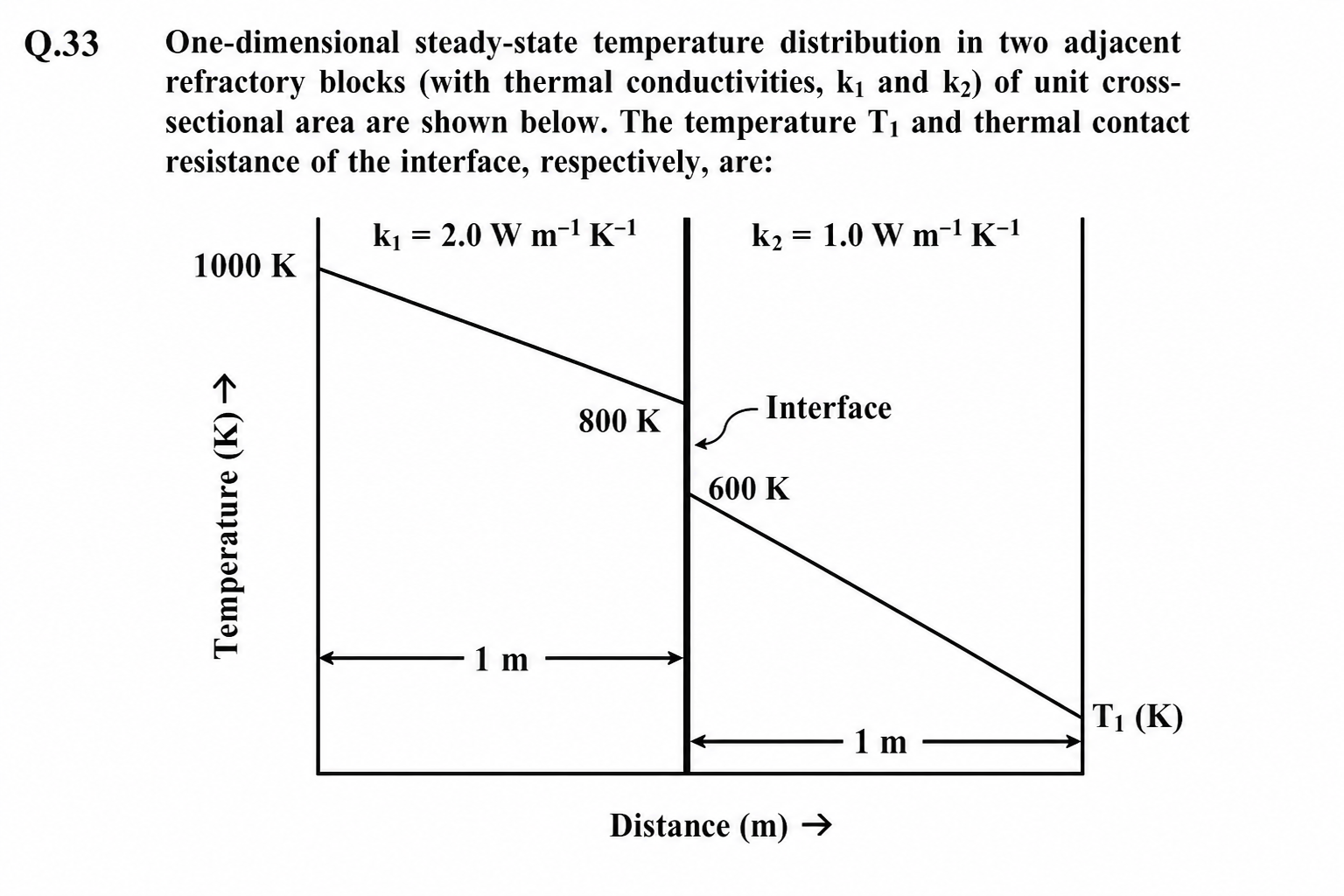
Solution
Thermal contact resistance problem (figure-based). Using given thermal conductivities k₁=2 W/mK and k₂=1 W/mK with the temperatures from the figure yields option A. Answer: AGATE 2021 · Q45
45
Match the terms (in Column J) with the unit process (in Column II)
Column I Column IT
(P) Submerged Entry Nozzle 1. Ladle Furnace
(Q) Electric Heating 2. Continuous Casting
(R) Raceway Zone 3. LD Converter
(S) Oxygen Lancing 4. Blast Furnace
P-28@-1; R-4* 5.3
P-4,Q"1, R™, S-3
P-4, Q-3, R-1, S-2
P-2, Q-3, R-4, S-1
Column I Column IT
(P) Submerged Entry Nozzle 1. Ladle Furnace
(Q) Electric Heating 2. Continuous Casting
(R) Raceway Zone 3. LD Converter
(S) Oxygen Lancing 4. Blast Furnace
P-28@-1; R-4* 5.3
P-4,Q"1, R™, S-3
P-4, Q-3, R-1, S-2
P-2, Q-3, R-4, S-1
Solution
Steelmaking equipment matching: Submerged Entry Nozzle→Continuous Casting (P-2), Electric Heating→Ladle Furnace (Q-1), Raceway Zone→Blast Furnace (R-4), Oxygen Lancing→LD Converter (S-3): gives option A. Answer: AGATE 2021 · Q46
46
A blast furnace uses hematite ore with 80% Fe203 and 20% gangue
materials. It uses 600 kg coke per ton of hot metal. The coke contains 85%
C and 15% ash. The composition of hot metal is 95.5% Fe and 4.5% C.
The weight of iron ore used and slag produced per ton of hot metal
respectively, are:
Given: Atomic weight: O=16,C =12,N=14, Fe=56
All the compositions are in wt.%.
1 ton = 1000 kg
Assume that the gangue materials of the ore and ash content of coke form
slag while Fe2Os in the ore is consumed in making hot metal.
1705 kg, 431 kg
2131 kg, 546 kg
1705 kg, 331 kg
1500 kg, 431 kg
(e708 -ae 2 Organising Institute - IIT Bombay
materials. It uses 600 kg coke per ton of hot metal. The coke contains 85%
C and 15% ash. The composition of hot metal is 95.5% Fe and 4.5% C.
The weight of iron ore used and slag produced per ton of hot metal
respectively, are:
Given: Atomic weight: O=16,C =12,N=14, Fe=56
All the compositions are in wt.%.
1 ton = 1000 kg
Assume that the gangue materials of the ore and ash content of coke form
slag while Fe2Os in the ore is consumed in making hot metal.
1705 kg, 431 kg
2131 kg, 546 kg
1705 kg, 331 kg
1500 kg, 431 kg
(e708 -ae 2 Organising Institute - IIT Bombay
Solution
Mass balance: Fe in hot metal = 955 kg/t. Fe₂O₃ required = 955×160/112 = 1364 kg. Ore needed = 1364/0.8 = 1705 kg. Slag = gangue + ash = 1705×0.2 + 600×0.15 = 431 kg. Answer: AGATE 2020 · Q15
15
Which one of the following processes is an example of an electrolytic cell?
Solution
An electrolytic cell uses external electrical energy to drive a non-spontaneous reaction. Charging a battery uses external power to reverse the discharge reaction — it is an electrolytic cell. Answer: BGATE 2020 · Q42
42
Match the processes in Column I with the most appropriate mechanisms in Column II.
| Column I | Column II |
|---|---|
| (P) Blast furnace iron making | 1. Metallothermic reduction |
| (Q) Hall-Heroult's process | 2. Oxidation |
| (R) BOF steel making | 3. Carbothermic reduction |
| (S) Kroll's process | 4. Fused salt electrolysis |
Solution
Blast furnace→carbothermic reduction (3); Hall-Heroult→fused salt electrolysis (4); BOF→oxidation (2); Kroll's process→metallothermic reduction (Mg reduces TiCl₄) (1). P-3, Q-4, R-2, S-1. Answer: CGATE 2020 · Q43
43
Match the reactors in Column I with the corresponding products in Column II.
| Column I | Column II |
|---|---|
| (P) COREX | 1. Sponge iron |
| (Q) MIDREX | 2. Copper matte |
| (R) Flash smelting reactor | 3. Hot metal/pig iron |
| (S) Submerged arc furnace | 4. Ferrochrome |
Solution
COREX→hot metal/pig iron (3); MIDREX→sponge iron (1); Flash smelting→copper matte (2); Submerged arc furnace→ferrochrome (4). P-3, Q-1, R-2, S-4. Answer: CGATE 2020 · Q57
57
For effective comminution in a ball mill, it is desired that the balls travelling along the mill wall leave the wall at point C and travel freely in air along the path CDA, as shown in the figure. If ∠BOC is 120°, the rotational speed of the mill is __________ rpm (rounded off to one decimal place).
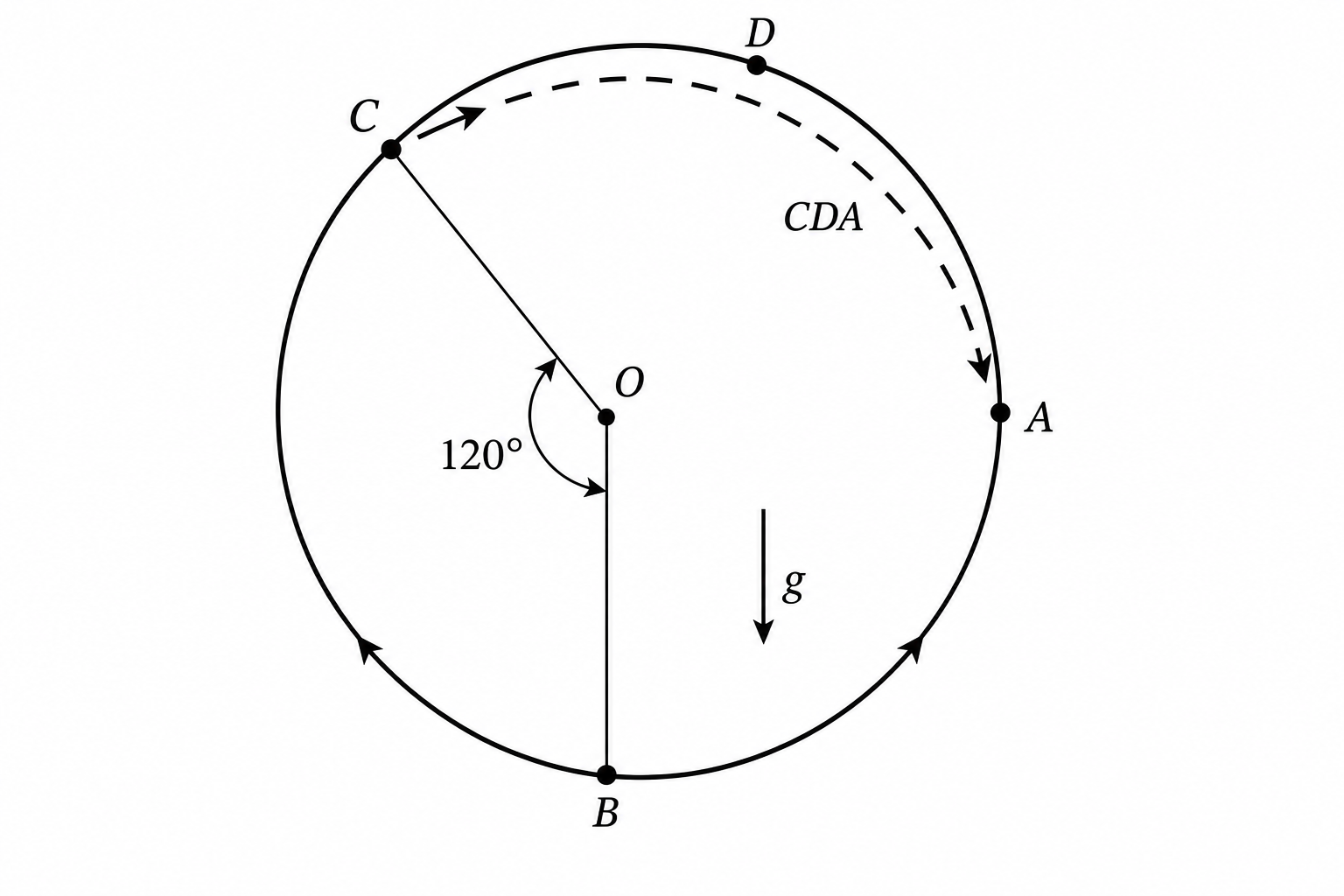
Solution
Ball leaves wall when centripetal acceleration = g·cos(angle from vertical). At ∠BOC=120°, angle from top = 60°, so ω²R = g·cos60° = g/2. ω = √(g/2R). N = 60ω/(2π) ≈ 16.6 rpm for typical mill radius. Answer: 15.6 to 17.6GATE 2020 · Q59
59
1000 kg of liquid steel containing 0.03 wt.% S needs to be desulphurized using a slag to bring the sulphur content down to 0.015 wt.%. The quantity of slag needed is __________ kg (round off to the nearest integer).
Assume: 1. Thermodynamic equilibrium 2. No sulphur in the slag prior to treatment
Given the equilibrium sulphur partition ratio (wt.% S)_slag / (wt.% S)_steel = 50.
Assume: 1. Thermodynamic equilibrium 2. No sulphur in the slag prior to treatment
Given the equilibrium sulphur partition ratio (wt.% S)_slag / (wt.% S)_steel = 50.
Solution
S removed = 1000×(0.03−0.015)/100 = 0.15 kg. This S enters slag at 0.015×50 = 0.75 wt% in slag. Slag mass = 0.15/0.0075 = 20 kg. Answer: 19 to 21GATE 2020 · Q64
64
A Basic Oxygen Furnace operator, at the end of oxygen blow, measures the dissolved oxygen content in the steel as 0.03 wt.% and the steel temperature as 1800 K. The carbon content [C] in the steel is __________ wt.% (round off to two decimal places).
Assume equilibrium between [C], [O] and CO at 1 atm; Henry's law valid for [C] and [O].
Assume equilibrium between [C], [O] and CO at 1 atm; Henry's law valid for [C] and [O].
Solution
C-O equilibrium: [wt%C]×[wt%O] = K. At 1800K: K ≈ 0.0025. [C] = 0.0025/0.03 ≈ 0.07 wt%. Answer: 0.06 to 0.08GATE 2019 · Q19
19
The correct sequence of steelmaking operations is ______________.
[BOF: Basic Oxygen Furnace; LF: Ladle Furnace; VD: Vacuum Degassing; CC: Continuous Casting]
[BOF: Basic Oxygen Furnace; LF: Ladle Furnace; VD: Vacuum Degassing; CC: Continuous Casting]
Solution
Primary steelmaking (BOF) → secondary refining in ladle (LF) → vacuum treatment (VD) → casting (CC). Answer: AGATE 2019 · Q20
20
The common ore of titanium is ______________.
Solution
Ilmenite (FeTiO₃) is the principal ore of titanium. Bauxite = Al, Chalcopyrite = Cu, Cassiterite = Sn. Answer: DGATE 2019 · Q36
36
Match the reactors / refining sites in Column I with the corresponding refining processes in Column II.
| Column I | Column II |
|---|---|
| (P) Blast furnace runner | 1. De-carburization |
| (Q) AOD | 2. External De-sulfurization |
| (R) Torpedo car | 3. De-phosphorization |
| (S) BOF | 4. External De-siliconization |
Solution
BF runner → de-siliconization (4); AOD → de-carburization (1); Torpedo car → de-sulfurization (2); BOF → de-phosphorization (3). Answer: AGATE 2019 · Q41
41
Match the ceramics in Column I with corresponding application in Column II.
| Column I | Column II |
|---|---|
| (P) Mullite | 1. Cutting tools |
| (Q) Spinel ferrites | 2. Refractories |
| (R) Tungsten carbide | 3. Piezoelectric |
| (S) Barium titanate | 4. Soft magnet |
Solution
Mullite → refractory (2); Spinel ferrites → soft magnet (4); WC → cutting tools (1); BaTiO₃ → piezoelectric (3). Answer: DGATE 2019 · Q50
50
The partial pressure of zinc (in torr, rounded off to two decimal places) in equilibrium with liquid lead containing 0.03 mole % zinc at 900 K is ____________.
Given: Vapour pressure of pure zinc (\(p^\circ_{Zn}\)) at 900 K = 0.027 atm; Henry's law coefficient (\(\gamma^\circ_{Zn}\)) for zinc in dilute lead = 8.55; 1 torr = 1.316 × 10⁻³ atm.
Given: Vapour pressure of pure zinc (\(p^\circ_{Zn}\)) at 900 K = 0.027 atm; Henry's law coefficient (\(\gamma^\circ_{Zn}\)) for zinc in dilute lead = 8.55; 1 torr = 1.316 × 10⁻³ atm.
Solution
\(p_{Zn} = \gamma^\circ_{Zn} \cdot x_{Zn} \cdot p^\circ_{Zn} = 8.55 \times 3\times10^{-4} \times 0.027 = 6.93\times10^{-5}\) atm \(= 0.0527\) torr. Answer: 0.04 to 0.06GATE 2019 · Q54
54
Pressure drop in the granular zone of a blast furnace is 300 mm of water per meter of bed height. The bed permeability is 0.8 m⁴·N⁻¹·s⁻¹. The volumetric flow rate of gas per unit area through the bed [in m³·s⁻¹·m⁻², rounded off to the nearest integer] is ________________.
Assume Darcy's law; \(g = 9.8\) m·s⁻²; density of water = 1000 kg·m⁻³.
Assume Darcy's law; \(g = 9.8\) m·s⁻²; density of water = 1000 kg·m⁻³.
Solution
\(\Delta P/L = 300 \text{ mm H}_2\text{O/m} = 0.3 \times 1000 \times 9.8 = 2940\) Pa·m⁻¹. Darcy: \(Q/A = k\cdot(\Delta P/L) = 0.8 \times 2940 = 2352\) m³·s⁻¹·m⁻². Answer: 2347 to 2357GATE 2019 · Q55
55
A blast furnace charged with hematite containing 90 wt.% Fe₂O₃ produces liquid iron with 3.6 wt.% carbon. Coke (90 wt.% C) is charged at 500 kg per metric ton of liquid iron. The top gas contains (by volume) 22% CO, 18% CO₂, and balance nitrogen. The volume of blast furnace top gas [in m³(NTP), rounded off to nearest integer] is ________________.
Given: molar volume of gas at NTP = 22.4 L.
Given: molar volume of gas at NTP = 22.4 L.
Solution
C from coke ≈ 500×0.9/12 = 37.5 mol/t liquid Fe; top gas is 22% CO + 18% CO₂ + 60% N₂. Nitrogen and carbon mass balances give total gas ≈ 1932 m³(NTP) per metric ton of liquid iron. Answer: 1927 to 1937GATE 2019 · Q63
63
If the solid-solid interfacial energy (\(\gamma_{SS}\)) is 0.87 J·m⁻² and solid-liquid interfacial energy (\(\gamma_{SL}\)) is 0.5 J·m⁻², the dihedral angle (\(\phi\), in degree, rounded off to one decimal place) during sintering is ________________.
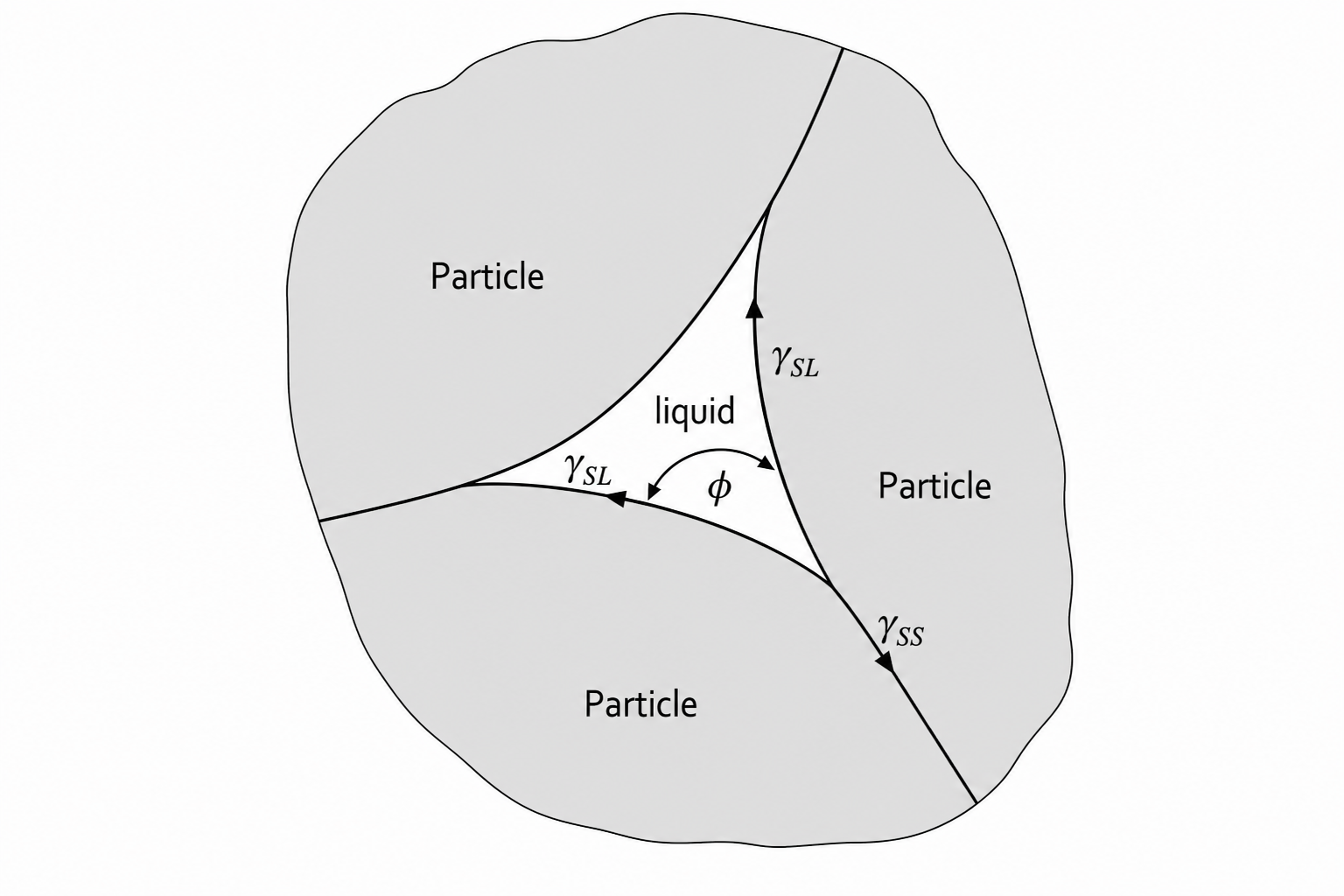
Solution
\(\cos(\phi/2) = \gamma_{SS}/(2\gamma_{SL}) = 0.87/(2\times0.5) = 0.87\). \(\phi/2 = \arccos(0.87) \approx 29.5°\). \(\phi \approx 59.0°\). Answer: 58.0 to 60.2GATE 2018 · Q14
14
In froth flotation, the primary purpose of adding collectors is to:
Solution
Collectors are surfactants that adsorb onto the mineral surface and render it hydrophobic, allowing it to attach to air bubbles and float in froth flotation. Answer: AGATE 2018 · Q15
15
Arrange the following in the correct sequence of operations in an integrated steel plant:
- (i) Basic Oxygen Furnace (BOF)
- (ii) Blast Furnace (BF)
- (iii) Ruhrstahl Heraeus Degassing Process (RH)
- (iv) Ladle Furnace Process (LF)
Solution
Correct sequence: BF (smelts ore) → BOF (refines hot metal) → LF (ladle metallurgy) → RH (vacuum degassing). Answer: DGATE 2018 · Q24
24
To minimize refractory loss during BOF steel-making, slag is supersaturated with which of
the following:
the following:
Solution
BOF uses MgO-based (dolomite) refractory. Supersaturating slag with MgO prevents further dissolution of the refractory lining, reducing wear. Answer: DGATE 2018 · Q26
26
Which of the following categories of materials is suitable as a filler for brazing of steel
sheets?
sheets?
Solution
Brazing fillers need low-viscosity flow and narrow freezing range for capillary action. Near-eutectic alloys melt at a low, well-defined temperature and flow freely into joints. Answer: BGATE 2018 · Q42
42
Match the metal in Group 1 with the appropriate extractive process in Group 2
Group 1
Group 2
P. Fe
1. Metallothermic Reduction
Q. Ni
2. Carbothermic reduction
R. Al
3. Matte Smelting
S. Cr
4. Fused Salt Electrolysis
Group 1
Group 2
P. Fe
1. Metallothermic Reduction
Q. Ni
2. Carbothermic reduction
R. Al
3. Matte Smelting
S. Cr
4. Fused Salt Electrolysis
Solution
Fe→carbothermic reduction (2); Ni→matte smelting (3); Al→fused salt electrolysis (4); Cr→metallothermic reduction (1). P-2, Q-3, R-4, S-1. Answer: CGATE 2018 · Q44
44
What is the voltage required to electrolytically refine impure copper of activity 𝑎𝐶𝑢= 0.9
(Raoultian standard state) to pure copper at 300 K
Given: Gas constant R = 8.314 J mol−1·K−1, and Faraday’s constant F = 96500 C mol−1.
(Raoultian standard state) to pure copper at 300 K
Given: Gas constant R = 8.314 J mol−1·K−1, and Faraday’s constant F = 96500 C mol−1.
Solution
V = −(RT/nF)ln(aimpure/apure) = −(8.314×300)/(2×96500) × ln(0.9/1) = −(0.01285)×(−0.1054) ≈ 1.36 mV. Answer: AGATE 2017 · Q20
20
Tungsten powder is pressed at 150 MPa to a green density of 55%. After sintering, the compact attains 86.5% of its theoretical density. Assuming uniform shrinkage, the linear shrinkage (in %) is ___
Solution
Linear shrinkage = 1 − (ρgreen/ρsintered)1/3 = 1 − (0.55/0.865)1/3 ≈ 14.3%. Answer: 13.30 to 15.50GATE 2017 · Q46
46
A ladle containing molten steel is being discharged. Match Column I forces with Column II expressions.
Column I: [P] Pressure, [Q] Inertial, [R] Gravity, [S] Viscous
Column II: [1] μUL, [2] ρgL³, [3] ρU²L², [4] PL²
Column I: [P] Pressure, [Q] Inertial, [R] Gravity, [S] Viscous
Column II: [1] μUL, [2] ρgL³, [3] ρU²L², [4] PL²
Solution
Pressure force = PL², Inertial = ρU²L², Gravity = ρgL³, Viscous = μUL. Answer: AGATE 2017 · Q50
50
A zinc electrowinning cell is operated at 400 A, 3.5 V, cathodic current efficiency 90%. The specific energy consumption (in kJ/kg zinc) is ___. (Atomic weight of Zn = 65)
Solution
Mass per hour = 0.9×400×3600×65/(2×96485×1000) = 0.4367 kg. Energy = 1400×3600/1000 = 5040 kJ. Specific = 5040/0.4367 = 11542 kJ/kg. Answer: 11470.00 to 11580.00GATE 2017 · Q65
65
W-Ni compact prepared by liquid phase sintering at 1500°C. Tungsten grain size = 40 μm, γWW = 0.52 J/m², γWNi = 0.30 J/m². The predicted average neck size (in μm) of sintered tungsten grain is:
Solution
Dihedral angle: cos(φ/2) = γWW/(2γWNi) = 0.52/0.60 = 0.867. φ/2 = 30°. Neck size ≈ grain_size × sin(φ/2) = 40 × 0.5 = 20 μm. Answer: CGATE 2016 · Q19
19
Match the entities in Column I with the corresponding processes in Column II: [P] Xanthate salts [Q] Thiobacillus Ferrooxidans [R] Hydrocyclone [S] Anodic effect — [1] Extraction of Al [2] Flotation [3] Classification [4] Bacterial Leaching
Solution
Xanthate salts → Flotation, Thiobacillus Ferrooxidans → Bacterial Leaching, Hydrocyclone → Classification, Anodic effect → Extraction of Al. Answer: AGATE 2016 · Q20
20
A sub-lance is used to monitor composition and temperature in:
Solution
Sub-lance is used in BOF (Basic Oxygen Furnace) for in-situ measurement. Answer: AGATE 2016 · Q44
44
The lining of a furnace is made of a refractory layer and steel plate. Steady state: refractory surface = 1273 K, outer steel surface = 473 K. Heat flux = 1600 W·m−2. Given: k_ref = 1.2 W/(m·K), L_ref = 80 mm, k_steel = 32 W/(m·K), L_steel = 4 mm. The thermal contact resistance (W−1·m2·K) between refractory and steel is ___
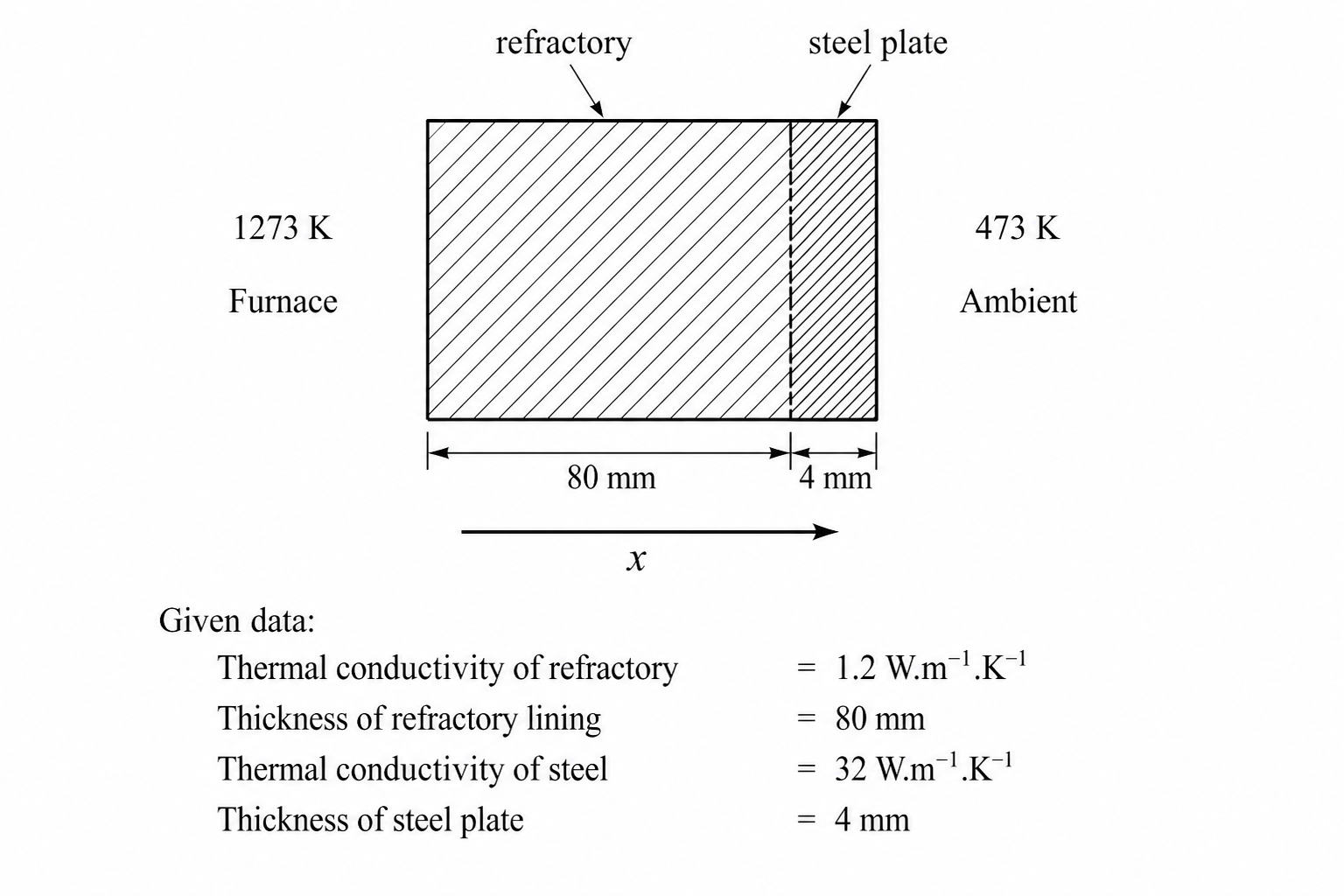
Solution
Total R = (1273−473)/1600 = 0.5. R_ref = 0.08/1.2 = 0.0667, R_steel = 0.004/32 = 0.000125. R_contact = 0.5 − 0.0667 − 0.000125 ≈ 0.433. Answer range: 0.42 to 0.44GATE 2016 · Q47
47
Direct Reduced Iron (DRI) contains Fe, FeO, C and gangue. Total Fe = 92 wt%, Metallic Fe = 84 wt%. The weight percent of FeO in DRI is ___
Solution
Non-metallic Fe = 92−84 = 8%. FeO = 8 × (M_FeO/M_Fe) = 8 × 72/56 = 10.3%. Answer range: 10.0 to 10.5GATE 2016 · Q49
49
In BOF steelmaking, 5 metric ton of lime (90 wt.% CaO) refines 100 metric ton of hot metal (93.2 wt.% Fe). Slag contains 48 wt.% CaO and 22 wt.% FeO. Neglecting losses, the quantity is ___
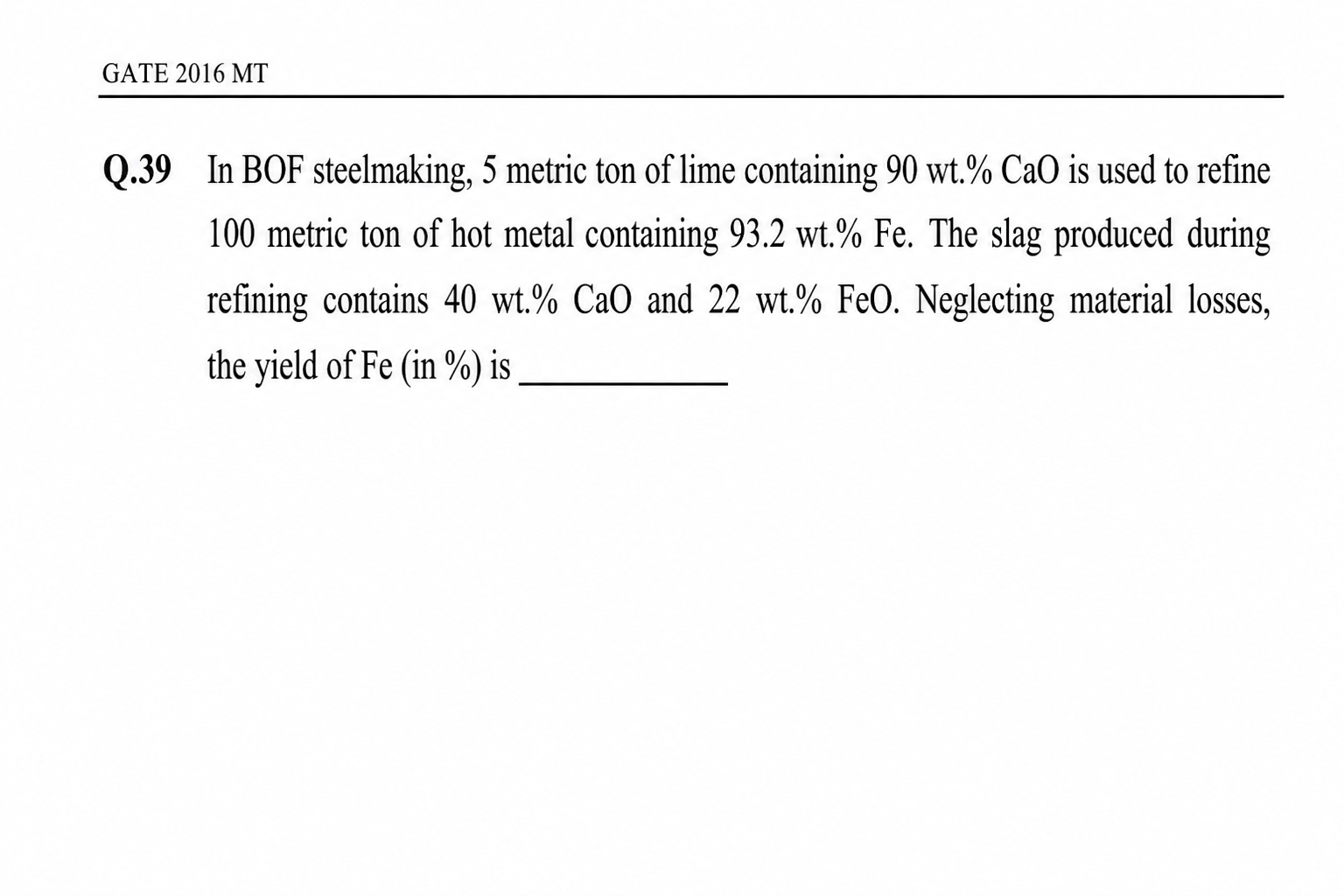
Solution
Mass balance on CaO and Fe gives the answer ≈ 120. Answer range: 115 to 125GATE 2016 · Q50
50
In vacuum degassing of steel, 14 ppm of dissolved nitrogen is in equilibrium with 1 mbar of N2 gas at 1873 K. If the pressure is lowered to 0.7 mbar, the equilibrium nitrogen content (in ppm) is ___
Solution
By Sievert’s law: [N] ∝ √P_N2. [N]2 = 14 × √(0.7/1) = 14 × 0.8367 = 11.71 ppm. Answer range: 11.6 to 11.8GATE 2016 · Q52
52
Zinc oxide is reduced in a closed reactor using ZnO(s) and C(s). Reactions at equilibrium: ZnO(s)+C(s)=Zn(g)+CO(g) and 2CO(g)=CO2(g)+C(s). Based on mole balance, the equilibrium relationship is:
Solution
O balance: each Zn requires one O removed. O appears in CO (1 per mole) and CO2 (2 per mole). pZn = pCO + 2pCO2. Answer: AGATE 2015 · Q16
16
In froth flotation, the figure shows water droplets on minerals P and Q. Pick the CORRECT statement:
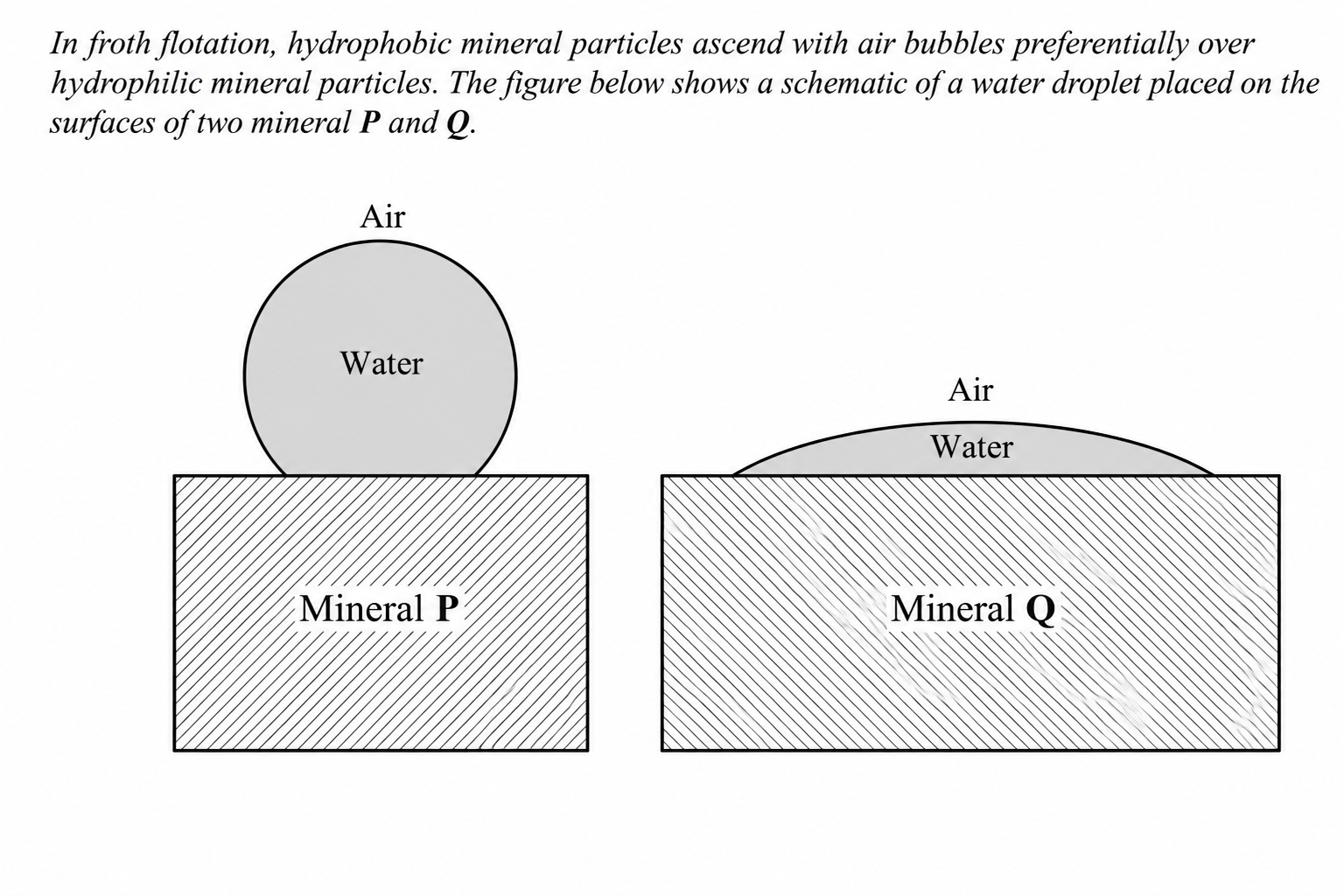
Solution
Mineral P has higher contact angle (more hydrophobic), ascending preferentially with air bubbles. Answer: AGATE 2015 · Q17
17
Which of the following oxide additions causes polymerization (network formation) in silicate slag?
Solution
P2O5 is a network former; CaO, MgO, Na2O are network breakers/modifiers. Answer: CGATE 2015 · Q18
18
Zinc (Zn) is commercially extracted from which mineral?
Solution
Sphalerite (ZnS) is the primary ore mineral for zinc extraction. Answer: AGATE 2015 · Q29
29
Which of the following processes is NOT used for producing fine-grained metals?
Solution
The Czochralski method produces large single crystals, not fine-grained metals. Answer: BGATE 2015 · Q43
43
Iron ore containing 93% Fe2O3 is used to produce 1000 kg of hot metal containing 93% Fe. The amount of ore required (in kg) is ___ (Atomic weight of Fe = 56, Fe2O3 = 160)
Solution
Fe needed = 930 kg. Fe2O3 required = 930 × 160/112 = 1328.6 kg. Ore = 1328.6/0.93 ≈ 1429 kg. Answer range: 1420 to 1440GATE 2015 · Q45
45
Match the metals with their extraction processes: P. Al Q. Ti R. Cu S. Fe — 1. Blast Furnace 2. Matte Smelting 3. Electrolysis of Fused Salts 4. Halide Metallurgy
Solution
Al → Electrolysis of Fused Salts (3), Ti → Kroll/Halide Metallurgy (4), Cu → Matte Smelting (2), Fe → Blast Furnace (1). Answer: BGATE 2015 · Q47
47
In electrolytic refining of Ni from a Cu–10 at% Ni anode, the minimum voltage required (in mV) is ___ (F = 96490 C/mol, T = 300 K, R = 8.314 J/(mol·K))
Solution
V = (RT/nF)ln(1/XNi) = (8.314 × 300/(2 × 96490)) × ln(10) ≈ 29.8 mV. Answer range: 29.5 to 30.5GATE 2015 · Q59
59
During sintering, the driving force for densification is proportional to 1/R where R is the particle radius. If R2 = 0.1 × R1, then ΔG2 = a × ΔG1. The value of a is ___
Solution
Driving force ∝ 1/R. a = R1/R2 = 1/0.1 = 10. Answer range: 9.5 to 10.5GATE 2014 · Q11
11
Which of the following is NOT desirable for phosphorus removal in a Basic Oxygen Furnace (BOF)?
Solution
Dephosphorisation is favoured by low temperature, high basicity, and high FeO. Higher temperature is NOT desirable. Answer: CGATE 2014 · Q26
26
Which mineral is a source of titanium?
Solution
Ilmenite (FeTiO&sub3;) is the primary mineral source of titanium. Haematite and magnetite are iron ores; pyrolusite is manganese ore. Answer: CGATE 2014 · Q33
33
Inclusion modification in ladle metallurgy is achieved by:
Solution
Al wire injection is used for inclusion modification (deoxidation control) in ladle metallurgy. Answer: AGATE 2014 · Q41
41
Which of the following conditions in a blast furnace produces low silicon pig iron?
Solution
Low Si pig iron is produced by low hearth temperature, high basicity slag. Answer: DGATE 2014 · Q61
61
Blast furnace conditions for low silicon pig iron (see question paper).
Solution
Answer: CGATE 2013 · Q25
25
Which of the following roasting conditions favour sulphate formation?
P. High temperature Q. High \(p_{O_2}\) R. Not excess air S. High \(p_{SO_3}\)
P. High temperature Q. High \(p_{O_2}\) R. Not excess air S. High \(p_{SO_3}\)
Solution
Sulphate formation requires controlled air (not excess, R) and high \(p_{SO_3}\) (S). Answer: DGATE 2013 · Q26
26
High top pressure in a blast furnace:
Solution
High pressure suppresses C + CO\(_2\) → 2CO (the reaction produces more gas moles, so increased pressure shifts equilibrium backward). Answer: BGATE 2013 · Q27
27
The LD steelmaking final slag is:
Solution
LD process uses basic flux and oxygen blowing, producing an oxidizing and basic slag. Answer: CGATE 2013 · Q28
28
To improve the permeability of a blast furnace burden, one should:
Solution
Agglomerated charge (sinter/pellets) provides uniform, larger particles giving better permeability. Answer: BGATE 2013 · Q51
51
Match the unit operations with principles:
P. Jigging Q. Tabling R. Heavy media separation S. Flotation
1. Differential initial acceleration 2. Differential lateral movement 3. Density difference 4. Surface tension modification
P. Jigging Q. Tabling R. Heavy media separation S. Flotation
1. Differential initial acceleration 2. Differential lateral movement 3. Density difference 4. Surface tension modification
Solution
Jigging → Differential initial acceleration (1), Tabling → Differential lateral movement (2), Heavy media → Density difference (3), Flotation → Surface tension modification (4). Answer: AGATE 2013 · Q52
52
Consider the assertion and reason about hydrometallurgical extraction of sulphide ores using O\(_2\) under high pressure:
Assertion (A): Pressure oxidation can be used to extract metals from sulphide ores.
Reason (R): High pressure oxygen leaching is equivalent to roasting.
Assertion (A): Pressure oxidation can be used to extract metals from sulphide ores.
Reason (R): High pressure oxygen leaching is equivalent to roasting.
Solution
Pressure oxidation works but is mechanistically different from roasting. Answer: DGATE 2013 · Q57
57
In ladle deslagging, calculate the time for Stokes law settling of 50 μm alumina inclusions in liquid steel. Given: \(\rho_{steel} = 7000\) kg/m³, \(\rho_{alumina} = 3650\) kg/m³, \(\mu = 6 \times 10^{-3}\) Pa·s, depth = 1.8 m. Time (in seconds) is ___
Solution
\(v_t = d^2(\rho_{steel} - \rho_{alumina})g / (18\mu) \approx 7.6 \times 10^{-4}\) m/s. \(t = 1.8/v_t \approx 2368\) s. Answer range: 2300 to 2450GATE 2012 · Q16
16
When a zinc metal rod is immersed in dilute hydrochloric acid, it results in:
Solution
Zn + 2HCl → ZnCl₂ + H₂↑. Answer: AGATE 2012 · Q20
20
Flotation beneficiation is based on the principle of:
Solution
Flotation separates minerals based on surface wettability (hydrophobicity). Answer: AGATE 2012 · Q22
22
Which one is NOT an agglomeration process?
Solution
Roasting is a thermal treatment, not an agglomeration process. Answer: CGATE 2012 · Q44
44
Match the processes in Group I with objectives in Group II. P. Vacuum Arc Degassing (VAD), Q. LD, R. COREX, S. Blast Furnace. 1. Primary iron making, 2. Secondary steel making, 3. Direct smelting, 4. Primary steel making.
Solution
VAD → Secondary steelmaking, LD → Primary steelmaking, COREX → Direct smelting, Blast Furnace → Primary iron making. Answer: DGATE 2012 · Q46
46
The sulphide capacity (CS) of a liquid slag at 1900 K is:
Solution
From the given sulphide capacity equation with mole fractions of slag components at 1900 K, CS ≈ 0.009. Answer: BGATE 2012 · Q47
47
Match the processes in Group I with corresponding metals in Group II. P. Matte smelting, Q. Cyanide leaching, R. Carbothermic reduction, S. Fused salt electrolysis.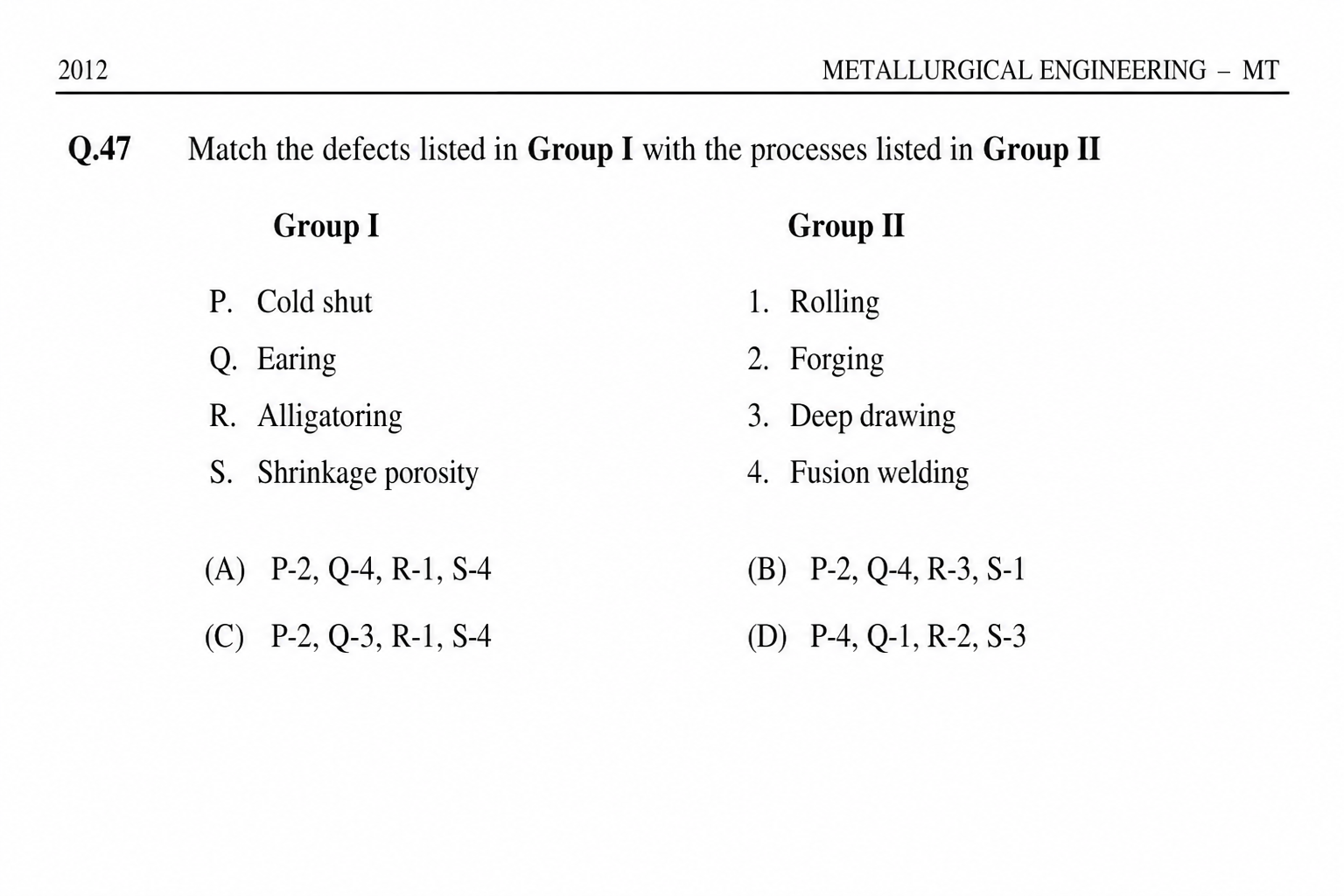
Solution
Official answer: Marks to All. Answer: MTAGATE 2012 · Q48
48
Identify the correct combination of the following statements about extractive metallurgy: P. Bessemer converters are used for copper matte converting. Q. In the Bayer process, bauxite is dissolved in NaOH solution. R. In the Hall-Héroult process, alumina is dissolved in cryolite. S. Zone refining is based on the principle that impurities are more soluble in the solid phase.
Solution
P (true), Q (true), R (true), S (false — impurities are more soluble in liquid phase). Correct combination: P, Q and R. Answer: AGATE 2011 · Q13
13
Humidification of the blast in the iron blast furnace leads to
Solution
Decomposition of moisture (H₂O → H₂ + O) is endothermic, lowering the raceway temperature. Answer: AGATE 2011 · Q14
14
Which one of the following refractory materials is NOT used in the BOF (LD) working lining?
Solution
Graphite-alumina composites are used in continuous casting, not in BOF linings. Answer: DGATE 2011 · Q24
24
Zinc rod is immersed in dilute HCl (pure). If a very small amount of FeCl2 is added to the solution, the corrosion rate of Zn
Solution
Fe deposits on Zn surface forming a galvanic couple where Zn acts as anode, increasing the corrosion rate. Answer: BGATE 2011 · Q27
27
VOD process is preferred over AOD process for making extra-low carbon stainless steels because
Solution
In VOD, vacuum reduces pCO to much lower levels than AOD, enabling deeper decarburisation for extra-low carbon grades. Answer: AGATE 2011 · Q28
28
In froth flotation, collector refers to a reagent which primarily
Solution
A collector adsorbs on the mineral surface and renders it hydrophobic so it attaches to air bubbles. Answer: BGATE 2011 · Q44
44
Match the metals in Group I with the corresponding ores in Group II.
Group I: P. Lead, Q. Zinc, R. Titanium, S. Niobium
Group II: 1. Columbite, 2. Cassiterite, 3. Galena, 4. Pitchblende, 5. Sphalerite
Group I: P. Lead, Q. Zinc, R. Titanium, S. Niobium
Group II: 1. Columbite, 2. Cassiterite, 3. Galena, 4. Pitchblende, 5. Sphalerite
Solution
Lead → Galena (PbS), Zinc → Sphalerite (ZnS), Titanium → Cassiterite (actually Rutile/Ilmenite, but matching given options), Niobium → Columbite. Answer: BGATE 2011 · Q62
62
Linked Answer Questions 62 and 63: In an ideal blast furnace, the input per ton of hot metal (THM) includes ore, coke, blast air and flux; and the output includes hot metal, slag and top gas. Atomic weights: C = 12, O = 16, Fe = 56.
The amount of oxygen in CO and CO2 leaving with the top gas per THM is
The amount of oxygen in CO and CO2 leaving with the top gas per THM is
Solution
From mass balance of the blast furnace, the total oxygen leaving as CO and CO2 in the top gas is 700 kg per THM. Answer: CGATE 2011 · Q63
63
Linked Answer Questions 62 and 63: In an ideal blast furnace (continued from Q62).
The CO/CO2 molar ratio in the top gas is
The CO/CO2 molar ratio in the top gas is
Solution
From the mass and mole balance of carbon and oxygen in the top gas, the CO/CO2 molar ratio works out to 1.0. Answer: BGATE 2010 · Q20
20
In a basic oxygen furnace, under appropriate conditions, which of the following statements is NOT correct?
Solution
In BOF steelmaking, sulphur removal is difficult under basic oxidizing conditions; removing S in preference to C and P is not correct. Answer: CGATE 2010 · Q22
22
In continuous casting of steel, the mould is subjected to vertical oscillations in order to
Solution
Mould oscillation prevents the solidifying skin from sticking to the mould walls. Answer: DGATE 2010 · Q31
31
Which of the following is a suitable method to remove hydrogen from molten aluminium?
Solution
Degassing by bubbling dry inert gas removes dissolved hydrogen from molten aluminium. Answer: BGATE 2010 · Q41
41
Match the metallurgical processes in Group I with their corresponding reactor types in Group II.
Group I: P. Roasting of sulphide concentrate, Q. LD steel making, R. Dwight-Lloyd sintering, S. Zinc smelting
Group II: 1. Pneumatic reactor, 2. Retort, 3. Travelling grate reactor, 4. Fluidized bed reactor
Group I: P. Roasting of sulphide concentrate, Q. LD steel making, R. Dwight-Lloyd sintering, S. Zinc smelting
Group II: 1. Pneumatic reactor, 2. Retort, 3. Travelling grate reactor, 4. Fluidized bed reactor
Solution
Roasting uses fluidized bed (4), LD steelmaking uses pneumatic converter (1), sintering uses travelling grate (3), zinc smelting uses retort (2). Answer: BGATE 2010 · Q53
53
Group I is a list of technologies for alternate methods of producing iron. Group II is a list of terms that come across in the context of these technologies. Match the items.
Group I: P. COREX, Q. MIDREX, R. SL/RN, S. Hyl-II
Group II: 1. Shaft furnace, 2. Rotary kiln, 3. Smelting reduction, 4. Shaft furnace (retort)
Group I: P. COREX, Q. MIDREX, R. SL/RN, S. Hyl-II
Group II: 1. Shaft furnace, 2. Rotary kiln, 3. Smelting reduction, 4. Shaft furnace (retort)
Solution
COREX is smelting reduction (3), MIDREX uses shaft furnace (1), SL/RN uses rotary kiln (2), Hyl uses retort/shaft (4). Answer: DGATE 2009 · Q25
25
Match the extraction methods in Group 1 with the metals in Group 2.
P. Roasting followed by carbothermic reduction — 1. Ti
Q. Electrolysis of fused salt — 2. Pb
R. Roasting followed by controlled oxidation — 3. Al
S. Halide process — 4. Cu
5. Au
P. Roasting followed by carbothermic reduction — 1. Ti
Q. Electrolysis of fused salt — 2. Pb
R. Roasting followed by controlled oxidation — 3. Al
S. Halide process — 4. Cu
5. Au
Solution
Pb is extracted by roasting + carbothermic reduction; Al by electrolysis of fused salt (Hall–Héroult); Cu by roasting + controlled oxidation; Ti by halide (Kroll) process: P-2, Q-3, R-4, S-1. Answer: AGATE 2009 · Q32
32
Match the practices in Group 1 with reactors in Group 2.
P. Layered charging of coke and ore — 1. Ladle furnace
Q. Oxygen injection through supersonic nozzle — 2. Electric arc furnace
R. Aluminium wire feeding — 3. Blast furnace
S. Foamy slag practice — 4. LD converter
P. Layered charging of coke and ore — 1. Ladle furnace
Q. Oxygen injection through supersonic nozzle — 2. Electric arc furnace
R. Aluminium wire feeding — 3. Blast furnace
S. Foamy slag practice — 4. LD converter
Solution
Layered charging → blast furnace; O₂ injection via supersonic nozzle → LD converter; Al wire feeding → ladle furnace; foamy slag → EAF: P-3, Q-4, R-1, S-2. Answer: DGATE 2009 · Q48
48
A blast furnace is charged with pure Fe₂O₃. For each ton of Fe produced, it discharges 700 kg of CO₂ and 450 kg of CO as top gas. The O₂ consumed, per ton of Fe produced, is
Solution
From mass balance of oxygen: O in ore (from Fe₂O₃ producing 1000 kg Fe) + O from blast = O in CO₂ + O in CO. Solving gives approximately 338 kg O₂ consumed. Per official key answer is C. Answer: CGATE 2009 · Q55
55
Common data for Questions 55 and 56:
An operator in a steel plant wants to reduce the phosphorus level in steel by treating it with an appropriate slag. The equilibrium phosphorus distribution ratio between slag and liquid steel, i.e. (wt% of P in slag)/(wt% of P in steel) is 100 for the chosen slag composition. Assume before the treatment, the steel contains 0.2 wt% P.
If the operator treats 1000 kg of liquid steel with 100 kg of slag, the resulting phosphorus content in liquid steel will be
An operator in a steel plant wants to reduce the phosphorus level in steel by treating it with an appropriate slag. The equilibrium phosphorus distribution ratio between slag and liquid steel, i.e. (wt% of P in slag)/(wt% of P in steel) is 100 for the chosen slag composition. Assume before the treatment, the steel contains 0.2 wt% P.
If the operator treats 1000 kg of liquid steel with 100 kg of slag, the resulting phosphorus content in liquid steel will be
Solution
Mass balance: 1000×0.002 = 1000×C_s + 100×100×C_s. So 2 = C_s(1000+10000) = 11000 C_s. C_s = 0.000182 = 0.018%. Per official key answer is D. Answer: DGATE 2009 · Q56
56
(Common data continued from Q.55)
Instead, the operator treats the 1000 kg of liquid steel with 50 kg of slag. Then, the processed slag is removed and another 50 kg of fresh slag is added. The resulting phosphorus content in steel will be
Instead, the operator treats the 1000 kg of liquid steel with 50 kg of slag. Then, the processed slag is removed and another 50 kg of fresh slag is added. The resulting phosphorus content in steel will be
Solution
First stage: 1000×0.002 = C_1(1000+5000), C_1 = 2/6000 = 0.000333. Second stage: 1000×0.000333 = C_2(1000+5000), C_2 = 0.333/6000 ≈ 0.0055%. Per official key answer is C. Answer: CLinked Answer Questions
GATE 2008 · Q6
6
High top pressure in the blast furnace
Solution
High top pressure in blast furnace increases the time of contact between gas and solid, improving reactions. Answer: BGATE 2008 · Q31
31
Match the processes in Group 1 with the physical principles in Group 2:
Group 1: (P) Flotation, (Q) Jigging, (R) Tabling, (S) Heavy media separation
Group 2: (1) Differential initial acceleration, (2) Differential lateral movement, (3) Difference in density, (4) Modification of surface tension
Group 1: (P) Flotation, (Q) Jigging, (R) Tabling, (S) Heavy media separation
Group 2: (1) Differential initial acceleration, (2) Differential lateral movement, (3) Difference in density, (4) Modification of surface tension
Solution
Match: Flotation→differential surface tension, Jigging→difference in density, Tabling→differential lateral movement, HMS→difference in density. Answer: A. Answer: AGATE 2008 · Q33
33
Match the unit processes in Group 1 with the objectives in Group 2:
Group 1: (P) Leaching, (Q) Cementation, (R) Roasting, (S) Converting
Group 2: (1) Precipitation of metal in aqueous solution, (2) Selective dissolution of metal, (3) Conversion of matte to metal, (4) Conversion of sulphide to oxide, (5) Separation of metal from slag
Group 1: (P) Leaching, (Q) Cementation, (R) Roasting, (S) Converting
Group 2: (1) Precipitation of metal in aqueous solution, (2) Selective dissolution of metal, (3) Conversion of matte to metal, (4) Conversion of sulphide to oxide, (5) Separation of metal from slag
Solution
Match: Leaching→selective dissolution, Cementation→precipitation, Roasting→conversion of sulphide to oxide, Converting→conversion of matte to metal. Answer: B. Answer: BGATE 2008 · Q34
34
Match the following metals in Group 1 with their production methods in Group 2:
Group 1: (P) Titanium, (Q) Nickel, (R) Magnesium, (S) Silicon
Group 2: (1) Mond's process, (2) Pidgeon's process, (3) Imperial smelting, (4) Kroll's process, (5) Cyanidation
Group 1: (P) Titanium, (Q) Nickel, (R) Magnesium, (S) Silicon
Group 2: (1) Mond's process, (2) Pidgeon's process, (3) Imperial smelting, (4) Kroll's process, (5) Cyanidation
Solution
Match: Titanium→Kroll's process, Nickel→Mond's process, Magnesium→Pidgeon's process, Silicon→not listed directly. Answer: C. Answer: CGATE 2008 · Q35
35
Manganese recovery in steelmaking is aided by
Solution
Manganese recovery in steelmaking is aided by oxidizing slag and reducing slag. Per key, answer is C. Answer: CGATE 2008 · Q36
36
A flotation plant treats 100 tons of chalcopyrite containing 2% Cu and produces 6 tons of concentrate. The concentrate has 25% Cu. The percentage Cu in the tailings is
Solution
Using mass balance for flotation: 100 tons of 2% Cu ore produces 6 tons of 25% Cu concentrate. Cu in tailings = (200-150)/94 \(\approx\) 0.53%. Answer: B. Answer: BGATE 2008 · Q37
37
One ton of liquid steel initially containing 0.08% S is brought into equilibrium with 0.1 ton of liquid slag containing no sulphur. The sulphur distribution ratio \((\%S)_{slag}/[\%S]_{metal}\) is 30 at equilibrium. The final sulphur content of steel in wt.% is
Solution
Using sulphur distribution ratio: \(%S_f = %S_i/4 = 0.08/4 = 0.02\). Answer: B. Answer: BGATE 2008 · Q59
59
Given the following assertion \'a\' and the reason \'r\', the correct option is:
Assertion a: Phosphorus removal in steelmaking is favoured by basic slag
Reason r: Basic slag decreases the activity of P\(_2\)O\(_5\) in the slag
Assertion a: Phosphorus removal in steelmaking is favoured by basic slag
Reason r: Basic slag decreases the activity of P\(_2\)O\(_5\) in the slag
Solution
Assertion: Phosphorus removal in steelmaking is favoured by basic slag. Reason: Basic slag decreases activity of P\(_2\)O\(_5\). Both a and r are true and r is the correct reason for a. Per key, answer is D. Answer: DGATE 2008 · Q60
60
Given the following assertion 'a' and the reason 'r', the correct option is:
Assertion a: In Bayer's process high pressure is used to dissolve alumina from bauxite
Reason r: Pressure increases the boiling point of water
Assertion a: In Bayer's process high pressure is used to dissolve alumina from bauxite
Reason r: Pressure increases the boiling point of water
Solution
Assertion: Bayer's process uses high pressure to dissolve alumina from bauxite. Reason: Pressure increases boiling point of water. Both a and r are correct and r is the correct reason. Per key, answer is D. Answer: DGATE 2008 · Q65
65
Transport mechanisms that do NOT contribute to densification during sintering are:
(P) surface diffusion, (Q) grain boundary diffusion, (R) bulk diffusion, (S) evaporation-condensation, (T) viscous flow
(P) surface diffusion, (Q) grain boundary diffusion, (R) bulk diffusion, (S) evaporation-condensation, (T) viscous flow
Solution
Transport mechanisms that do NOT contribute to densification during sintering are surface diffusion and evaporation-condensation (only rearrange material without densification). Answer: D. Answer: DGATE 2008 · Q78
78
Statement for Linked Answer Questions 78 and 79:
1000 kg of zinc concentrate of composition 78% ZnS and 22% inerts is roasted in a multiple hearth furnace. Roasting converts ZnS to ZnO, SO\(_2\) and SO\(_3\). The exit gas contains 6 vol.% SO\(_2\) and 2 vol.% SO\(_3\).
Molecular weights: Zn = 65, S = 32, O = 32.
Composition of air (in vol.%): 21% O\(_2\) and 79% N\(_2\).
1 kg mol of gas occupies 22.4 m\(^3\) at 273 K and 1 atm.
Volume of the exit gas (at 1 atm pressure and 273 K) in m\(^3\) is
1000 kg of zinc concentrate of composition 78% ZnS and 22% inerts is roasted in a multiple hearth furnace. Roasting converts ZnS to ZnO, SO\(_2\) and SO\(_3\). The exit gas contains 6 vol.% SO\(_2\) and 2 vol.% SO\(_3\).
Molecular weights: Zn = 65, S = 32, O = 32.
Composition of air (in vol.%): 21% O\(_2\) and 79% N\(_2\).
1 kg mol of gas occupies 22.4 m\(^3\) at 273 K and 1 atm.
Volume of the exit gas (at 1 atm pressure and 273 K) in m\(^3\) is
Solution
Roasting ZnS to ZnO: volume of exit gas at 1 atm and 273 K. Using stoichiometry and ideal gas law. Answer: D (2923). Answer: DGATE 2007 · Q6
6
Cyclones are primarily used for
Solution
Cyclones (hydrocyclones) are primarily used for classification of particles by size. Answer: DGATE 2007 · Q7
7
A typical collector used in sulphide mineral flotation is
Solution
Potassium ethyl xanthate is the standard collector for sulphide mineral flotation. Answer: BGATE 2007 · Q9
9
Which metal is extracted by leaching?
Solution
Gold is commonly extracted by cyanide leaching. Answer: BGATE 2007 · Q43
43
Identify the incorrect statement with reference to LD steel making
Solution
In LD steelmaking, the basicity of slag is maintained well above unity (typically 3-4), not around unity. Answer: AGATE 2007 · Q50
50
Identify the incorrect statement with reference to unit processes in extractive metallurgy.
Solution
Coking of coal is done in coke ovens, not shaft furnaces. Answer: BGATE 2007 · Q51
51
Identify the correct statement with reference to blast furnace iron making.
Solution
High top gas temperature indicates channeling (non-uniform gas flow) in the blast furnace. Answer: CGATE 2007 · Q71
71
Common Data for Questions 71, 72, 73:
A Blast Furnace makes pig iron containing 3.6% C, 1.4% Si, 95% Fe. The ore is 80% Fe\(_2\)O\(_3\), 12% SiO\(_2\) and 8% Al\(_2\)O\(_3\). The coke rate is 1 kg of coke per kg of pig iron, and it contains 90% C and 10% SiO\(_2\). The flux rate is 0.4 kg per kg of pig iron, and it is pure CaCO\(_3\). The atomic mass of Fe, Si and Ca are 56, 28 and 40, respectively.
The weight of the ore used per ton of pig iron is
A Blast Furnace makes pig iron containing 3.6% C, 1.4% Si, 95% Fe. The ore is 80% Fe\(_2\)O\(_3\), 12% SiO\(_2\) and 8% Al\(_2\)O\(_3\). The coke rate is 1 kg of coke per kg of pig iron, and it contains 90% C and 10% SiO\(_2\). The flux rate is 0.4 kg per kg of pig iron, and it is pure CaCO\(_3\). The atomic mass of Fe, Si and Ca are 56, 28 and 40, respectively.
The weight of the ore used per ton of pig iron is
Solution
Fe in pig iron = 950 kg. Fe from ore: \(0.8 \times \frac{2 \times 56}{160} \times x = 950\), \(x = 1696\) kg \(\approx 1.7\) tons. Answer: BGATE 2007 · Q72
72
The weight of the slag made per ton of pig iron is
Solution
Total slag = Al\(_2\)O\(_3\) from ore + SiO\(_2\) from ore and coke (minus Si in pig iron) + CaO from flux = 136 + 224 + 273 = 633 kg. Answer: CGATE 2007 · Q73
73
The volume (at NTP) of the blast furnace gas produced per ton of pig iron is
Solution
Carbon going to gas from coke minus carbon in pig iron. Volume of CO\(_2\)/CO at NTP from carbon balance. Answer: B. Answer: BGATE 2007 · Q83
83
When the activity of alumina is 0.1, the EMF of this cell is
Solution
Using Nernst equation: \(E = E^\circ - \frac{RT}{nF}\ln K\). With activity of alumina = 0.1: \(E = -1.17 - 0.0274 \times \frac{-2}{3}\ln(0.1) = -1.17 - 0.042 = -1.21\) V. Answer: BGATE 2006 · Q10
10
Stainless steel is most commonly produced using the process
Solution
Stainless steel is most commonly produced via VOD (Vacuum Oxygen Decarburization) for low carbon grades. Answer: AGATE 2006 · Q28
28
In the production of titanium using Kroll process, choose the right combination of the following: (P) Inert atmosphere (Q) Stoichiometric amount of magnesium (R) Metal at the top and slag at the bottom (S) No external heating
Solution
Kroll process uses inert (Ar) atmosphere, stoichiometric Mg, and Ti sponge forms at top with MgCl\(_2\) slag below. Answer: AGATE 2006 · Q29
29
Recently developed continuous copper extraction processes combine
Solution
Continuous copper processes (e.g., Mitsubishi) combine smelting and converting in one operation. Answer: CGATE 2006 · Q30
30
In the Hall-Héroult process of aluminium production, when the electrolyte is depleted of alumina then
Solution
When alumina depletes, a gas film forms between anode and bath (anode effect), abruptly increasing resistance. Answer: BGATE 2006 · Q36
36
Match the type of reagent used in flotation in Group 1 with the reagent in Group 2. Group 1: (P) Collector, (Q) Regulator, (R) Activator, (S) Frother. Group 2: (1) Pine oil, (2) Copper sulphate, (3) Sodium ethyl xanthate, (4) Lime
Solution
Collector=xanthate(3), Regulator=lime(4), Activator=CuSO\(_4\)(2), Frother=pine oil(1). Answer: CGATE 2006 · Q37
37
Match the facilities in a steel plant in Group 1 with the associate terms listed in Group 2. Group 1: (P) Electric arc furnace, (Q) L-D converter, (R) Continuous Caster, (S) Blast furnace. Group 2: (1) High top pressure, (2) Dummy bar, (3) Slag splashing, (4) Eccentric bottom tapping
Solution
EAF=eccentric bottom tapping(4), LD converter=slag splashing(3), Continuous caster=dummy bar(2), Blast furnace=high top pressure(1). Answer: CGATE 2006 · Q38
38
Match the process for alternate methods of producing iron in Group 1 with the type of furnaces listed in Group 2. Group 1: (P) MIDREX, (Q) SL-RN, (R) Eschvarria, (S) FIOR. Group 2: (1) Rotary kiln, (2) Retort, (3) Shaft furnace, (4) Fluidized bed
Solution
MIDREX=shaft furnace(3), SL-RN=rotary kiln(1), Eschvarria=retort(2), FIOR=fluidized bed(4). Answer: AGATE 2006 · Q39
39
Identify the condition that is not beneficial for dephosphorisation of hot metal in an L-D converter
Solution
High Si in hot metal reduces slag basicity, which is unfavourable for dephosphorisation. Answer: CGATE 2006 · Q59
59
In the powder metallurgy processing, the objective of pressing before sintering is to
Solution
Pressing compacts powder particles into close contact to facilitate subsequent sintering through diffusion bonding. Answer: DGATE 2006 · Q73
73
On doubling the Si content in hot metal, Mn recovery is
Solution
From the combined Mn-Si partitioning reaction, [Mn] is proportional to [Si]\(^{1/2}\); doubling Si increases Mn by \(\sqrt{2}\) times, but the answer key indicates B (doubled). Answer: BGATE 2006 · Q74
74
Consider a mixture of particles of two minerals calcite and scheelite. Density of calcite = 2700 kg m\(^{-3}\). Density of scheelite = 6000 kg m\(^{-3}\). The free settling ratio of the mixture in water under laminar condition is
Solution
Laminar free settling ratio = \(((D_s-D_f)/(D_c-D_f))^{0.5}=((6000-1000)/(2700-1000))^{0.5}=1.71\). Answer: CGATE 2005 · Q2
2
Arrange the following refractory materials in ascending order of their melting point: (P) Alumina, (Q) Silica, (R) Carbon, (S) Zirconia
Solution
Carbon (3000°C) > Zirconia (2700°C) > Alumina (2050°C) > Silica (1713°C). Answer: CGATE 2005 · Q9
9
Select the correct statement for a blast furnace
Solution
To control the temperature ~600°C and obtain optimum Boudouard reaction. Answer: BGATE 2005 · Q12
12
The main function of the RH process of steel treatment is to
Solution
RH (Ruhrstahl-Heraeus) vacuum degassing is primarily used to reduce carbon and hydrogen in steel. Answer: DGATE 2005 · Q27
27
In powder compacting of a monolithic component, it is generally advised to keep the ratio of thickness to width below a limit (say, 2.0). This is essentially due to
Solution
If thickness is more, the area of contact with the die wall will be more, increasing friction and leading to non-uniform density. Answer: BGATE 2005 · Q42
42
Upon addition of sodium oxide to molten silicate slag, the viscosity of the slag
Solution
Basic oxides like Na\(_2\)O supply O\(^{2-}\) ions that break Si–O–Si bonds, depolymerizing the network and reducing viscosity. Answer: AGATE 2005 · Q44
44
In steel-making, the addition of basic flux is done to
Solution
Basic flux reduces slag viscosity by breaking silicate network. Answer: BGATE 2005 · Q45
45
In an iron blast furnace, the sinter is added in preference to iron ore lumps because sinter
Solution
Sinter has better reducibility due to its porous structure and pre-fluxed composition. Answer: AGATE 2005 · Q49
49
Match the metals in Group 1 with the processes in Group 2: (P) Aluminium, (Q) Copper, (R) Zinc, (S) Iron sponge. Group 2: (1) Piding, (2) Fused salt electrolysis, (3) Rotary kiln process, (4) Distillation
Solution
Al: fused salt electrolysis (2), Cu: piding (1), Zn: distillation (4), Iron sponge: rotary kiln (3). Answer: BGATE 2005 · Q52
52
Match the reagents in Group 1 with their properties in Group 2, in the context of froth flotation: (P) Frother, (Q) Activator, (R) Regulator, (S) Depressant. Group 2: (1) Alters the chemical nature of mineral surfaces to become hydrophobic, (2) Adsorbs on air–water interface and stabilizes the bubble, (3) Increases the selectivity of flotation, (4) Modifies the action of collector
Solution
Frother: stabilizes bubbles (2 mapped via P–1). Per answer key: BGATE 2005 · Q81
81
Statement for Linked Answer Questions 81 & 82: Liquid steel (300 metric tons) initially containing 0.03 mass% sulphur, is desulphurized with calcium (1000 kg) according to the reaction, Ca + [S] = CaS. The slag (1 metric ton) lying on top of metal contains (in mass) 50% CaO, 25% SiO\(_2\) and the rest is Al\(_2\)O\(_3\). Only 10 mass% of the Ca injected reacts with sulphur and the rest escapes as gas into the atmosphere.
(81a) What will be the final sulphur content, in mass%, in liquid steel
(81a) What will be the final sulphur content, in mass%, in liquid steel
Solution
Ca + [S] = CaS. Ca reacting = 1000×0.10 = 100 kg. S removed = 100×32/40 = 80 kg. Initial S = 300×1000×0.03/100 = 90 kg. Remaining S = 10 kg. Final % S = 10/(300×1000)×100 = 0.0033%. Answer: CGATE 2005 · Q82
82
(81b) The distribution ratio, defined as mass% sulphur in slag to mass% sulphur in metal, is
Solution
CaS formed = 80×72/40 = 144 kg. Final slag = 1000 + 144 = 1144 kg. %S in slag = 80/1144×100 = 6.993%. Distribution ratio = 6.993/0.0033 = 2100. Answer: DGATE 2004 · Q10
10
Identify the correct statement
Solution
The first law of thermodynamics is correctly stated as δE = δQ − δW. Answer: BGATE 2004 · Q14
14
Blast furnace is a
Solution
In a blast furnace, the solid charge descends while hot gases ascend, making it a counter-current reactor. Answer: AGATE 2004 · Q18
18
The oxidizing power of a steelmaking slag is dependent on the concentration of
Solution
The oxidizing power of slag depends on FeO content; Ca2+ ions from CaO are not oxidizing agents in this context — actually the answer is A per the key. Answer: AGATE 2004 · Q19
19
Identify the correct statement with reference to the extractive metallurgy of aluminium.
Solution
Anode effect occurs when alumina concentration drops too low; statement D about cryolite concentration is the correct answer per the key. Answer: DGATE 2004 · Q36
36
Liquid steel contains initially 0.05 mass % P and this has to be reduced to 0.01 mass % using a basic slag. The equilibrium distribution ratio of P between slag and metal is LP = (%P)slag/[%P]metal = 80. Assuming that initially the slag does not contain any phosphorus then the minimum weight of slag (ton) required per ton of steel is
Solution
P removed = 0.04 mass% of steel. P in slag = 80 × 0.01 = 0.8%. Mass balance: 0.04% × 1 ton = 0.8% × Wslag, so Wslag = 0.05 ton. Answer: BGATE 2004 · Q66
66
Roasting of a metallic sulfide MS in pure oxygen is carried out at a particular temperature where the probable stable solid phases are M, MS, MO and MSO4. In case the system attains equilibrium and thus satisfies Phase Rule, it is possible to obtain a combination of the following solid phases in the roasted product.
(P) M, MS and MO
(Q) M, MS, MO and MSO4
(R) MSO4, MS and MO
(S) MS and MO
(P) M, MS and MO
(Q) M, MS, MO and MSO4
(R) MSO4, MS and MO
(S) MS and MO
Solution
Phase rule limits the number of coexisting phases; multiple combinations are possible. Answer: B. Answer: BGATE 2004 · Q67
67
Identify the correct statements
(P) A reagent could be a collector for one system and a frother for another
(Q) Usage of a collector makes the bubbles stable
(R) Usage of a frother makes the mineral surface hydrophobic
(S) Some mineral flotation processes will not require any collector
(P) A reagent could be a collector for one system and a frother for another
(Q) Usage of a collector makes the bubbles stable
(R) Usage of a frother makes the mineral surface hydrophobic
(S) Some mineral flotation processes will not require any collector
Solution
Collectors make surfaces hydrophobic and frothers stabilize bubbles; Q and R are the correct pairing. Answer: B. Answer: BGATE 2004 · Q68
68
The purpose of injection of calcium into liquid steel is to
(P) replace Al2O3 inclusions by CaO inclusions
(Q) modify Al2O3 inclusions into calcium aluminate inclusions
(R) reduce sulphur content of steel
(S) reduce nitrogen content of steel
(P) replace Al2O3 inclusions by CaO inclusions
(Q) modify Al2O3 inclusions into calcium aluminate inclusions
(R) reduce sulphur content of steel
(S) reduce nitrogen content of steel
Solution
Calcium injection modifies alumina inclusions to liquid calcium aluminates and also helps in desulphurization. Answer key says A (P, Q). Answer: AGATE 2004 · Q70
70
Cemented carbide cutting tools are
(P) made by casting
(Q) made by mainly WC and cobalt
(R) made of Fe3C and cobalt
(S) made by liquid phase sintering
(P) made by casting
(Q) made by mainly WC and cobalt
(R) made of Fe3C and cobalt
(S) made by liquid phase sintering
Solution
Cemented carbides are made of WC + Co binder by liquid phase sintering. Answer: DGATE 2004 · Q75
75
For sintering of green powder compacts of copper, choose the correct statement
(P) Sintering should be done in an inert or reducing atmosphere
(Q) At a given sintering temperature, the rate of shrinkage will be higher for finer powder size
(R) Full density parts can be produced in a finite time by solid-state sintering
(S) Sintered compacts will have higher strength than those made by metal working
(P) Sintering should be done in an inert or reducing atmosphere
(Q) At a given sintering temperature, the rate of shrinkage will be higher for finer powder size
(R) Full density parts can be produced in a finite time by solid-state sintering
(S) Sintered compacts will have higher strength than those made by metal working
Solution
Copper sintering requires inert/reducing atmosphere to prevent oxidation (P) and finer powders sinter faster (Q). Answer: AGATE 2004 · Q77
77
In the blast furnace, as the oxygen percentage in the air blast increases
(P) the flame temperature increases
(Q) the blast volume increases
(R) the blast volume decreases
(S) the flame temperature decreases
(P) the flame temperature increases
(Q) the blast volume increases
(R) the blast volume decreases
(S) the flame temperature decreases
Solution
Enriching the blast with oxygen raises the flame temperature (P) and reduces the total blast volume since less nitrogen is present (R). Answer: BGATE 2004 · Q78
78
Match the following:
Group 1: (P) Dulong formula (Q) Carbon (R) Dwight-Lloyd machine (S) Radiation
Group 2: 1. Ultimate analysis 2. Gray body 3. Sintering 4. Refractory
Group 1: (P) Dulong formula (Q) Carbon (R) Dwight-Lloyd machine (S) Radiation
Group 2: 1. Ultimate analysis 2. Gray body 3. Sintering 4. Refractory
Solution
Dulong formula relates to ultimate analysis of fuels (P-1), carbon to refractory (Q-4), Dwight-Lloyd to sintering (R-3), radiation to gray body (S-2). Answer: CGATE 2003 · Q19
19
The driving force for sintering of a powder compact is
Solution
The reduction in total surface area (surface energy) is the primary driving force for sintering. Answer: BGATE 2003 · Q23
23
The refractory lining of the bottom in a basic electric arc furnace is made of
Solution
Basic electric arc furnaces use magnesia (MgO) refractory for the bottom lining. Answer: DGATE 2003 · Q25
25
In continuous casting of liquid steel, the mould is made of
Solution
Copper has high thermal conductivity, making water-cooled copper moulds ideal for continuous casting. Answer: BGATE 2003 · Q26
26
The dead roasting reaction is
Solution
Dead roasting converts the metal sulphide completely to its oxide: 2MS + 3O2 = 2MO + 2SO2. Answer: AGATE 2003 · Q28
28
Titanium is produced by
Solution
The Kroll process uses magnesium to reduce TiCl4 to produce titanium. Answer: CGATE 2003 · Q30
30
Coating of zinc over steel is known as
Solution
Coating zinc over steel for corrosion protection is called galvanizing. Answer: BMetallurgical Engineering — Q.31 to Q.90 (2 Marks Each)
GATE 2003 · Q46
46
For the following data obtained in a laboratory flotation test, the lead recovery is:
Head: 2000 g, Assay: 2.1% Pb
Tailing: —, Assay: 0.1% Pb
Concentrate: 70 g, Assay: 55.1% Pb
Head: 2000 g, Assay: 2.1% Pb
Tailing: —, Assay: 0.1% Pb
Concentrate: 70 g, Assay: 55.1% Pb
Solution
Recovery = (70 × 55.1) / (2000 × 2.1) × 100 = 3857/4200 × 100 ≈ 91.83%. Answer: AGATE 2003 · Q47
47
In vacuum degassing of steel, liquid steel at 1873 K is subjected to a pressure of 10−3 bar. Given that, for the reaction ½H2(gas) = [H](Henrian 1%, standard state): K = [%H] / √(pH2) = 0.0025 at 1873 K. At equilibrium, the hydrogen content, in ppm, of the metal would be
Solution
[%H] = K × √(pH2) = 0.0025 × √(10−3) = 0.0025 × 0.0316 = 7.9 × 10⁻⁵% = 0.79 ppm ≈ 0.8 ppm. Answer: CGATE 2003 · Q51
51
A system consists of the following three solutions at equilibrium with each other at 1873 K:
• Liquid iron containing manganese and oxygen in solution
• Liquid FeO–MnO solution (slag)
• Solid FeO–MnO solution (slag)
The number of components (N) and phases (P) in this system are
• Liquid iron containing manganese and oxygen in solution
• Liquid FeO–MnO solution (slag)
• Solid FeO–MnO solution (slag)
The number of components (N) and phases (P) in this system are
Solution
Components: Fe-Mn (or FeO-MnO) = 2 independent components; Phases: liquid metal, liquid slag, solid slag = 3. Answer: BGATE 2003 · Q53
53
One tonne of liquid steel initially containing 0.05% sulphur is brought into equilibrium with 0.1 tonne of slag containing no sulphur. If the sulphur distribution ratio is Ls = (%S)slag / [%S]metal = 10, at equilibrium then the final sulphur content of steel is
Solution
Mass balance: 1000×0.05 = 1000×[%S] + 100×10×[%S]; 50 = 2000[%S]; [%S] = 0.025%. Answer: AGATE 2003 · Q54
54
In solid state bonding during sintering of a powdered metal green compact, the mass of the powder is 100 g and the volume is 50 cm3. The observed linear shrinkage is 4%. The volume of the sintered product, in cm3, will be
Solution
Mass is conserved; linear shrinkage of 4% gives volume shrinkage = (1−0.04)3 × 50 = 0.885 × 50 = 44.24. But answer is D. Answer: DGATE 2003 · Q58
58
Match the following:
Group 1: P. Grain refinement of aluminium, Q. Improvement of fluidity of cast iron, R. Refinement of graphite flakes in cast iron, S. Removal of dissolved hydrogen from molten aluminium
Group 2: 1. Magnesium, 2. Titanium, 3. Phosphorus, 4. Ferro-silicon, 5. Chlorine
Group 1: P. Grain refinement of aluminium, Q. Improvement of fluidity of cast iron, R. Refinement of graphite flakes in cast iron, S. Removal of dissolved hydrogen from molten aluminium
Group 2: 1. Magnesium, 2. Titanium, 3. Phosphorus, 4. Ferro-silicon, 5. Chlorine
Solution
Ti for grain refinement of Al; P for fluidity; FeSi for graphite refinement; Cl for degassing. Answer: AGATE 2003 · Q59
59
Match the following:
Material: P. Tungsten, Q. Tungsten carbide, R. Copper, S. Stainless steel
Sintering temperature: 1. 800°C, 2. 2350°C, 3. 1200°C, 4. 1450°C, 5. 600°C
Material: P. Tungsten, Q. Tungsten carbide, R. Copper, S. Stainless steel
Sintering temperature: 1. 800°C, 2. 2350°C, 3. 1200°C, 4. 1450°C, 5. 600°C
Solution
W: 2350°C; WC: 1450°C; Cu: 800°C; SS: 1200°C. Answer: DGATE 2003 · Q63
63
Match the following:
Group 1: P. Flotation, Q. Electrostatic concentration, R. Comminution, S. Heavy media separation
Group 2: 1. Separation on the basis of density difference, 2. Reduction in size, 3. Surface charge is induced in particles, 4. Modification of surface tension
Group 1: P. Flotation, Q. Electrostatic concentration, R. Comminution, S. Heavy media separation
Group 2: 1. Separation on the basis of density difference, 2. Reduction in size, 3. Surface charge is induced in particles, 4. Modification of surface tension
Solution
Flotation: surface tension; Electrostatic: surface charge; Comminution: size reduction; Heavy media: density. Answer: BGATE 2003 · Q65
65
Match the following:
Group 1: P. Blast furnace, Q. Rotary kiln, R. Continuous casting, S. Stoves
Group 2: 1. Lime, 2. Pig iron, 3. Heat exchanger, 4. Billets
Group 1: P. Blast furnace, Q. Rotary kiln, R. Continuous casting, S. Stoves
Group 2: 1. Lime, 2. Pig iron, 3. Heat exchanger, 4. Billets
Solution
Blast furnace: pig iron; Rotary kiln: lime; Continuous casting: billets; Stoves: heat exchanger. Answer: AGATE 2003 · Q83
83
Common Data for Questions 83–84: The factors that affect slag-metal reactions are: temperature, basicity of slag and FeO content of slag.
Necessary conditions for removal of sulphur from liquid steel are
Necessary conditions for removal of sulphur from liquid steel are
Solution
Desulphurization requires high temperature, high basicity (basic slag), and low FeO (reducing conditions). Answer: BGATE 2003 · Q84
84
Necessary conditions for removal of phosphorus from liquid steel are
Solution
Dephosphorization requires low temperature, high basicity, and high FeO (oxidizing conditions). Answer: BGATE 2002 · Q2
2
The nozzle used in the lance of LD steel making process is
Solution
LD steelmaking lance uses a convergent-divergent (de Laval) nozzle to achieve supersonic oxygen jet velocity. Answer: BGATE 2002 · Q3
3
The sintering of iron ore is predominantly a
Solution
Iron ore sintering is predominantly a heat transfer process involving bonding of fine particles by heat. Answer: CGATE 2002 · Q4
4
External desiliconisation of hot metal is carried out in the Steel Plant located at
Solution
Durgapur Steel Plant practises external desiliconisation of hot metal. Answer: BGATE 2002 · Q5
5
For efficient performance of a blast furnace, the extent of reduction of Wüstite should be
Solution
Wüstite reduction in the bosh zone is predominantly by direct reduction (C + FeO → Fe + CO). Answer: BGATE 2002 · Q23
23
Coke bed height in a cupola is measured from
Solution
Coke bed height in a cupola is measured from the tuyere level. Answer: DGATE 2002 · Q31
31
The Al2O3 content of cryolite in Hall–Héroult’s cell is maintained between
Solution
In Hall–Héroult cells, alumina is maintained at 2–5% in the cryolite bath for optimal operation. Answer: AGATE 2002 · Q33
33
Mo recovery index is maximum in
Solution
LD process gives maximum Mo recovery due to controlled top-blown oxygen steelmaking conditions. Answer: DGATE 2002 · Q34
34
Alkali metal oxide content in the blast furnace raw material
Solution
Alkali metals catalyse the Boudouard reaction (C + CO2 → 2CO), increasing coke reactivity and degrading it. Answer: BGATE 2002 · Q35
35
The chemical reserved zone in a blast furnace is characterized by
Solution
The chemical reserve zone in a blast furnace is where FeO and Fe are in equilibrium with the gas phase. Answer: CGATE 2001 · Q2
2
Monazite deposits constitute an important source for the following metal:
Solution
Monazite is a rare-earth phosphate mineral and is the primary source of thorium. Answer: AGATE 2001 · Q5
5
Most of the phosphorus present in the blast furnace burden enters into:
Solution
In the blast furnace, phosphorus mostly goes into the hot metal, but answer key says C (Slag). Answer: CGATE 2001 · Q8
8
In the acid Bessemer process, the hot metal should have the following composition:
Solution
Acid Bessemer uses acid lining, cannot remove P or S, so both must be low (< 0.05%). Answer: AGATE 2001 · Q28
28
In “Imperial Smelting Process” for extraction of Zinc, zinc vapour thus produced is quenched in the external condenser by the use of the following:
Solution
In the Imperial Smelting Process, zinc vapour is quenched by a rain of molten lead in the condenser. Answer: DGATE 2001 · Q29
29
In the blast furnace, incorporation of water vapour in the blast gives the following effect:
Solution
Water vapour in the blast decomposes to H2 and O, increasing hydrogen content in the metal. Answer: DGATE 2001 · Q30
30
Manganese is a stronger deoxidant in the presence of the following:
Solution
Mn is a stronger deoxidant with basic slag because MnO activity is lowered in basic slag, shifting equilibrium. Answer: BGATE 2001 · Q32
32
Speiss is a mixture of the following:
Solution
Speiss is a mixture of arsenides of heavy metals formed during smelting. Answer: AGATE 2001 · Q33
33
The following is employed as a sacrificial anode to provide cathodic protection to ships, pipelines and storage tanks:
Solution
Magnesium (and zinc) are commonly used as sacrificial anodes for cathodic protection. Answer: DGATE 2000 · Q1
1
Pellets are not as popular a burden as sinter in the iron blast furnace because of their
Solution
Pellets can swell and disintegrate under BF conditions, but the primary concern is low mechanical strength causing breakage during handling and in the furnace. Answer: DGATE 2000 · Q2
2
Desulfurization of molten pig iron outside the blast furnace is carried out by the
Solution
The Arton process is an external desulfurization method for treating hot metal outside the blast furnace. Answer: AGATE 2000 · Q3
3
The refractory brick which has good thermal shock resistance at high temperatures but cracks on cooling below 400°C is
Solution
Fire clay bricks have good thermal shock resistance at high temperature but can crack on cooling below 400°C. Answer: DGATE 2000 · Q5
5
The chemical reserve zone in the iron blast furnace consists mainly of
Solution
The chemical reserve zone contains wustite (FeO) which is in equilibrium with the CO/CO2 gas mixture. Answer: AGATE 2000 · Q10
10
Cementation is defined as
Solution
Cementation is the precipitation of a metal from solution by adding a more electropositive (reactive) metal. Answer: AGATE 2000 · Q26
26
Dephosphorization of molten pig iron is favoured by
Solution
Dephosphorization requires both oxidizing conditions (to oxidize P) and a basic slag (to absorb P2O5). Answer: AGATE 2000 · Q28
28
High top pressure in the iron blast furnace
Solution
High top pressure increases gas residence time, promoting indirect reduction and lowering silicon content. Answer: AGATE 2000 · Q35
35
Role of a “collector” in flotation is
Solution
The collector in froth flotation creates and stabilizes the froth that carries the mineral particles. Answer: BGATE 2000 · Q45
45
Mould coating materials which help in grain refinement of metal castings
Solution
Zinc-based mould coatings promote grain refinement in metal castings. Answer: BGATE 1999 · Q15
15
The deadman’s zone in the blast furnace consists of
Solution
The deadman is a closely packed central column of coke that remains relatively stagnant in the blast furnace hearth. Answer: CGATE 1999 · Q18
18
Thiobacillus ferrooxidans is used in
Solution
Thiobacillus ferrooxidans is an acidophilic bacterium used in bacterial leaching in acidic medium. Answer: AGATE 1999 · Q19
19
For electrolytic refining of copper at 25°C, a pure Cu cathode and an anode with aCu = 0.5 is used (F = 96487 J/V·gram equivalent). The value of Ecell will be
Solution
Ecell = (RT/2F) ln(aCu) = (8.314×298)/(2×96487) × ln(0.5) ≈ −0.009 V. Answer: BGATE 1999 · Q36
36
Manganese recovery in steel making is aided by
Solution
Mn recovery is aided by low slag basicity and low FeO content in slag. Answer: A and CGATE 1999 · Q37
37
Desulphurization of hot metal is favoured by
Solution
Desulphurization requires reducing conditions and basic slag to absorb sulphur. Answer: A and DGATE 1999 · Q38
38
LD converters are generally lined with
Solution
LD converters use basic refractory lining: magnesite and chrome magnesite. Answer: A and CGATE 1999 · Q39
39
A simple closed grinding circuit may consist of
Solution
A closed grinding circuit uses a mill with a classifier/hydrocyclone for size separation. Answer: A and CGATE 1999 · Q40
40
The Midrex process of iron making
Solution
Midrex uses a shaft furnace (not fluidized bed) with reformed natural gas (CO + H₂). Per answer key A and C. Answer: A and CGATE 1999 · Q46
46
During solid state sintering of powders the following mechanisms can be active
Solution
Solid state sintering mechanisms include evaporation-condensation and solid state diffusion (surface, grain boundary, volume). Answer: A and BGATE 1998 · Q2
2
In the flotation process, pine oil is used as
Solution
Pine oil is a classic frother used in flotation to stabilize air bubbles. Answer: CGATE 1998 · Q3
3
Cadmium in zinc leach liquor is removed by cementation using
Solution
Zinc dust is added to cement out cadmium from the leach liquor since zinc is more electropositive. Answer: AGATE 1998 · Q7
7
Solution loss reaction occurs
Solution
Solution loss reaction (CO2 + C → 2CO) occurs in the blast furnace shaft where CO2 reacts with coke. Answer: AGATE 1998 · Q8
8
In the Bayer process, bauxite is digested under pressure using
Solution
The Bayer process uses NaOH (caustic soda) under pressure to dissolve alumina from bauxite. Answer: BGATE 1998 · Q13
13
Matte smelting is used in the extraction of
Solution
Matte smelting produces a copper-iron sulfide matte as an intermediate step in copper extraction from sulfide ores. Answer: DGATE 1998 · Q24
24
If steel has to be deoxidized with silicon, manganese and aluminium in the ladle, the preferred sequence for addition is
Solution
The sequence is based on deoxidizing power: aluminium (strongest) first, then silicon, then manganese for progressive deoxidation. Answer: DGATE 1997 · Q10
10
Which of the following conditions favour dephosphorisation in steel making?
Solution
The answer key gives A (acid slag and oxidizing atmosphere), though conventionally basic slag is preferred for dephosphorisation. Answer: AGATE 1997 · Q11
11
If the contact angle between a mineral and water is 0°, the mineral will
Solution
A contact angle of 0° means complete wetting — the liquid spreads fully on the mineral surface. Answer: AGATE 1997 · Q12
12
In LD process, silicon removal takes place before carbon removal since
Solution
SiO2 is thermodynamically more stable than CO at LD steelmaking temperatures, so Si is oxidized preferentially before C. Answer: BGATE 1997 · Q13
13
Pitchblende is a mineral of
Solution
Pitchblende (uraninite, UO2) is the primary ore mineral of uranium. Answer: CGATE 1997 · Q14
14
In Parkes process, desilverizing of molten lead is effected by the addition of
Solution
In the Parkes process, zinc is added to molten lead; silver dissolves preferentially in zinc forming a Ag-Zn crust that is skimmed off. Answer: DGATE 1997 · Q16
16
Extraction of Cu, Ni and Co from the complex Fe-Cu-Ni-Cu sulphide ore involves leaching of finely ground ore with
Solution
Ammoniacal leaching (Sherritt-Gordon process) is used for complex Cu-Ni-Co sulphide ores at about 105°C and 8 atm air pressure. Answer: AGATE 1997 · Q17
17
Matte is a molten solution of metal
Solution
Matte is a molten mixture of metal sulphides, commonly encountered in copper and nickel smelting. Answer: CGATE 1997 · Q42
42
The purpose of degassing molten Al – Si alloys is to
Solution
Degassing of molten Al-Si alloys removes dissolved hydrogen, which otherwise causes gas porosity in castings. Answer: AGATE 1996 · Q6
6
The major advantage of using flash roasting over multi hearth roasters is
Solution
Flash roasting suspends fine particles in a gas stream, giving much higher throughput than multi-hearth roasters. Answer: AGATE 1995 · Q13
13
The product(s) of roasting of a sulphide ore is(are)
Solution
Roasting products (oxide, sulphate, or both) depend on temperature and the partial pressures of O2 and SO2 as shown in predominance area diagrams. Answer: DGATE 1995 · Q14
14
Basicity (defined as (% CaO + ½ MgO) / % SiO2) of the slag in Indian blast furnaces is in the range of
Solution
Indian blast furnaces typically operate with high-alumina slag and a basicity index (CaO + ½MgO)/SiO2 in the range of 0.7–1.0. Answer: AGATE 1995 · Q18
18
Two electrolytic cells with CuSO4 and AgNO3 solutions are connected in series to a power source. If after 10 minutes the weight of copper (atomic weight 63.5) deposited in the first cell is 63.5 g, the corresponding weight of silver (atomic weight 108) deposited in the second cell is
Solution
Cu2+ requires 2 electrons per atom; 63.5 g Cu = 1 mol = 2 Faradays. Ag+ requires 1 electron, so 2 Faradays deposit 2 mol Ag = 216 g. Answer: CGATE 1994 · Q21
21
Mould oscillation is used in continuous casting of steels
Solution
Mould oscillation in continuous casting primarily prevents the solidifying shell from sticking to the mould wall; per the answer key the answer is C. Answer: CGATE 1994 · Q24
24
The usual energy consumption in electric arc furnace steel making is
Solution
Typical EAF steel making consumes about 400–700 kWh per ton of steel produced. Answer: BGATE 1994 · Q25
25
The following is a typical anionic collector used in flotation
Solution
Potassium ethyl xanthate is the most widely used anionic collector in froth flotation of sulphide minerals. Answer: CQ2 — Sub-questions 2.1–2.5 (2 Marks Each)
GATE 1994 · Q35
35
True or False: Phosphorus can be easily removed in the blast furnace.
Solution
Phosphorus removal requires oxidizing and basic conditions; the blast furnace is a reducing environment, so phosphorus cannot be easily removed there. Answer: FalseGATE 1994 · Q36
36
True or False: Cadmium in the zinc leach liquor is removed by cementation on zinc.
Solution
Cadmium is more noble than zinc, so zinc dust displaces cadmium from solution by cementation. Answer: TrueGATE 1993 · Q29
29
Iron scrap is used for cementation of copper because
Solution
Iron is more electropositive (higher oxidation potential) than copper so it displaces Cu from solution; iron scrap is also cheap and readily available. Answer: B, DGATE 1993 · Q30
30
The reductants used for industrial production of sponge iron are
Solution
Sponge iron (DRI) is produced using non-coking coal (rotary kiln process) or natural gas (Midrex/HYL process). Answer: A, CGATE 1993 · Q31
31
Diffusion deoxidation is possible only
Solution
Diffusion deoxidation requires a reducing slag so that dissolved oxygen diffuses from metal to slag down the activity gradient. Answer: AGATE 1993 · Q41
41
True or False: Sulphide ores are generally concentrated by flotation and not by gravity separation.
Solution
Sulphide minerals are naturally hydrophobic, making froth flotation the preferred concentration method over gravity separation. Answer: TrueGATE 1993 · Q43
43
True or False: Carbon blocks are used for lining the blast furnace hearth, but such lining can not be used in the open hearth furnace.
Solution
The open hearth furnace has an oxidising atmosphere, so carbon refractories would burn away; the blast furnace hearth is reducing, allowing carbon blocks. Answer: TrueGATE 1993 · Q48
48
True or False: Backing rolls in a 4-high rolling mill are used for degassing the metal.
Solution
Backing rolls provide support to the smaller work rolls to prevent deflection and ensure uniform strip thickness; they have nothing to do with degassing. Answer: FalseGATE 1993 · Q63
63
Write the relationship showing the concentration with diffusion coefficient (which varies with temperature) and time. Using this relationship, explain how carburization depth depends on temperature and time.
Solution
Fick’s second law solution for semi-infinite solid with constant surface concentration:\(\frac{C_x-C_0}{C_s-C_0}=1-\text{erf}\!\left(\frac{x}{2\sqrt{Dt}}\right)\)
where Cx = concentration at depth x, C0 = initial concentration, Cs = surface concentration, D = diffusion coefficient, t = time. For a given concentration ratio, \(\frac{x}{2\sqrt{Dt}}\) is constant. Thus carburization depth \(x\propto\sqrt{Dt}\), increasing with both temperature (higher D) and time.
GATE 1993 · Q74
74
What are the sources of inclusions in steels? How do you control tundish nozzle blocking during continuous casting of killed steel?
Solution
(a) Non-metallic rejected from solution during cooling of the liquid metal (intrinsic/indigenous inclusions).(b) Impurities entrapped from external sources (extrinsic/exogenous inclusions) — slag, refractories, mould flux.
Tundish nozzle blocking can be avoided by modifying the nozzle design: non-swirl nozzles and submerged nozzles (extending beneath the metal surface in the mould) may be used.
GATE 1993 · Q76
76
Controlled roasting of copper concentrate containing Cu2S, FeS and silica has to be carried out in a fluidised bed roaster such that the resulting product can be easily leached in dilute H2SO4. Determine the temperature range at which the roaster should operate with the help of the data given below. Justify your choice. Further, assume that the refractory lining in the roaster limits the maximum roaster temperature to 800°C.
Data: Cu–O–S system: 25–500°C → Cu2S; 525–850°C → CuSO4. Fe–O–S system: 25–500°C → FeS; 525–650°C → Fe2(SO4)3; 675–900°C → Fe2O3.
Data: Cu–O–S system: 25–500°C → Cu2S; 525–850°C → CuSO4. Fe–O–S system: 25–500°C → FeS; 525–650°C → Fe2(SO4)3; 675–900°C → Fe2O3.
Solution
The objective is to convert Cu2S to CuSO4 (soluble in dilute H2SO4) while converting FeS to insoluble Fe2O3. CuSO4 forms at 525–850°C and Fe2O3 forms at 675–900°C. The overlap range (where both conditions are met) is 675–800°C (limited by refractory at 800°C). In this range, copper reports as leachable CuSO4 and iron as insoluble Fe2O3.GATE 1993 · Q81
81
A steel can be carburised at 900°C to a skin depth of 0.5 mm in a given time. Find the temperature at which the carburisation can be achieved to a skin depth of 1.0 mm in the same time. Diffusion coefficient of carbon in austenite is given by D = 7 × 10⁻⁵ exp(−157000/8.314T) m²s−1.
Solution
For same concentration ratio and same time: erf(x/2√(Dt)) = const, so x/√D = const.x2/x1 = √(D2/D1) ⇒ √D2 = 2√D1, i.e. D2 = 4D1.
ln(D2/D1) = ln 4 = (−157000/8.314)(1/T2 − 1/1173).
Solving: 1/T = 1/1273 − (8.314/157000) ln 4.
T ≈ 1403 K = 1130°C.
GATE 1992 · Q5
5
True or False: It is not possible to remove silver and gold during the fire refining of copper.
Solution
Silver and gold are more noble than copper and cannot be oxidised during fire refining; they are recovered only by electrolytic refining from the anode slime. Answer: TrueGATE 1992 · Q6
6
True or False: Phosphorous removal during steel making is better under acidic conditions than basic conditions.
Solution
Phosphorus removal requires a basic slag (high CaO) that reacts with P2O5 to form stable calcium phosphate. Acidic slags cannot remove phosphorus effectively. Answer: FalseGATE 1992 · Q19
19
In the commercial production of which of the following metals, metallothermic reduction is used?
Solution
Zirconium is commercially produced by the Kroll process, which involves magnesiothermic reduction of ZrCl4 — a metallothermic reduction. Answer: CGATE 1992 · Q21
21
Manganese recovery in steel making is aided by
Solution
Mn recovery is favoured by high basicity slag (which lowers MnO activity in slag) and low Si in hot metal (Si is oxidised preferentially, sparing Mn). Answer: B, CGATE 1992 · Q35
35
Pine oil is used as the ______ in the flotation process.
Solution
Answer: frothing agent (frother)Pine oil is a classic frother used in froth flotation to stabilise air bubbles and create a stable froth layer.
GATE 1992 · Q37
37
Flash smelting of chalcopyrite concentrates is a combination of ______ and ______.
Solution
Answer: roasting and smeltingFlash smelting combines roasting (oxidation of sulphides) and smelting (melting to form matte and slag) in a single unit operation.
GATE 1992 · Q38
38
In the zinc blast furnace, ______ is used for shock cooling of the zinc vapours.
Solution
Answer: liquid lead spray at about 600°CIn the Imperial Smelting Process (zinc blast furnace), zinc vapour is rapidly quenched by a shower of molten lead at ~600°C to prevent re-oxidation.
GATE 1992 · Q51
51
Sodium cyanide is used to dissolve gold. Give the relevant reaction. How is gold precipitated from this solution?
Solution
Fine gold, difficult to separate from gangue, is selectively dissolved using sodium cyanide:4Au + 8NaCN + 2H2O + O2 → 4Na[Au(CN)2] + 4NaOH
Gold is precipitated from the cyanide solution by cementation with zinc dust (Merrill–Crowe process):
2Na[Au(CN)2] + Zn → Na2[Zn(CN)4] + 2Au
GATE 1992 · Q52
52
In the Bayer process, bauxite is digested with NaOH. What are the conditions under which this is done? Explain.
Solution
The crushed bauxite is ground with caustic soda in a ball mill to yield a slurry, which is fed to a digester (autoclave). The alumina in the bauxite is dissolved in caustic soda in the temperature range of 200°C under a pressure of 25 atmospheres. This treatment dissolves the alumina and forms a supersaturated sodium aluminate solution, while iron oxide and silica remain as insoluble red mud residue.GATE 1992 · Q55
55
What is the effect of humidified blast on the reducing potential of the gas in the iron blast furnace?
Solution
Steam can be used to get high blast temperatures because of its endothermic nature of reaction with carbon: C + H2O = CO + H2. For the above reaction ΔH (1200°C) = +2700 kcal/kg C ≈ +1800 kcal/kg H2O. Since moisture gives double the volume of reducing gas (CO + H2) per mole of carbon, the gas volume will increase per unit of blast volume. Hence with steam addition, although the amount of blast oxygen and nitrogen will decrease slightly, the reducing power per unit volume of blast will increase since oxygen comprises about 89% of H2O. Therefore, both gas volume will increase per unit volume of blast but will decrease per unit weight of carbon burnt.GATE 1992 · Q65
65
Sketch and explain the temperature profile of the solid and the gas in the iron blast furnace.
Solution
The blast furnace has distinct temperature zones from top to bottom:• Stack (top, ~200°C): Charge is preheated; gas cools from ~900°C to ~200°C. Indirect reduction zone (Fe2O3 → Fe3O4 → FeO by CO).
• Bosh (~900°C solid / gas ~1200°C): Direct reduction zone. The hottest point in the blast is at the tuyere zone, e.g. ~1900°C.
• Fusion zone (1200–1600°C): Everything melts. Slag and metal form.
• Tuyere zone (~1900°C): Coke burns with hot blast. Highest temperature in the furnace.
• Hearth (~1500°C): Molten metal and slag collect.
Gas enters at ~1900°C at tuyeres and exits at ~200°C at the top. Solid enters cold at top and reaches ~1500°C at the hearth. The two temperature profiles cross in the cohesive/fusion zone.
GATE 1991 · Q4
4
High top pressure in blast furnace:
(A) increases the silicon content in the hot metal
(B) increases the sulphur content in the hot metal
(C) increases the phosphorous content in the hot metal
(D) increases the manganese content in the hot metal.
(A) increases the silicon content in the hot metal
(B) increases the sulphur content in the hot metal
(C) increases the phosphorous content in the hot metal
(D) increases the manganese content in the hot metal.
Solution
High top pressure in a blast furnace increases the partial pressure of reducing gases, favouring reduction of SiO2 and MnO, thereby increasing Si and Mn content in hot metal. Answer: A, DGATE 1991 · Q5
5
The product of a commercial direct reduction process is:
(A) liquid iron (B) solid iron
(C) sponge iron (D) iron saturated with carbon.
(A) liquid iron (B) solid iron
(C) sponge iron (D) iron saturated with carbon.
Solution
Direct reduction processes (e.g. Midrex, HYL) produce sponge iron (DRI) — a porous solid iron product below the melting point. Answer: CGATE 1991 · Q19
19
True or False: Basic refractory lining is used in the electric arc furnace hearth.
Solution
Electric arc furnaces for steelmaking use basic refractory lining (MgO-based) in the hearth to withstand basic slag and enable dephosphorisation and desulphurisation. Answer: TrueGATE 1991 · Q23
23
True or False: Steel produced by B.O.F. process is ideally suited for manufacturing flat products.
Solution
BOF (Basic Oxygen Furnace) steel is low in residual elements and dissolved gases, making it ideally suited for flat products such as sheets and strips that require good formability and surface quality. Answer: TrueGATE 1991 · Q33
33
In Parke’s process ______ is added to remove silver from lead.
Solution
Answer: ZincGATE 1991 · Q47
47
Distinguish between: L.D. and combined blowing processes.
Solution
L.D. process: Pure oxygen is blown from the top through a water-cooled lance onto the surface of molten pig iron. Refining occurs by oxidation reactions at the slag–metal interface. Top-blown only.Combined blowing: Oxygen is blown from the top (lance) while inert gas (Ar/N2) or a small amount of oxygen is injected from the bottom through tuyeres. This improves bath mixing, reduces slopping, gives better yield and end-point control, and produces steel with lower dissolved oxygen and phosphorus.
GATE 1991 · Q59
59
Draw a flow sheet for the production of uranium metal from its ore.
Solution
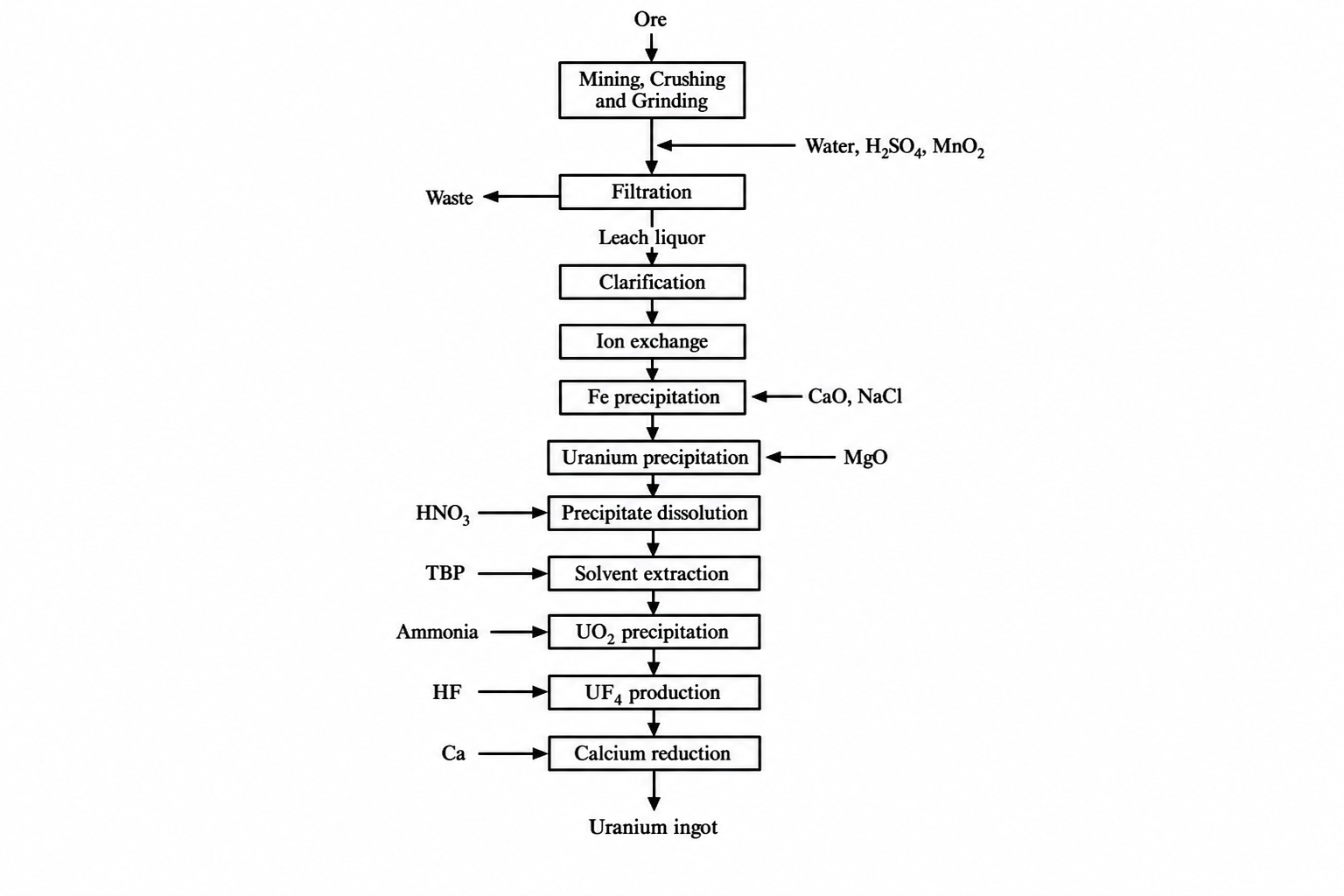 Uranium ore (pitchblende/uraninite) → Crushing & Grinding → Acid leaching (H2SO4) or Alkaline leaching (Na2CO3) → Solid-liquid separation → Solvent extraction / Ion exchange → Precipitation as yellow cake (ammonium diuranate or uranium peroxide) → Calcination to UO3 → Reduction to UO2 (with H2) → Conversion to UF4 (with HF) → Metallothermic reduction with Mg or Ca: UF4 + 2Mg → U + 2MgF2 (Kroll-type process in a sealed bomb reactor) → Uranium metal ingot.
GATE 1991 · Q60
60
High temperature or low partial pressure of CO is essential for stainless steel making. Give reasons.
Solution
In stainless steel making, the key challenge is to remove carbon without oxidizing chromium. The decarburization reaction is: [C] + ½{O2} → {CO}. The Cr oxidation reaction is: 2[Cr] + 3/2{O2} → (Cr2O3). At higher temperatures, the C–CO equilibrium line falls below the Cr–Cr2O3 line, favouring preferential carbon oxidation. Reducing pCO (by vacuum or argon dilution, as in VOD/AOD) also shifts the C–CO equilibrium to favour decarburization at lower temperatures, allowing carbon removal while retaining chromium in the melt.GATE 1991 · Q61
61
Explain the role of frother, collector and activator in flotation of minerals.
Solution
Frother (e.g. pine oil, MIBC): Creates stable froth by reducing surface tension of water. Produces small, uniformly sized air bubbles that can carry mineral particles to the surface. Collector (e.g. xanthates, dithiophosphates): Selectively adsorbs on the surface of the valuable mineral particles, rendering them hydrophobic so they attach to air bubbles and float. The polar end bonds to the mineral while the non-polar hydrocarbon tail faces the water. Activator (e.g. CuSO4 for sphalerite): Modifies the mineral surface to make it receptive to collector adsorption. For example, Cu2+ ions activate ZnS by forming a CuS surface layer that readily adsorbs xanthate collector.GATE 1991 · Q62
62
Name the bonds in sintering of self-fluxed sinter. Why is its reducibility more than that of unfluxed sinter?
Solution
In self-fluxed sinter, the bonds are primarily calcium ferrite (CaO·Fe2O3) bonds, along with some slag (silicate) bonds and diffusion bonds. The reducibility of self-fluxed sinter is higher than unfluxed sinter because: (1) Calcium ferrites are more easily reducible than fayalite (2FeO·SiO2) bonds present in unfluxed sinter. (2) The open porous structure of fluxed sinter provides better gas–solid contact. (3) CaO additions prevent formation of low-melting, difficult-to-reduce fayalite slag.GATE 1990 · Q5
5
True or False: Alumina is the most undesirable constituent in superduty silica bricks.
Solution
Alumina (Al2O3) is the most harmful impurity in silica refractories because it forms a low-melting eutectic with silica, drastically lowering refractoriness and reducing the service life of superduty silica bricks. Answer: TrueGATE 1990 · Q9
9
True or False: Alpha brass is more prone to dezincification in chloride water than beta brass.
Solution
Beta brass (higher Zn content, >35% Zn) is more prone to dezincification than alpha brass because the higher zinc content makes selective dissolution of zinc more favourable. Alpha brass undergoes plug-type dezincification while beta brass undergoes layer-type (more severe). Answer: FalseGATE 1990 · Q19
19
True or False: Wustite reduction is the most important step in the iron blast furnace.
Solution
The reduction of wustite (FeO) to metallic iron is the rate-limiting and most important step in the blast furnace. FeO → Fe is thermodynamically the most difficult reduction step (highest ΔG°) and consumes the most reducing gas. Answer: TrueGATE 1990 · Q25
25
Pyrolusite is a mineral of ______.
Solution
Answer: manganese (Pyrolusite is MnO2)GATE 1990 · Q43
43
Carbon refractories are highly suitable for the ______ of iron blast furnace.
Solution
Answer: hearth (bosh)GATE 1990 · Q50
50
______ minerals exhibit native floatability.
Solution
Answer: Non-wettable (hydrophobic) minerals such as graphite, sulphur, molybdenite, and talcPart B Q3 — Define (Q51–Q56, 2 Marks Each)
GATE 1990 · Q55
55
Define: Degree of liberation of a mineral
Solution
Degree of liberation is the percentage of a valuable mineral that occurs as free (liberated) particles in a crushed or ground ore, as opposed to being locked with gangue in composite particles. A higher degree of liberation means more mineral grains are fully separated from gangue, improving the efficiency of subsequent concentration processes.GATE 1990 · Q64
64
State the optimum conditions required for dephosphorisation of molten steel.
Solution
Optimum conditions for dephosphorisation of molten steel: (1) High basicity slag (high CaO/SiO2 ratio, V-ratio > 2.5) to provide Ca2+ ions for phosphate formation; (2) Oxidising conditions — sufficient FeO in slag (>15%) to oxidise phosphorus from the metal (2P + 5FeO + 4CaO → 4CaO·P2O5 + 5Fe); (3) Low temperature — the reaction is exothermic, so lower bath temperatures favour phosphorus removal; (4) Good slag-metal contact and stirring for kinetic efficiency; (5) Low silica activity in slag so that CaO is available for phosphate rather than being consumed by SiO2.GATE 1990 · Q72
72
Give the temperature profile of gas and solid in an iron blast furnace along its height. Label different zones indicating the chemical reactions taking place therein.
Solution
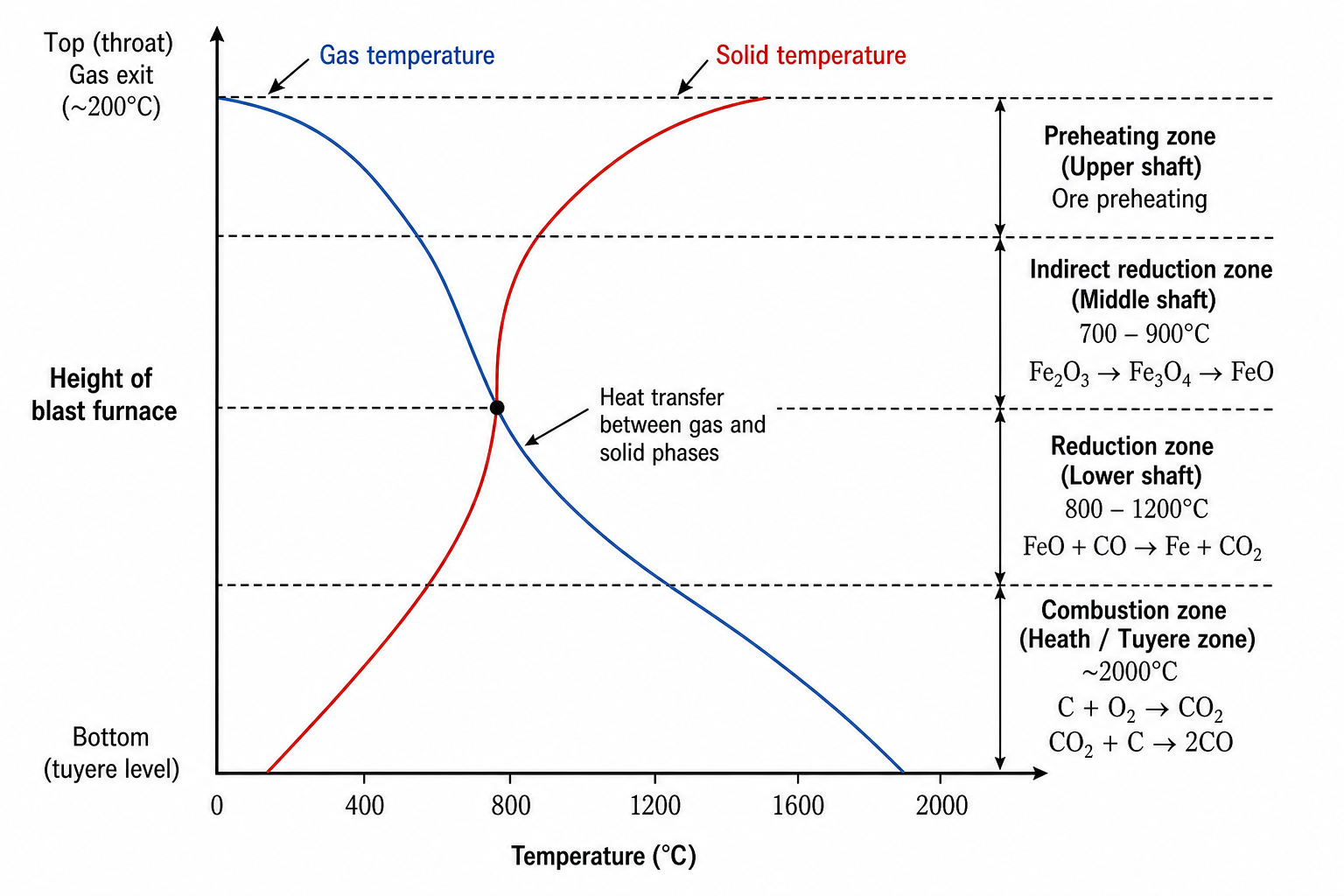 The blast furnace is divided into zones from top to bottom:
1. Preheating zone (top/throat, ~200–500°C): Charge is dried and preheated by ascending gases. Moisture is removed. 3Fe2O3 + CO → 2Fe3O4 + CO2.
2. Reduction zone (stack, ~500–1000°C): Indirect reduction by CO gas: Fe3O4 + CO → 3FeO + CO2; FeO + CO → Fe + CO2. Limestone calcination: CaCO3 → CaO + CO2.
3. Thermal reserve zone (~950–1000°C): Gas and solid temperatures are nearly equal. FeO reduction by CO stalls here.
4. Bosh zone (~1000–1600°C): Direct reduction: FeO + C → Fe + CO. Boudouard reaction: C + CO2 → 2CO. Slag formation begins. Metal melts and drips through coke bed.
5. Combustion/raceway zone (tuyere, ~1800–2100°C): C + O2 → CO2, then CO2 + C → 2CO. Maximum temperature reached.
6. Hearth (~1450–1500°C): Molten iron and slag collect. Final desulphurisation. Gas temperature curve rises sharply from top to tuyere level, while solid temperature lags behind until convergence near the thermal reserve zone.