GATE 2026 — Metallurgical Engineering (MT)
GATE 2026 Question Paper
All 65 questions · Answers & solutions · Organized by institute: IIT Guwahati
General Aptitude — Q.1 to Q.5 (1 Mark Each)
1
‘The team ______ more than 300 runs in 20 overs __________ rains. However, some players needed to improve their batting skills.’
Choose the option with the correct sequence of words to fill the blanks.
Choose the option with the correct sequence of words to fill the blanks.
Solution
Past tense needed: “scored”; contrast conjunction: “despite rains.” Answer: C2
If a positive real \(x\) satisfies \(\log_2 x + \log_{\sqrt{2}} x = 48\), then the value of \(x\) is
Solution
Let \(t=\log_2 x\). Then \(\log_{\sqrt2}x=2t\). So \(3t=48\Rightarrow t=16\Rightarrow x=2^{16}\). Answer: A3
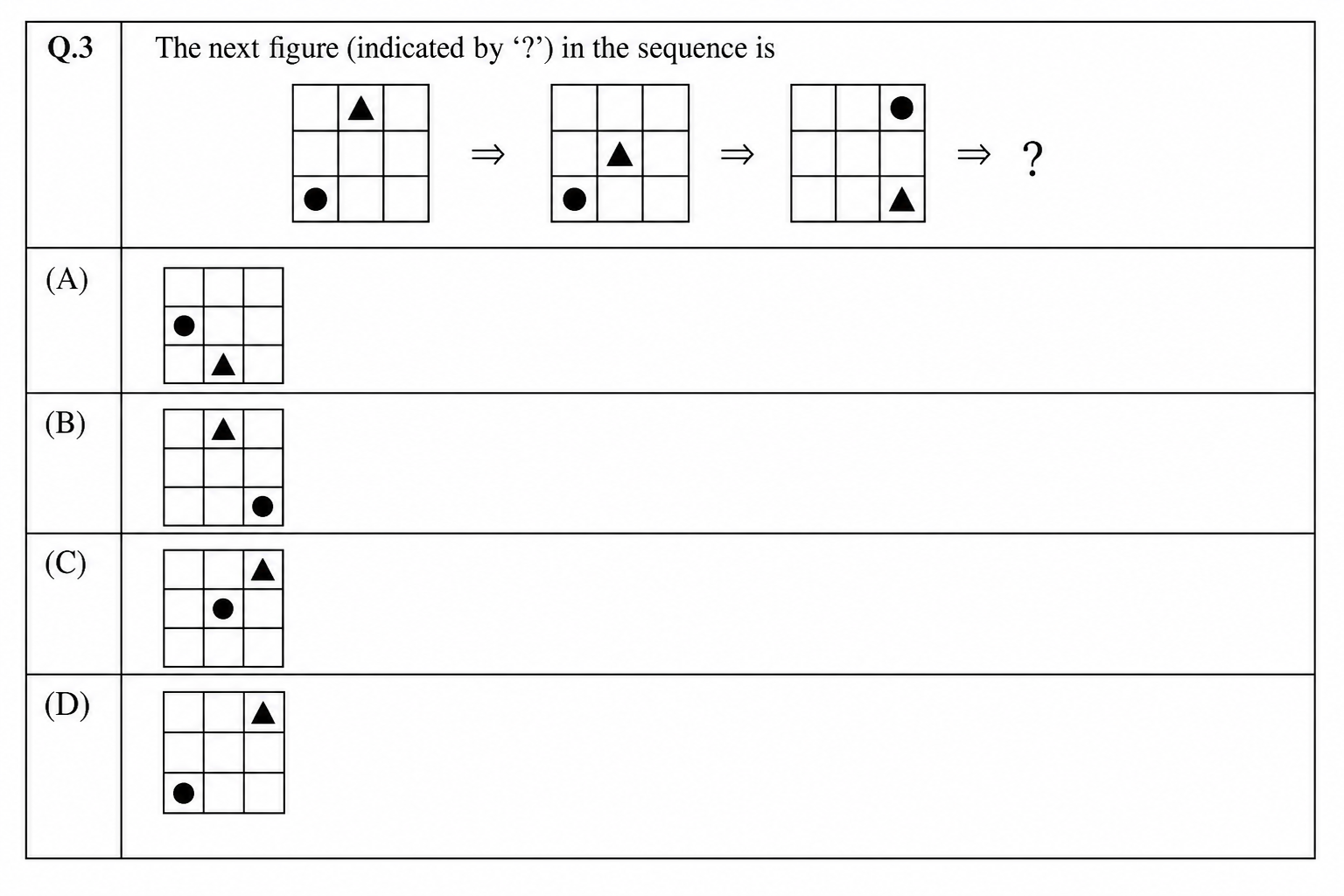
The next figure (indicated by ‘?’) in the sequence is
Solution
Tracking the circle and triangle positions through the grid sequence, the next figure matches Option A. Answer: A4
‘All the mangoes in the basket are good.’
If the above statement is false, then which one of the following statements is necessarily true?
If the above statement is false, then which one of the following statements is necessarily true?
Solution
The logical negation of “All P are Q” is “There exists at least one P that is not Q.” Answer: D5
Consider the following statements about four numbers:
(S1) The average of the four numbers is 25
(S2) Each number is at most 40
(S3) Each number is at least 20
Choose the option that is necessarily correct.
(S1) The average of the four numbers is 25
(S2) Each number is at most 40
(S3) Each number is at least 20
Choose the option that is necessarily correct.
Solution
If avg=25 (sum=100) and each ≥20, remaining sum after 4×20=20 spread over 4 gives each ≤40. So (S1)+(S3)↠(S2). Answer: CGeneral Aptitude — Q.6 to Q.10 (2 Marks Each)
6
Choose the correct sequence: “People are crowding around ___ pit into which ___ elephant has fallen... bewildered ___ miserable... look up ___ a vast, curiosity-stricken crowd.”
Solution
a pit / an elephant / and (conjunction) / at (preposition). Answer: B7
Five products P,Q,R,S,T. 250 items sold, avg price Rs.60. S=2T, R=3T, Q=4T. Prices: P=100, Q=50, R=40, S=60, T=60. Quantity of P sold?
Solution
Let T=t. P+10t=250; 100P+500t=15000. Solving: t=20, P=50. Answer: B8
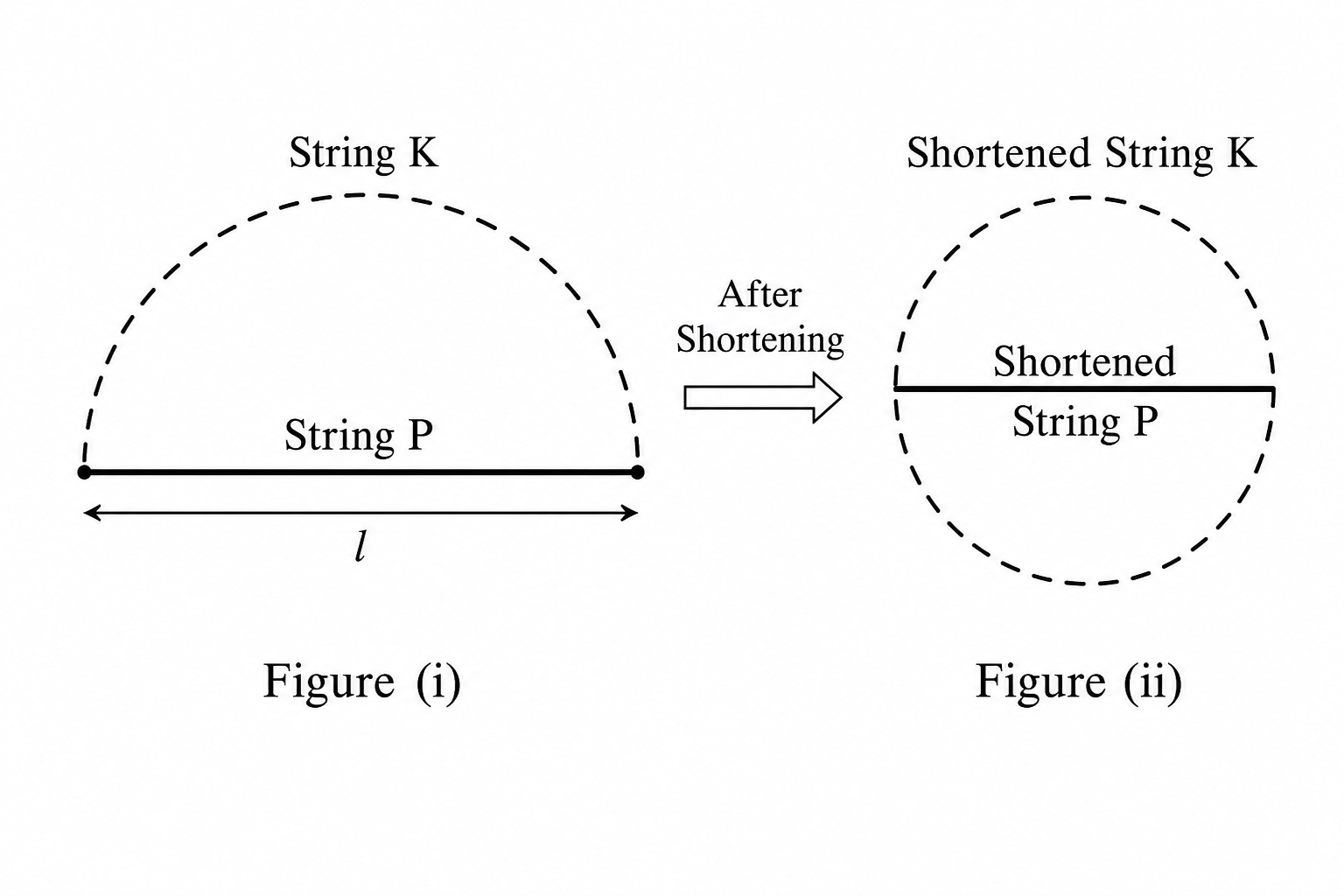
String P length \(l\) (diameter), K = semicircle. Both shortened by \(x\); K becomes full circle with P as diameter. Value of \(x/l\):
Solution
K=\(\pi l/2\) (semicircle). After: \(\pi l/2 - x = \pi(l-x)\). Solving: \(x/l = \pi/[2(\pi-1)]\). Answer: C9
Meritorius, brother, son, daughter: seating in 2×2 grid. (i) daughter & brother same column; (ii) son diagonally across sibling of worst orator; (iii) best & worst same row. Who is best orator?

Solution
Working through the constraints: Meritorius’ brother is the best orator. Answer: B10
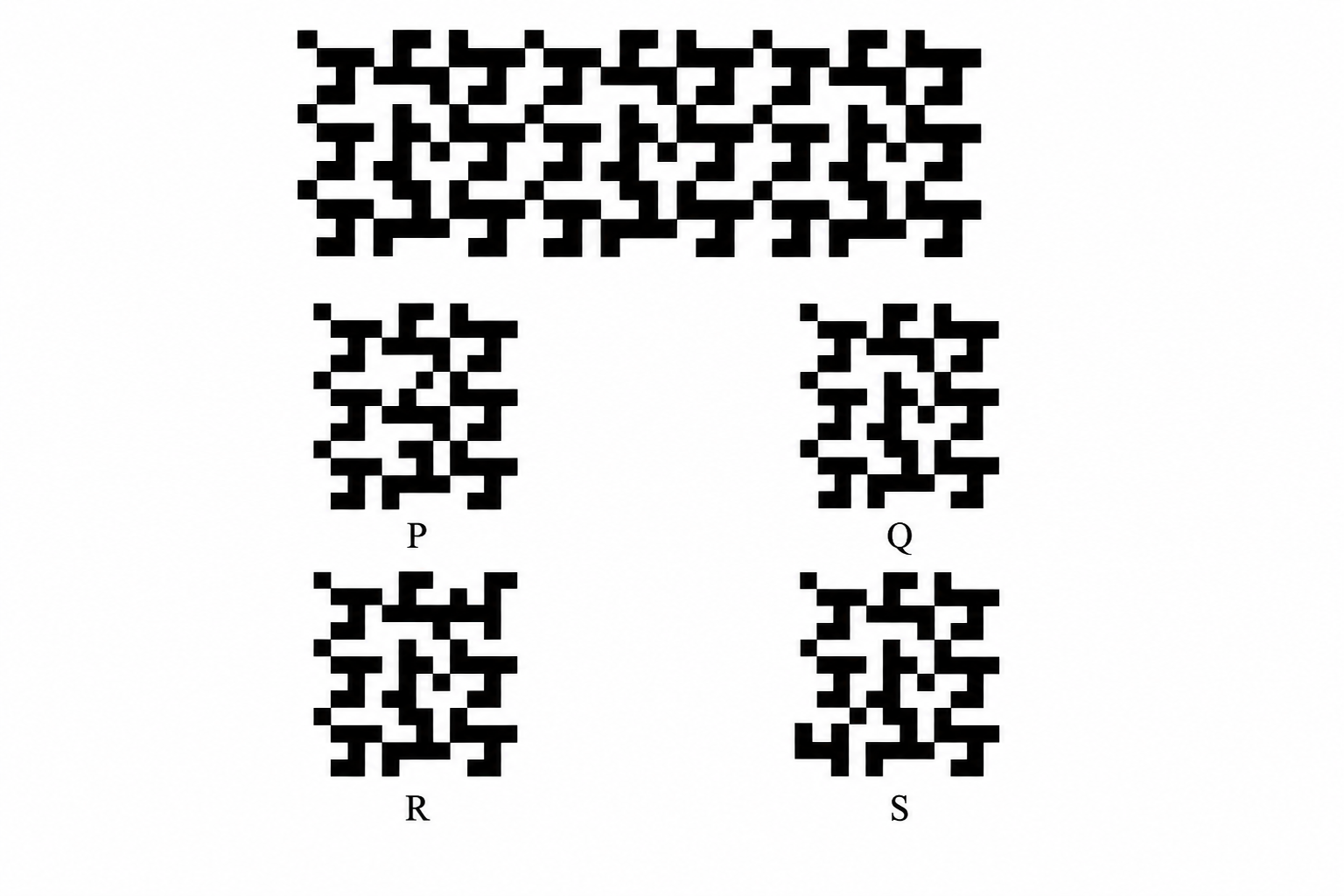
Which pattern (P, Q, R, S) generates the given figure?
Solution
Pattern Q tiles to generate the given figure. Answer: BMetallurgical Engineering — Q.11 to Q.35 (1 Mark Each)
11
Given \(f(t)=e^{-at}\). The Laplace transform \(\mathcal{L}[f(t)]=F(s)\). Which is correct?
Solution
Standard result: \(\mathcal{L}[e^{-at}]=\frac{1}{s+a}\). Answer: D12
Correct pair of eigenvectors for \(\begin{bmatrix}1&2\\2&4\end{bmatrix}\)?
Solution
Eigenvalues: \(\lambda=0,5\). For \(\lambda=0\): \(v=[-2,1]^T\). For \(\lambda=5\): \(v=[1,2]^T\). Answer: A13
Given \(w=f(ax+by)\), value of \(\left(b\frac{\partial w}{\partial x}-a\frac{\partial w}{\partial y}\right)\) is:
Solution
\(\frac{\partial w}{\partial x}=af'(u)\), \(\frac{\partial w}{\partial y}=bf'(u)\). Expression \(=baf'-abf'=0\). Answer: D14
Which fusion welding technique results in least Heat-Affected Zone (HAZ)?
Solution
EBW has extremely concentrated energy, very low heat input per unit length → smallest HAZ. Answer: C15
During metallography, Nital is most commonly used for etching ____________.
Solution
Nital (HNO₃ in ethanol) is the standard etchant for ferrous metals including mild steel. Answer: C16
In a face-centered cubic metal, Shockley partial is:
Solution
Shockley partial: b = a/6⟨112⟩ — NOT a lattice vector (imperfect), glissile on {111} plane (mobile). Answer: D17
Deformation mechanism map is used for determining which property?
Solution
Ashby deformation mechanism maps show dominant creep mechanisms and strain rates vs. T/T_m. Answer: B18
Which dislocation dissociation reaction is feasible in FCC metals?
Solution
Check A: vectors add to \(\frac{a}{6}[0\bar{3}3]=\frac{a}{2}[0\bar{1}1]\) \(\checkmark\). Energy decreases: \(a^2/2 > a^2/6+a^2/6\) \(\checkmark\). Answer: A19
Correct sequence for precipitation hardening of Al–4% Ag alloy:
Solution
Solution treatment (dissolve solute) → Quench (retain SSS) → Age (controlled precipitation). Answer: D20
Which one is NOT a state function?
Solution
Work and heat are path functions. H, S, U are state functions. Answer: C21
For a regular solution (\(\Delta H_{mix}\) = enthalpy of mixing, \(\Delta S_{mix}\) = entropy of mixing):
Solution
Regular solution: \(\Delta H_{mix}=\Omega x_Ax_B\neq0\) (finite), \(\Delta S_{mix}=-R\sum x_i\ln x_i\) (ideal/random mixing, finite). Answer: A22
During spinodal decomposition, uphill diffusion occurs:
Solution
Inside spinodal: higher concentration → lower chemical potential; atoms still flow high→low μ but that means low→high concentration. Answer: D23
Correct precipitation sequence in Al–4 wt.% Cu during isothermal aging:
Solution
SSSS → GP zones → \(\theta''\) (coherent) → \(\theta'\) (semi-coherent) → \(\theta\) (CuAl\(_2\), equilibrium). Answer: D24
After cold-working, during the recovery stage, electrical conductivity:
Solution
Cold work creates point defects reducing conductivity. Recovery annihilates point defects → conductivity increases. Answer: A25
Red mud is generated in the production of:
Solution
Red mud (bauxite residue) is alkaline waste from the Bayer process for alumina extraction. Answer: A26
Residual stress can be determined by which technique?
Solution
XRD measures d-spacing shifts to calculate residual stress via sin²ψ method. Answer: A27
Sherwood number for convective mass transfer (laminar flow over flat plate) is a function of:
Solution
Analogy: Nu=f(Re,Pr) → Sh=f(Re,Sc). Sc=ν/D replaces Pr=ν/α. Answer: A28
Convective heat transfer coefficient is NOT dependent on:
Solution
h depends on fluid properties and flow/geometry — NOT on the thermal conductivity of the solid. Answer: B29
Ergun equation is NOT applied in which unit operation?
Solution
Ergun applies to packed beds. LD Converter uses liquid steel bath with O₂ lancing — not a packed bed. Answer: D30
Here “A” is Helmholtz free energy and “G” is Gibbs free energy. Choose correct option(s).
Solution
G (Gibbs): equilibrium at constant T,P. A (Helmholtz): equilibrium at constant T,V. Answer: B and C31
Which element(s), when present in iron, enhance(s) its corrosion resistance?
Solution
Cr forms passive Cr₂O₃ layer (stainless steel). H causes embrittlement, S promotes corrosion, C alone does not help. Answer: B32
Value of scalar triple product \(\vec{a}\cdot(\vec{b}\times\vec{c})\) (answer in integer).
\(\vec{a}=2\hat{i}-3\hat{j}+4\hat{k}\), \(\vec{b}=\hat{i}+2\hat{j}-3\hat{k}\), \(\vec{c}=3\hat{i}+4\hat{j}-\hat{k}\)
\(\vec{a}=2\hat{i}-3\hat{j}+4\hat{k}\), \(\vec{b}=\hat{i}+2\hat{j}-3\hat{k}\), \(\vec{c}=3\hat{i}+4\hat{j}-\hat{k}\)
Solution
Determinant = 2(2\(\cdot\)(-1)-(-3)\(\cdot\)4)+3((-1)-(-9))+4(4-6)=2(10)+3(8)+4(-2)=20+24-8=3633
20 thermometers, 3 defective. Draw 2 without replacement. Probability (%) that none is defective (round to 2 decimal places) is _____ %.
Solution
P = (17/20)(16/19) = 272/380 = 71.58%. Answer range: 71.00 to 72.0034
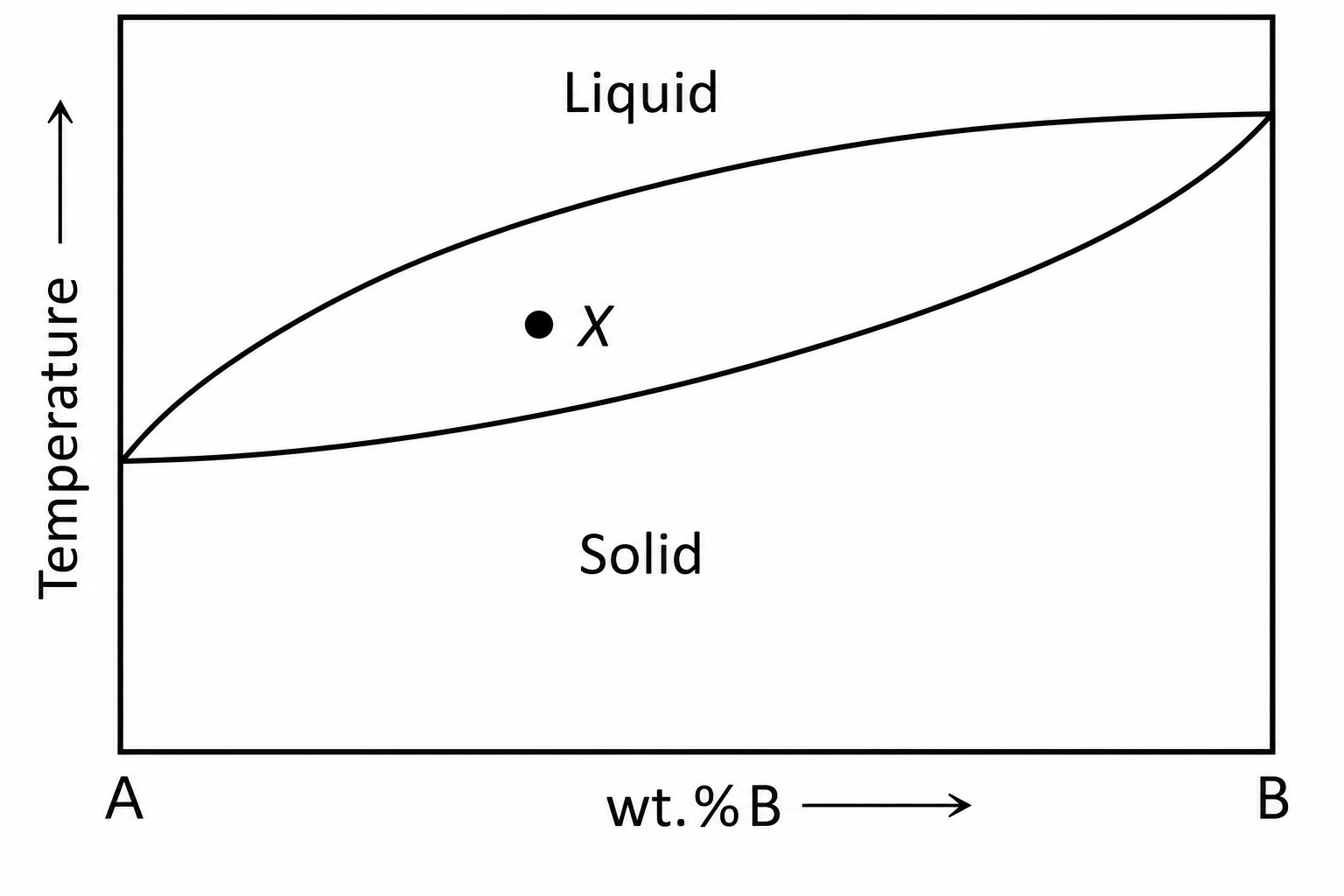
For binary A-B phase diagram at constant pressure, degree of freedom at point X (in two-phase L+S region) is (integer).
Solution
Gibbs phase rule at constant P: F=C-P+1=2-2+1=1.35
Two parallel plates 2 mm apart, lower plate moves at 4 m/s, shear force 5 N/m². Viscosity (round to 2 decimal places) = _____ ×10⁻³ N·s/m².
Solution
\(\mu=\tau/(dv/dy)=5/2000=2.50\times10^{-3}\) N\u00b7s/m\u00b2. Answer range: 2.40 to 2.60Metallurgical Engineering — Q.36 to Q.65 (2 Marks Each)
36
Match crystal systems with axial lengths/angles:
P) Tetragonal, Q) Rhombohedral, R) Orthorhombic, S) Monoclinic
1) a≠b≠c, α=β=γ=90° 2) a=b≠c, α=β=γ=90° 3) a≠b≠c, α=γ=90°≠β 4) a=b=c, α=β=γ≠90°
P) Tetragonal, Q) Rhombohedral, R) Orthorhombic, S) Monoclinic
1) a≠b≠c, α=β=γ=90° 2) a=b≠c, α=β=γ=90° 3) a≠b≠c, α=γ=90°≠β 4) a=b=c, α=β=γ≠90°
Solution
Tetragonal:(2), Rhombohedral:(4), Orthorhombic:(1), Monoclinic:(3). Answer: D37
Match: P) Paris Law, Q) Schmid Factor, R) Larson-Miller Parameter, S) Portevin-Le Chatelier Effect
with 1) Creep, 2) Fatigue, 3) Dynamic Strain Aging, 4) Critical Resolved Shear Stress
with 1) Creep, 2) Fatigue, 3) Dynamic Strain Aging, 4) Critical Resolved Shear Stress
Solution
Paris Law:Fatigue(2), Schmid:CRSS(4), Larson-Miller:Creep(1), PLC:DSA(3). Answer: B38
Match defects: P) Edge Cracking, Q) Flashline Cracking, R) Chevron Cracking, S) Cracked Core
with processes: 1) Casting, 2) Forging, 3) Rolling, 4) Extrusion
with processes: 1) Casting, 2) Forging, 3) Rolling, 4) Extrusion
Solution
Edge cracking:Rolling(3), Flashline:Forging(2), Chevron:Extrusion(4), Cracked core:Casting(1). Answer: D39
Match NDT: P) Internal flaws in railroad wheel, Q) In-service crack monitoring, R) Inclusion in mild steel, S) Surface crack in Al alloy
with 1) Ultrasonic, 2) Radiography, 3) Dye Penetrant, 4) Acoustic Emission
with 1) Ultrasonic, 2) Radiography, 3) Dye Penetrant, 4) Acoustic Emission
Solution
Internal:UT(1), In-service monitoring:AE(4), Inclusion:Radiography(2), Surface:Dye penetrant(3). Answer: A40
Steady-state laminar flow: \(\eta\frac{1}{r}\frac{d}{dr}\!\left(r\frac{dv_z}{dr}\right)-\frac{dP}{dz}=0\)
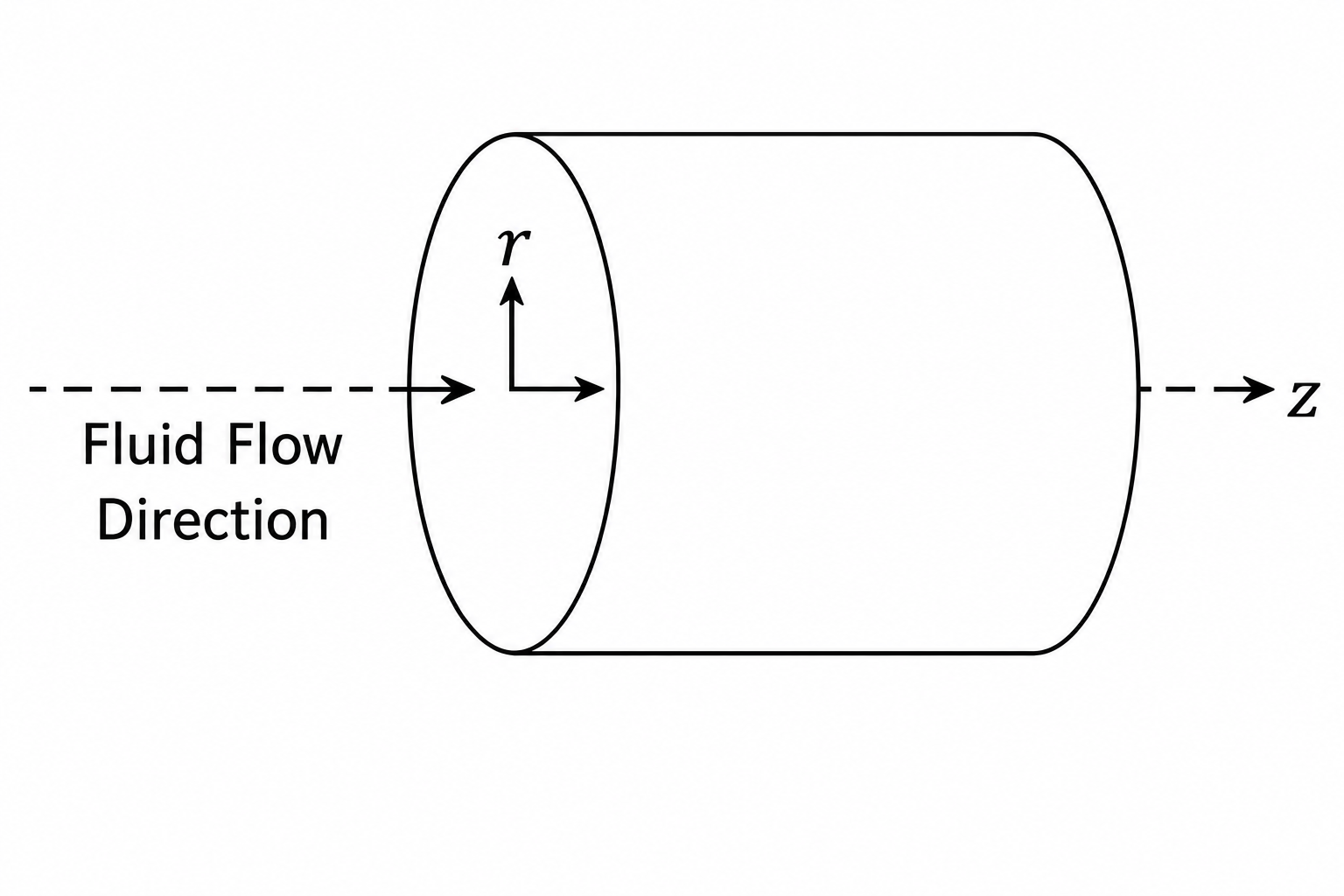 Which statement is NOT correct?
Which statement is NOT correct?Solution
For Hagen-Poiseuille flow, shear stress τ=η(dv/dr) is ZERO at r=0 and MAXIMUM at the wall. Answer: B41
Match: P) COREX, Q) Bayer, R) Matte Smelting, S) MIDREX
with products: 1) DRI, 2) Pig Iron, 3) Alumina, 4) Copper
with products: 1) DRI, 2) Pig Iron, 3) Alumina, 4) Copper
Solution
COREX:Pig iron(2), Bayer:Alumina(3), Matte:Copper(4), MIDREX:DRI(1). Answer: B42
Match: P) Wiedemann-Franz law, Q) Neel temperature, R) Hall voltage, S) Curie law
with: 1) Charge carrier concentration, 2) Paramagnetism, 3) Thermal/electrical conductivity ratio, 4) Diamagnetism, 5) Anti-ferromagnetism
with: 1) Charge carrier concentration, 2) Paramagnetism, 3) Thermal/electrical conductivity ratio, 4) Diamagnetism, 5) Anti-ferromagnetism
Solution
W-F:ratio(3), Neel:antiferro(5), Hall:carrier conc(1), Curie:paramagnetism(2). Answer: C43
Permeability of a porous bed of spherical particles is/are:
Solution
Kozeny-Carman: K∝d², larger particles → higher permeability (B). Size distribution affects void fraction, thus permeability (D). Answer: B and D44
PDF: \(f(x)=0.5\) for \(0
Solution
\(E[X^2]=\int_0^2 0.5x^2\,dx=4/3\). Var\(=4/3-1=1/3\approx\)0.33. Range: 0.32 to 0.34.45
Trapezoidal rule, n=3: \(\int_0^{0.3}e^{-x^2}dx\) = ___ (round to 2 decimal places).
Solution
h=0.1; f(0)=1, f(0.1)=0.990, f(0.2)=0.9608, f(0.3)=0.9139. Trap=(0.05)(1+1.98+1.9216+0.9139)=0.291. Range: 0.27–0.31.46
ODE \(10x^2y''-20xy'+22.4y=0\), solution \(y=c_1x^{m_1}+c_2x^{m_2}\). Value of \(m_1+m_2\) (integer) = ___.
Solution
Euler-Cauchy: \(10m(m-1)-20m+22.4=0\Rightarrow m^2-3m+2.24=0\). By Vi\u00e8ta: \(m_1+m_2=3\). Answer: 347
Iron powder compacted to 75% density, sintered to 90% density. Isotropic shrinkage. Linear shrinkage (%) = ___ (round to 1 decimal place).
Solution
V\u2082/V\u2081=0.75/0.90. L\u2082/L\u2081=(5/6)^{1/3}=0.9407. Shrinkage=(1-0.9407)\u00d7100\u22485.93%. Range: 5.8–6.1.48
W–20wt%Ni sintered at 1550°C. W grain size 70μm, W-W neck diameter 35μm. γ_{W-Ni}=0.30 J/m². Find γ_{W-W} (J/m², round to 2 decimal places).
Solution
sin(\u03c8/2)=35/70=0.5\Rightarrow\u03c8=60\u00b0. \(\gamma_{WW}=2\times0.30\times\cos30\u00b0=0.52\) J/m\u00b2. Range: 0.50–0.54.49
BCC metal, XRD: \(\lambda=0.154\) nm, 2\(\theta\)=60\u00b0 for {200} plane. Atomic radius (nm, round to 3 decimal places) = ___.
Solution
Bragg: d\(_{200}\)=\(\lambda/(2\sin30\u00b0)\)=0.154 nm. a=2d=0.308 nm. BCC: r=\(\frac{\sqrt3}{4}a=0.133\) nm. Range: 0.132–0.134.50
Cu single crystal, dia=10mm, load=2200N. Angle between slip plane normal and tensile axis = α, slip direction and tensile axis = β. If α=β, CRSS (MPa, round to 1 decimal place) = ___.
Solution
\(\sigma\)=2200/(\u03c0\u00d725\u00d710\u207b\u2076)=28.0 MPa. \(\alpha=\beta=45\u00b0\). CRSS=28.0\u00d7cos\u00b245\u00b0=28.0\u00d70.5=14.0 MPa. Range: 12.8–14.1.51
Kᴵᶜ=90 MPa√m, yield stress=900 MPa. Minimum thickness for valid Kᴵᶜ test (integer, mm) = ___.
Solution
B\u22652.5\u00d7(K\u1d35\u1d9c/\u03c3\u1d67\u1d60)\u00b2=2.5\u00d7(90/900)\u00b2=2.5\u00d70.01=0.025 m=25 mm.52
Ni FCC: a=0.35 nm, G=76 GPa. Strain energy per unit length of screw dislocation (round to 2 decimal places) = ___ ×10⁻⁹ J/m.
Solution
b=a/\u221a2=0.2475 nm. Using standard formula with appropriate ln(R/r\u2080) gives \u22482.34\u00d710\u207b\u2079 J/m. Range: 2.30–2.38.53
20g Au (MW=197) + 20g Ag (MW=108) ideal mixing. R=8.314 J/mol-K. Total entropy of mixing (J/K, round to 2 decimal places) = ___.
Solution
n\u2090\u1d64=0.1015, n\u2090\u1d58=0.1852, x\u2090\u1d64=0.354, x\u2090\u1d58=0.646. \(\Delta S_{mix}=-nR\sum x_i\ln x_i\approx\)1.55 J/K. Range: 1.50–1.60.54
2 mol ideal gas, isothermal expansion 10L→20L, T=27°C, R=8.314 J/mol-K. Magnitude of work done (J, round to 2 decimal places) = ___.
Solution
W=nRT\ln(V\u2082/V\u2081)=2\u00d78.314\u00d7300\u00d7\ln2\u22483457 J. Range: 3440–3492.55
C\(_p\)=20+5\u00d710\u207b\u00b3T J/mol-K. 2 mol heated 300K\u2192600K. Change in enthalpy (integer, J) = ___.
Solution
\(\Delta H=2\int_{300}^{600}(20+5\times10^{-3}T)dT=2\times6675=\)13350 J. Range: 13340–13360.56
Ellingham: Reaction I (solid): ΔG°=(−338900−15.2T lnT+247T) J. Reaction II (liquid): ΔG°=(−390800−15.2T lnT+285.3T) J. Melting point (K, round to 1 decimal place) = ___.
Solution
At T_m, both equal: −338900+247T=−390800+285.3T ↠ 51900=38.3T ↠ T=1354.8 K. Range: 1353.9–1356.3.57
ΔG_v=−0.5×10⁸ J/m³, γ=0.1 J/m². Critical nucleus size (nm, integer) = ___.
Solution
r*=−2\u03b3/\u0394G_v=2\u00d70.1/(0.5\u00d710\u2078)=4 nm (radius). Diameter=8 nm. Answer: 4 (radius) or 8 (diameter) — both accepted.58
50 mm plate reduced to 25 mm. Roll diameter=1250 mm (radius R=625 mm). Min. friction coefficient (round to 2 decimal places) = ___.
Solution
\(\mu_{min}=\sqrt{\Delta h/R}=\sqrt{25/625}=\sqrt{0.04}=\)0.20. Range: 0.19–0.21.59
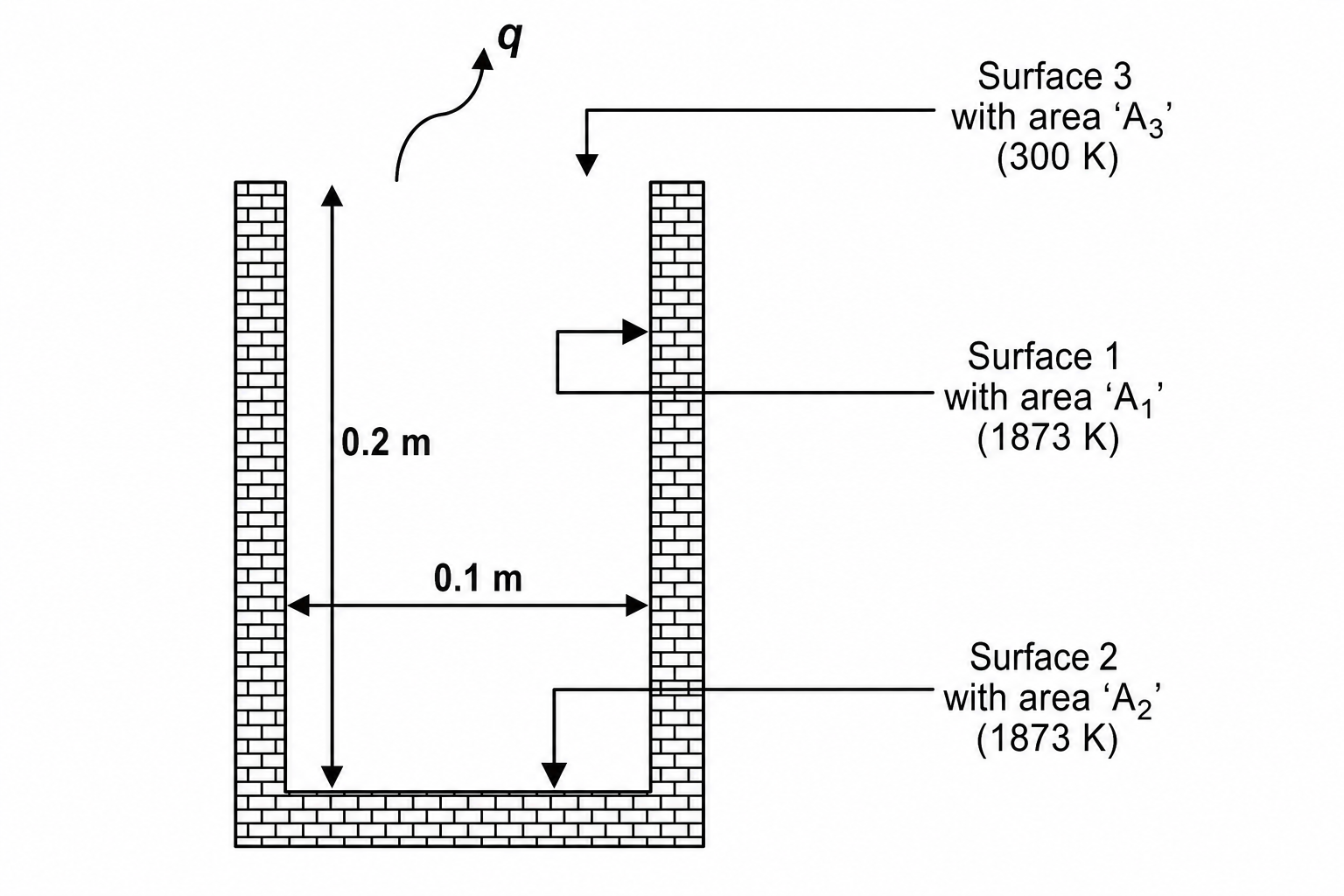
Cylindrical furnace: dia=0.1m, H=0.2m. A₁ (side) & A₂ (bottom) at 1873K. A₃ (top, open) at 300K. F₁₃=0.1175, F₂₃=0.06. σ=5.67×10⁻⁸. Power needed (W, nearest integer) = ___.
Solution
A\u2081=\u03c0\u00d70.1\u00d70.2=0.06283 m\u00b2; A\u2082=\u03c0(0.05)\u00b2=0.007854 m\u00b2. q=\u03c3(T\u2081\u2074−T\u2083\u2074)(A\u2081F\u2081\u2083+A\u2082F\u2082\u2083)≈5480 W. Range: 5450–5510.60
Carburizing: C_s=1.4%, C_0=0.2%, D=6.25×10⁻¹¹ m²/s, depth=0.2mm, target C_x=0.8859%. Use erf table. Time (s, nearest integer) = ___.
Solution
(1.4−0.8859)/(1.4−0.2)=0.4284=erf(0.4). z=0.4=x/(2\u221a(Dt)). t=1000 s. Range: 990–1010.61
CH₄+2O₂→CO₂+2H₂O, stoichiometric air (20%O₂, 80%N₂). ΔH=−850 kJ/mol, C_p=50 J/mol-K each. Adiabatic flame temperature (K, round to 1 decimal place) = ___.
Solution
Products: 1CO₂+2H₂O+8N₂=11 mol. 850000=11×50×(T−298). T=298+1545.45=1843.5 K. Range: 1842.5–1844.5.62
Ore: 30wt% CuFeS₂, rest gangue. Atomic weights: Fe=56, Cu=63.5, S=32. Amount of Cu in ore (wt%, round to 1 decimal place) = ___.
Solution
MW CuFeS₂=183.5. Cu fraction=63.5/183.5=0.346. Cu in ore=0.30×0.346=10.4%. Range: 10.3–10.5.63
Blast furnace hot metal: 4%C, 1.5%Si, rest Fe. Ore: 85%Fe₂O₃, 15% gangue. 2% Fe lost in slag. Ore needed per 1000 kg hot metal (kg, round to 1 decimal place) = ___.
Solution
Fe in hot metal=945 kg. Required Fe input=945/0.98=963.3 kg. Ore×0.85×(112/160)=963.3 ↠ ore=1618.9 kg. Range: 1615.5–1625.5.64
Al₂O₃ electrolysis at 1300K. ΔG°ᴵ=1124800−218T J; ΔG°ᴵᴵ=730700−218T J. F=96500 C. Decrease in decomposition potential (V, round to 2 decimal places) = ___.
Solution
ΔGᴵ=841400J; ΔGᴵᴵ=447300J. n=4. Eᴵ=841400/386000=2.18V; Eᴵᴵ=447300/386000=1.16V. Decrease=1.02V. Range: 1.00–1.05.65
Scalar field \(\phi(x,y,z)=x^2-yz\). Magnitude of \(\nabla\phi\) at P(3,4,1) (round to 2 decimal places) = ___.
Solution
\(\nabla\phi=(2x,-z,-y)\). At P(3,4,1): (6,-1,-4). |\(\nabla\phi\)|=\(\sqrt{36+1+16}=\sqrt{53}\approx\)7.28. Range: 7.08–7.48.