All 65 questions in original order · Answers & detailed solutions included
65
Questions
0
Attempted
0
Correct
0
Score
GATE 2025 — Metallurgical Engineering (MT)
65 Questions · 100 Marks
Score: 0 / 100
General Aptitude — Q.1 to Q.5 (1 Mark Each)
1
Despite his initial hesitation, Rehman's ______ to contribute to the success of the project never wavered.
MCQ1M
A
ambivalence
B
satisfaction
C
resolve
D
revolve
Solution
“Resolve” means firm determination, matching “never wavered.” Answer: C
2
Bird : Nest :: Bee : ?
MCQ1M
A
Kennel
B
Hammock
C
Hive
D
Lair
Solution
Birds live in nests; bees live in hives. Answer: C
3
If \(P e^x = Q e^{-x}\) for all real values of \(x\), which one of the following statements is true?
MCQ1M
A
\(P = Q = 0\)
B
\(P = Q = 1\)
C
\(P = 1;\ Q = -1\)
D
\(P/Q = 0\)
Solution
At \(x=0\): \(P=Q\). As \(x\to\infty\), \(Pe^x\) grows while \(Qe^{-x}\) decays, so equality holds only if \(P=Q=0\). Answer: A
4
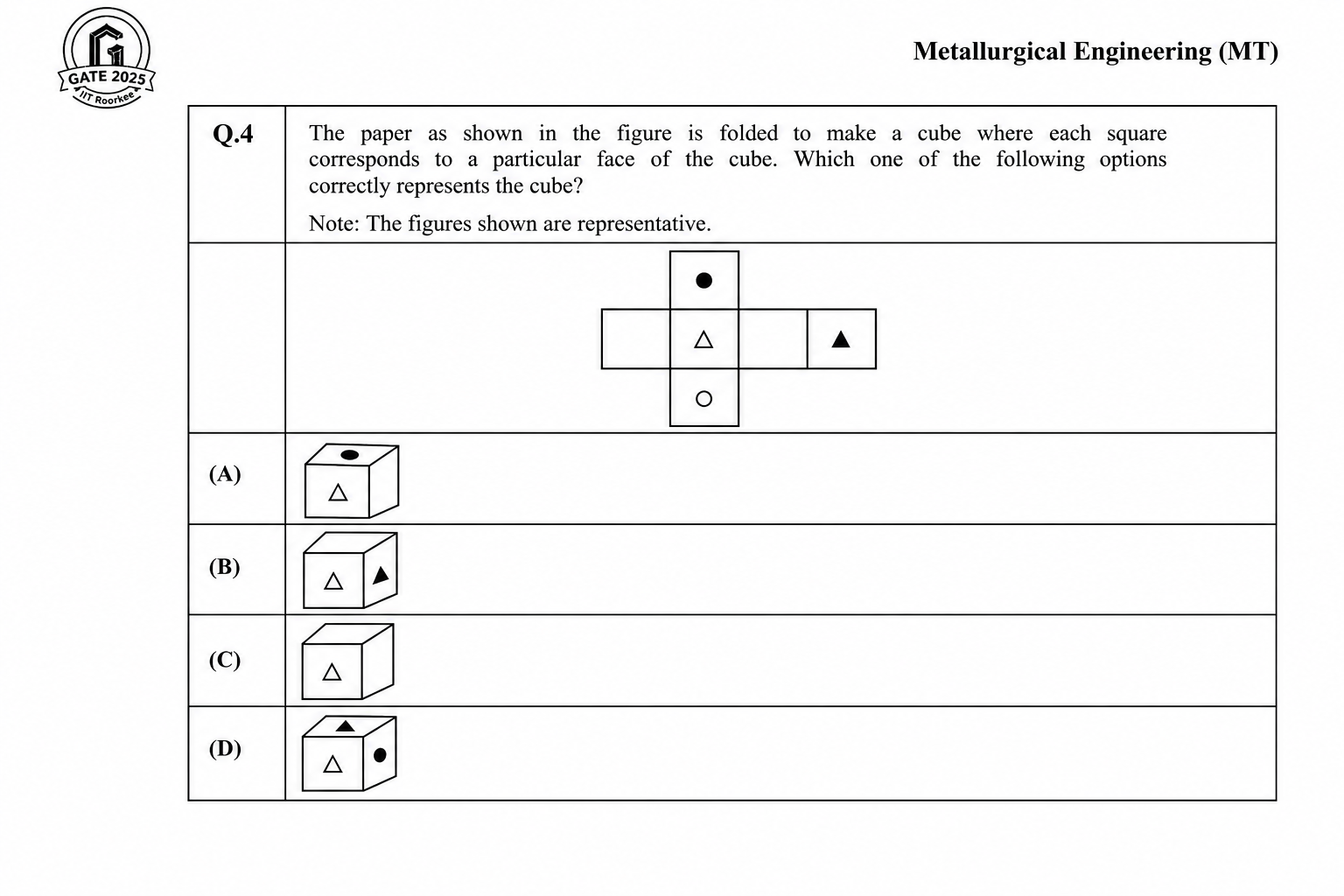
The paper as shown in the figure is folded to make a cube where each square corresponds to a particular face of the cube. Which one of the following options correctly represents the cube?
MCQ1M
A
Option A (see figure)
B
Option B (see figure)
C
Option C (see figure)
D
Option D (see figure)
Solution
Visualizing the fold: the dot face is on top, triangle on front, circle on bottom. Option A correctly represents this arrangement. Answer: A
5
Let \(p_1\) and \(p_2\) denote two arbitrary prime numbers. Which one of the following statements is correct for all values of \(p_1\) and \(p_2\)?
MCQ1M
A
\(p_1 + p_2\) is not a prime number.
B
\(p_1 p_2\) is not a prime number.
C
\(p_1 + p_2 + 1\) is a prime number.
D
\(p_1 p_2 + 1\) is a prime number.
Solution
The product of two primes is always composite (has at least 3 divisors: 1, \(p_1\), \(p_2\), and \(p_1p_2\)). Answer: B
General Aptitude — Q.6 to Q.10 (2 Marks Each)
6
“Even if I had known that you were in the hospital, I would not have gone there to see you,” Ramya told Josephine. Based on this conversation, identify the logically correct inference.
MCQ2M
A
Ramya knew that Josephine was in the hospital.
B
Ramya did not know that Josephine was in the hospital.
C
Ramya and Josephine were once close friends; but now, they are not.
D
Josephine was in the hospital due to an injury to her leg.
Solution
“Even if I had known” is a counterfactual conditional, implying Ramya did not know about the hospitalization. Answer: B
7
Select the correct option to complete the analogy. Komal : Fresh :: Five : ?
MCQ2M
A
Ten
B
Six
C
Three
D
Four
Solution
Komal (Hindi for “soft/fresh”) has 5 letters; Fresh has 5 letters — both relate to the number 5. Five doubled is Ten. Answer: A
8
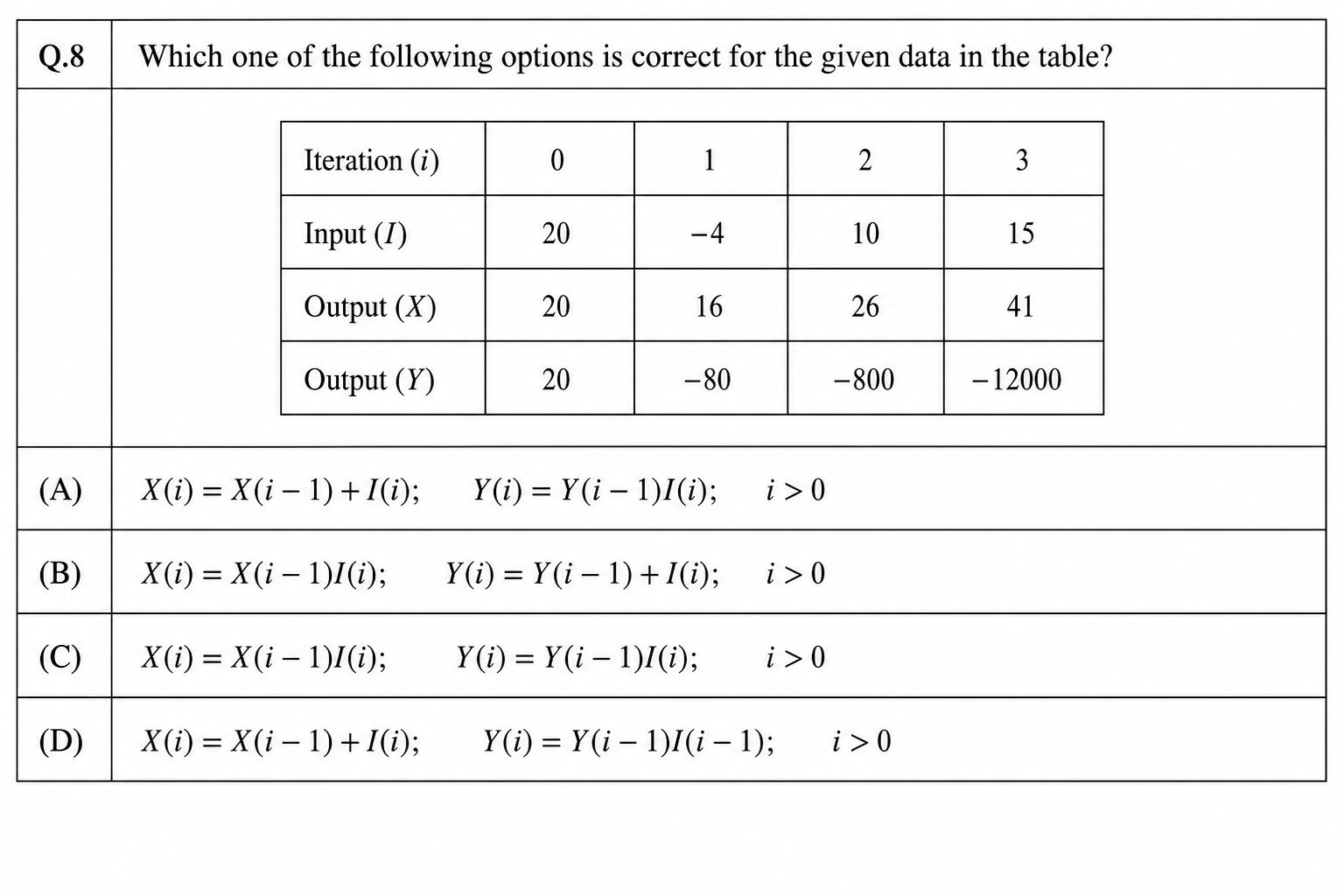
Which one of the following options is correct for the given data in the table?
MCQ2M
A
\(X(i)=X(i-1)+I(i);\ Y(i)=Y(i-1)I(i);\ i>0\)
B
\(X(i)=X(i-1)I(i);\ Y(i)=Y(i-1)+I(i);\ i>0\)
C
\(X(i)=X(i-1)I(i);\ Y(i)=Y(i-1)I(i);\ i>0\)
D
\(X(i)=X(i-1)+I(i);\ Y(i)=Y(i-1)+I(i-1);\ i>0\)
Solution
From the table: X increases by adding I (cumulative sum), Y is multiplied by I at each step. So \(X(i)=X(i-1)+I(i)\) and \(Y(i)=Y(i-1)\cdot I(i)\). Answer: A
9
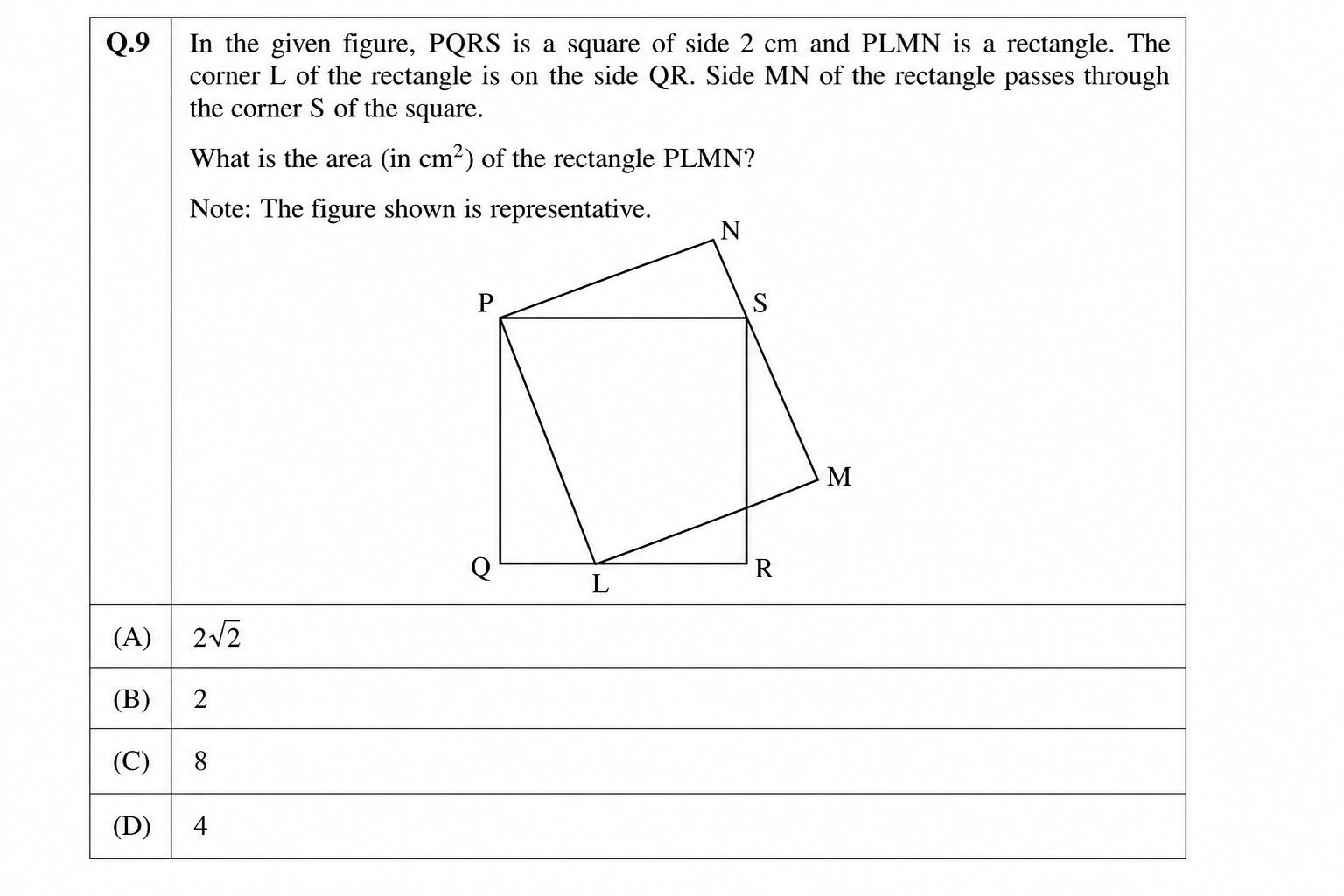
In the given figure, PQRS is a square of side 2 cm and PLMN is a rectangle. The corner L of the rectangle is on the side QR. Side MN of the rectangle passes through the corner S of the square. What is the area (in cm²) of the rectangle PLMN?
MCQ2M
A
\(2\sqrt{2}\)
B
2
C
8
D
4
Solution
Using geometric relationships for the tilted rectangle inscribed in the square of side 2 cm, the area works out to 8 cm². Answer: C
10
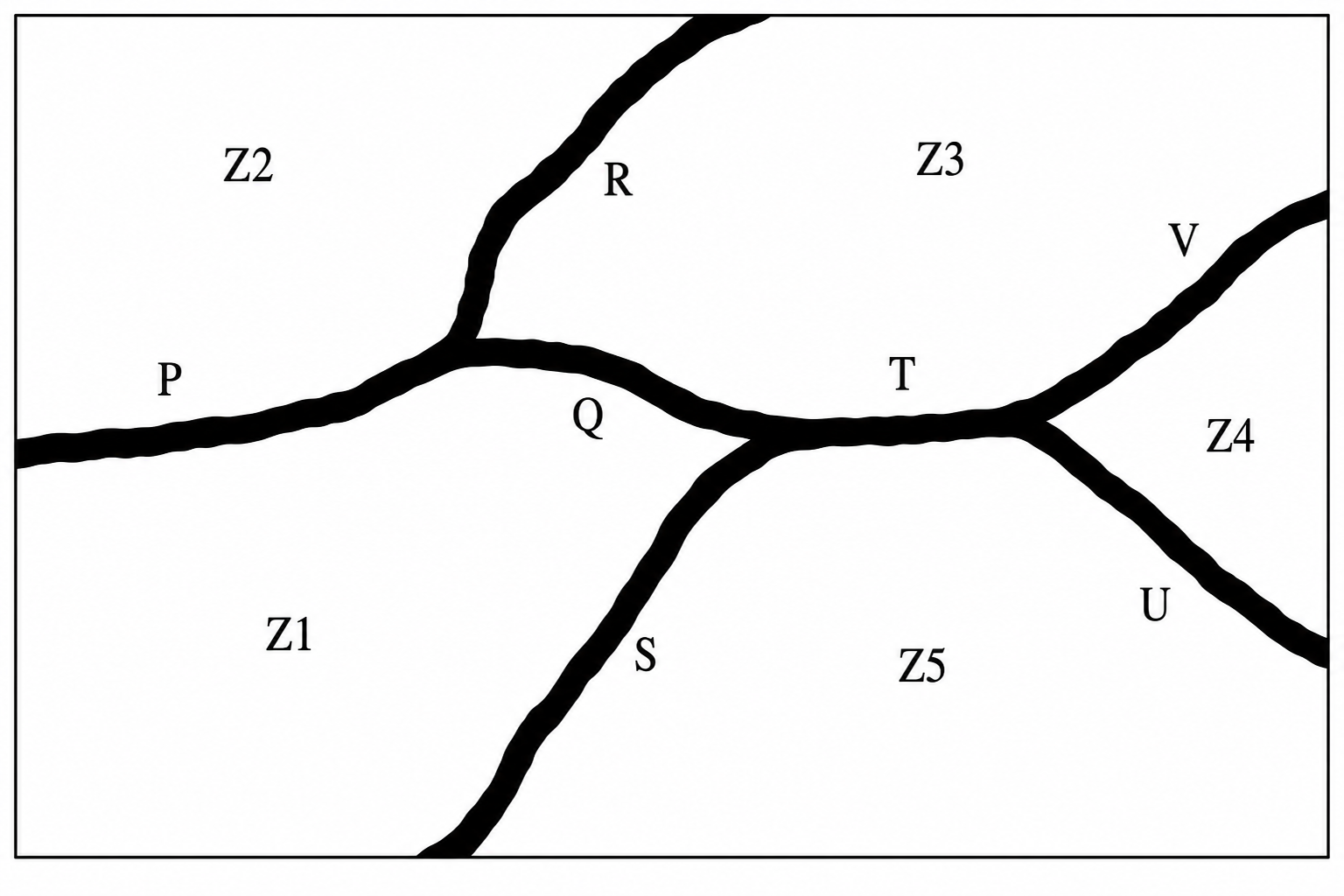
The diagram below shows a river system with 7 segments (P, Q, R, S, T, U, V) splitting land into 5 zones (Z1–Z5). We need to connect these zones using the least number of bridges. Which option is correct?
MCQ2M
A
Bridges on P, Q, and T
B
Bridges on P, Q, S, and T
C
Bridges on Q, S, and V
D
Bridges on P, Q, S, U, and V
Solution
Analyzing the river graph, 3 bridges on Q, S, and V are sufficient to connect all 5 zones while minimizing crossings. Answer: C
MT Core — Q.11 to Q.35 (1 Mark Each)
11
Which one of the following matrices has eigenvalues 1 and 6?
MCQ1M
A
\(\begin{pmatrix}5&-2\\-2&2\end{pmatrix}\)
B
\(\begin{pmatrix}3&-1\\-2&2\end{pmatrix}\)
C
\(\begin{pmatrix}3&-1\\-1&2\end{pmatrix}\)
D
\(\begin{pmatrix}2&-1\\-1&3\end{pmatrix}\)
Solution
For \(\begin{pmatrix}5&-2\\-2&2\end{pmatrix}\): trace=7=1+6 ✓; det=10−4=6=1×6 ✓. Characteristic equation: \(\lambda^2-7\lambda+6=0\Rightarrow\lambda=1,6\). Answer: A
12
For an isobaric process, the heat transferred is equal to the change in ______ of the system.
MCQ1M
A
enthalpy
B
entropy
C
Helmholtz free energy
D
Gibbs free energy
Solution
At constant pressure: \(q_P = \Delta U + P\Delta V = \Delta H\). Answer: A
13
Match each crystal defect in Column I with the corresponding type in Column II.
Column I: P. Edge dislocation Q. Stacking fault R. Frenkel defect S. Porosity Column II: 1. Zero-dimensional 2. One-dimensional 3. Two-dimensional 4. Three-dimensional
MCQ1M
A
P–3, Q–4, R–2, S–1
B
P–3, Q–4, R–1, S–2
C
P–2, Q–3, R–1, S–4
D
P–2, Q–4, R–3, S–1
Solution
Edge dislocation = line (1D); Stacking fault = planar (2D); Frenkel defect = point (0D); Porosity = volume (3D). Answer: C
14
At high temperatures, which one of the following empirical expressions correctly describes the variation of dynamic viscosity \(\mu\) of a Newtonian liquid with absolute temperature \(T\)? (A and B are positive constants.)
MCQ1M
A
\(\mu = A + BT\)
B
\(\mu = A\exp(-B/T)\)
C
\(\mu = A\exp(BT)\)
D
\(\mu = A\exp(B/T)\)
Solution
Arrhenius/Eyring form: \(\mu=A\exp(E/RT)\). Higher \(T\) decreases the exponent, reducing viscosity — correct behaviour for liquids. Answer: D
15
Which one of the following is an intensive property?
MCQ1M
A
Chemical potential
B
Volume
C
Mass
D
Entropy
Solution
Chemical potential is independent of system size (intensive). Volume, mass, and entropy all scale with amount (extensive). Answer: A
16
Hot metal from a blast furnace is treated with mill scale prior to oxygen steelmaking for ______.
MCQ1M
A
dephosphorization
B
decarburization
C
desulphurization
D
desiliconization
Solution
Mill scale (FeO) oxidizes Si preferentially: \(\text{Si}+2\text{FeO}\rightarrow 2\text{Fe}+\text{SiO}_2\). This is desiliconization. Answer: D
17
In optical microscopy, which one of the following combinations of wavelength (\(\lambda\)) and numerical aperture (NA) provides the best spatial resolution?
MCQ1M
A
\(\lambda=400\) nm, NA = 1.0
B
\(\lambda=600\) nm, NA = 1.2
C
\(\lambda=400\) nm, NA = 1.2
D
\(\lambda=600\) nm, NA = 1.0
Solution
Abbe’s law: \(d=0.61\lambda/\text{NA}\). Smallest \(d\) at \(\lambda=400\) nm, NA=1.2: \(d\approx203\) nm (best). Answer: C
18
The coordination number for an octahedral site in pure copper is ______.
MCQ1M
A
4
B
6
C
8
D
12
Solution
Cu is FCC. Octahedral interstitial sites in FCC are surrounded by 6 nearest atoms (vertices of an octahedron). Answer: B
19
Consider the gas-phase reaction \(2\text{SO}_2+\text{O}_2\rightleftharpoons 2\text{SO}_3\). If the enthalpy of reaction is negative, which condition promotes higher equilibrium concentration of SO\(_3\)?
MCQ1M
A
Higher pressure and higher temperature
B
Higher pressure and lower temperature
C
Lower pressure and higher temperature
D
Lower pressure and lower temperature
Solution
Forward reaction: fewer moles (3→2), so higher pressure favours SO\(_3\). Exothermic, so lower temperature favours forward. Answer: B
20
Which one of the following slag components is responsible for the oxidizing power of steelmaking slags?
MCQ1M
A
SiO\(_2\)
B
CaO
C
MgO
D
FeO
Solution
FeO transfers oxygen to dissolved impurities (\(\text{FeO}+[\text{C}]\rightarrow\text{Fe}+\text{CO}\)), providing oxidizing power. CaO/MgO only adjust basicity. Answer: D
21
Two randomly oriented polycrystalline copper samples: Sample A (grain size 10 µm) and Sample B (grain size 100 µm). \(E_A\), \(E_B\) = Young’s moduli; \(\text{YS}_A\), \(\text{YS}_B\) = yield strengths. Which statement is CORRECT?
MCQ1M
A
\(E_A>E_B\) and \(\text{YS}_A>\text{YS}_B\)
B
\(E_A=E_B\) and \(\text{YS}_A<\text{YS}_B\)
C
\(E_A>E_B\) and \(\text{YS}_A=\text{YS}_B\)
D
\(E_A=E_B\) and \(\text{YS}_A>\text{YS}_B\)
Solution
Young’s modulus is microstructure-independent (\(E_A=E_B\)). Hall–Petch: \(\sigma_y=\sigma_0+kd^{-1/2}\); finer grains (A) give higher yield strength. Answer: D
22
In metal casting, which one of the following gating ratios (sprue : runner : gate area ratio) represents a non-pressurized gating system?
MCQ1M
A
1 : 2 : 3
B
3 : 2 : 1
C
4 : 3 : 1
D
5 : 4 : 1
Solution
Non-pressurized system: gate area > sprue area (1:2:3 → expanding). Pressurized systems have gate < sprue (constricting). Answer: A
23
In the Fe–C system, the invariant reaction \(\text{Liquid}+\delta\rightleftharpoons\gamma\) takes place at 1493°C. This type of reaction is called ______.
MCQ1M
A
eutectic
B
eutectoid
C
peritectic
D
monotectic
Solution
Liquid + solid → new solid = peritectic reaction. At 1493°C: L + δ → γ. Answer: C
24
Match the elements in Column I with their respective ores in Column II.
Column I: P. Al Q. Fe R. Ti S. Cu Column II: 1. Rutile 2. Hematite 3. Chalcopyrite 4. Bauxite
MCQ1M
A
P–4, Q–2, R–3, S–1
B
P–2, Q–4, R–1, S–3
C
P–3, Q–1, R–4, S–2
D
P–4, Q–2, R–1, S–3
Solution
Al→Bauxite(4), Fe→Hematite(2), Ti→Rutile(1), Cu→Chalcopyrite(3). Answer: D
25
Which of the following functions is/are expandable using Maclaurin series? (A) \(\ln(1+z)\) (B) \(\ln z\) (C) \(1/z^2\) (D) \(\exp(z)\)
MSQ1M
A
\(\ln(1+z)\)
B
\(\ln z\)
C
\(1/z^2\)
D
\(\exp(z)\)
Solution
Maclaurin series requires analyticity at \(z=0\). \(\ln(1+z)\) and \(\exp(z)\) are analytic at 0. \(\ln z\) and \(1/z^2\) have singularities at 0. Answer: A, D
26
With reference to edge and screw dislocations, which of the following statements is/are CORRECT?
MSQ1M
A
Both edge and screw dislocations can leave the slip plane by climb.
B
Burgers vector of a screw dislocation is parallel to its line vector.
C
Both edge and screw dislocations can leave the slip plane by cross-slip.
D
Strain energy per unit length of an edge dislocation is higher than that of a screw dislocation.
Solution
B: Screw dislocation — Burgers vector ∥ line vector ✓. D: Edge dislocations store more energy (factor \(1/(1-\nu)\) higher than screw) ✓. Only edge can climb; only screw can cross-slip. Answer: B, D
27
Which of the following conditions is/are favorable for producing low-silicon hot metal in blast furnace ironmaking?
MSQ1M
A
Reduced raceway adiabatic flame temperature
B
Oxygen-enriched blast
C
Lime injection through tuyeres
D
Increased hearth temperature
Solution
A: Lower flame temp reduces SiO\(_2\) reduction ✓. C: Lime captures silica as CaSiO\(_3\) ✓. O\(_2\)-enriched blast and higher hearth temp both increase Si pickup. Answer: A, C
28
Which of the following statements is/are CORRECT with respect to the initial stage of GP zone formation in a precipitation-hardenable Al–4.5 wt.% Cu alloy?
MSQ1M
A
GP zones are Cu-rich clusters.
B
GP zones are CuAl\(_2\) precipitates.
C
GP zones are incoherent with the matrix.
D
GP zones are coherent with the matrix.
Solution
GP zones are nanoscale Cu-rich clusters (A ✓) coherent with the FCC-Al matrix (D ✓). CuAl\(_2\) (θ phase) appears at later stages. Answer: A, D
29
Which of the following techniques can be used to detect an internal defect in a metal casting?
MSQ1M
A
Ultrasonic inspection
B
Liquid (or dye) penetrant inspection
C
Gamma-ray radiography
D
X-ray radiography
Solution
UT (A) and radiography (C, D) detect internal defects. Liquid penetrant (B) only reveals surface-breaking flaws. Answer: A, C, D
30
Standard Gibbs free energies of formation per mole O\(_2\) at 1000 K: SiO\(_2\): −728 kJ; TiO\(_2\): −737 kJ; VO: −712 kJ; MnO: −624 kJ. Which statement(s) is/are CORRECT under standard conditions?
MSQ1M
A
Si can reduce TiO\(_2\).
B
Mn can reduce VO.
C
Ti can reduce MnO.
D
V can reduce SiO\(_2\).
Solution
Metal A reduces oxide of B if \(\Delta G^\circ_f(\text{AO})<\Delta G^\circ_f(\text{BO})\). Only Ti reducing MnO: \(-737-(-624)=-113\) kJ < 0 ✓. Answer: C
31
For fully developed, steady, 1D laminar flow through a pipe, the maximum velocity \(v_\text{max}\) is proportional to which of the following? (\(\Delta P\): pressure drop; \(\mu\): viscosity; \(R\): radius; \(L\): length)
MSQ1M
A
\(\Delta P\)
B
\(1/R^2\)
C
\(1/\mu\)
D
\(1/L\)
Solution
Hagen–Poiseuille: \(v_\text{max}=R^2\Delta P/(4\mu L)\). Proportional to \(\Delta P\), \(1/\mu\), \(1/L\). Scales as \(R^2\) (not \(1/R^2\)), so B is wrong. Answer: A, C, D
32
The hydrostatic stress for the stress tensor below is ______ MPa (integer). \[\boldsymbol{\sigma}=\begin{pmatrix}150&0&0\\0&-100&100\\0&100&250\end{pmatrix}\text{ MPa}\]
A linear regression model was fitted. Total sum of squares = 1200; sum of squares of error = 120. The coefficient of determination \(R^2\) is ______ (1 decimal place).
For two continuous functions \(M(x,y)\) and \(N(x,y)\), the relation \(M\,dx+N\,dy=0\) describes an exact differential equation if
MCQ2M
A
\(\partial M/\partial x=\partial N/\partial y\)
B
\(\partial M/\partial x=-\partial N/\partial y\)
C
\(\partial M/\partial y=\partial N/\partial x\)
D
\(\partial M/\partial y=-\partial N/\partial x\)
Solution
Exactness condition: \(\partial M/\partial y=\partial N/\partial x\) (equality of mixed partial derivatives of potential function \(\phi\)). Answer: C
37
Consider the phase diagram of a one-component system. \(V_\alpha\), \(V_\beta\), and \(V_\text{liquid}\) are molar volumes of \(\alpha\), \(\beta\), and liquid. Both \(\Delta H^{\alpha\to\beta}\) and \(\Delta H^{\beta\to\text{Liquid}}\) are positive. Which statement is TRUE?
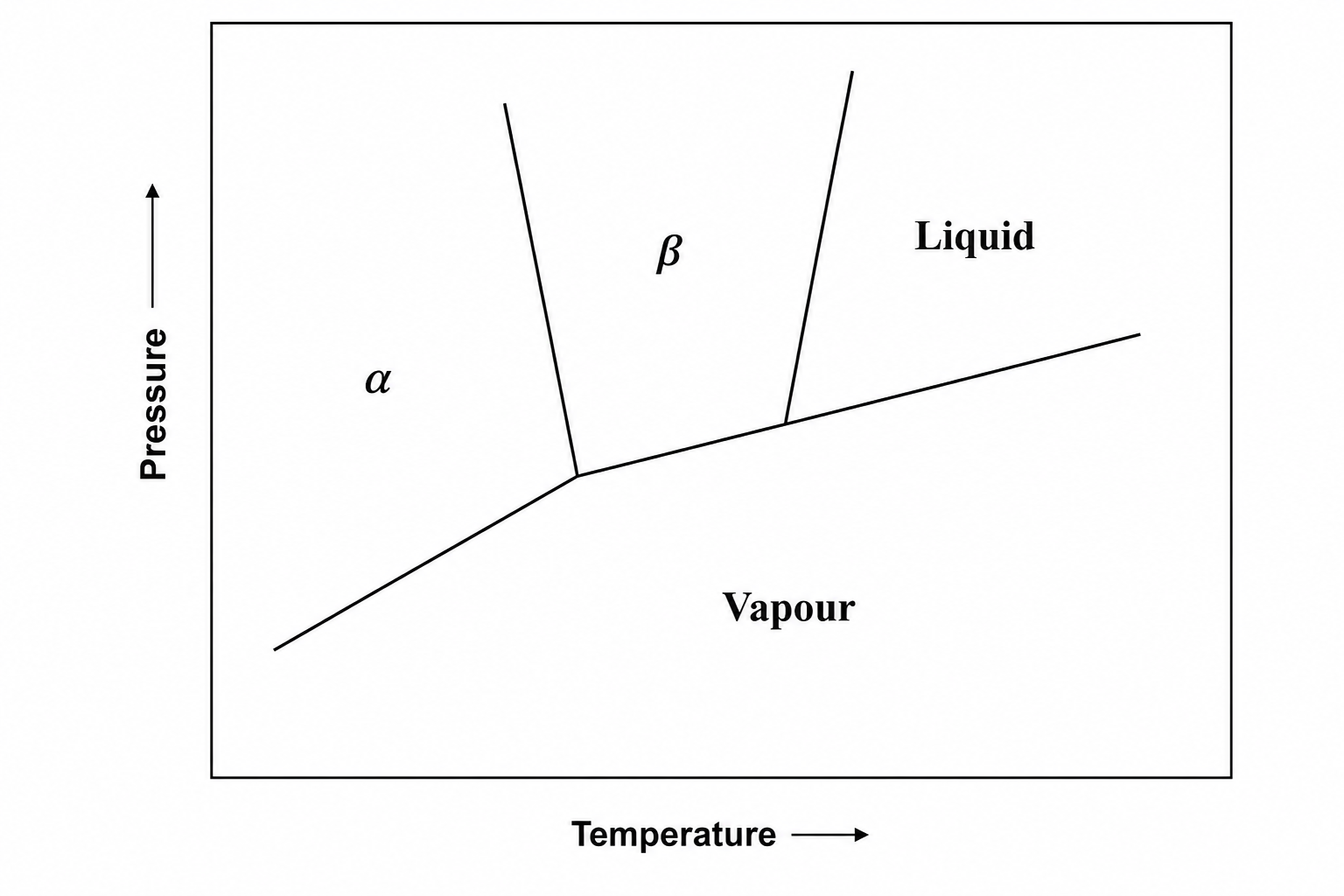
MCQ2M
A
\(V_\alpha
B
\(V_\alpha>V_\beta\) and \(V_\beta
C
\(V_\alphaV_\text{Liquid}\)
D
\(V_\alpha>V_\beta\) and \(V_\beta>V_\text{Liquid}\)
Solution
From Clausius–Clapeyron: positive slope of \(\alpha/\beta\) boundary means \(V_\alpha>V_\beta\). Positive slope of \(\beta/\)liquid boundary means \(V_\betaB
38
Match the steel plant processes in Column I with Column II.
Column I: P. Corex Q. Electric Arc Furnace R. Midrex S. Continuous Casting Column II: 1. Melter-gasifier 2. Natural gas reformer 3. Electromagnetic stirrer 4. Hot heel
MCQ2M
A
P–1, Q–4, R–2, S–3
B
P–1, Q–4, R–3, S–2
C
P–2, Q–4, R–1, S–3
D
P–1, Q–3, R–2, S–4
Solution
Corex→melter-gasifier; EAF→hot heel; Midrex→natural gas reformer; Continuous casting→electromagnetic stirrer. Answer: A
39
Radiative heat flux \(\dot{q}\) at surface \(T_s\) is expressed as \(\dot{q}=Af(T_s,T_\infty)(T_s-T_\infty)\). The function \(f(T_s,T_\infty)\) is given by?
MCQ2M
A
\((T_s+T_\infty)^2(T_s-T_\infty)\)
B
\((T_s^2+T_\infty^2)(T_s+T_\infty)\)
C
\((T_s^2-T_\infty^2)(T_s+T_\infty)\)
D
\((T_s-T_\infty)^2(T_s+T_\infty)\)
Solution
Stefan–Boltzmann: \(\dot{q}=\sigma(T_s^4-T_\infty^4)\). Factor: \(T_s^4-T_\infty^4=(T_s^2+T_\infty^2)(T_s+T_\infty)(T_s-T_\infty)\). So \(f=(T_s^2+T_\infty^2)(T_s+T_\infty)\). Answer: B
40
Match the phenomena in Column I with typical observations in Column II.
Column I: P. Dynamic strain aging Q. Recrystallization R. Bauschinger effect S. Superplasticity Column II: 1. Grain boundary sliding 2. Decrease in yield stress with reversal of loading 3. Decrease in dislocation density 4. Serrations in stress–strain curve
MCQ2M
A
P–4, Q–1, R–2, S–3
B
P–4, Q–3, R–2, S–1
C
P–3, Q–4, R–2, S–1
D
P–1, Q–4, R–2, S–3
Solution
Dynamic strain aging→serrations(4); Recrystallization→lower dislocation density(3); Bauschinger→lower yield on reversal(2); Superplasticity→grain boundary sliding(1). Answer: B
41
Which one of the following matrices is orthogonal?
Option B is a rotation matrix (\(\cos60°=1/2\), \(\sin60°=\sqrt{3}/2\)). Verifying \(A^TA=I\): rows are orthonormal. Answer: B
42
Match casting defects in Column I with features in Column II.
Column I: P. Misrun Q. Expansion scab R. Pin holes S. Hot tearing Column II: 1. Penetration of liquid metal behind surface sand layer 2. Premature solidification — sections not filled 3. Cracking due to contraction restraint 4. Gas evolution during solidification causing porosity
MCQ2M
A
P–2, Q–4, R–3, S–1
B
P–1, Q–3, R–2, S–4
C
P–1, Q–2, R–4, S–3
D
P–2, Q–1, R–4, S–3
Solution
Misrun=premature solidification(2); Expansion scab=metal penetration(1); Pin holes=gas porosity(4); Hot tearing=contraction cracking(3). Answer: D
43
Activation energies in polycrystalline BCC iron at 773 K: P = C diffusion in BCC Fe (lattice) Q = Fe diffusion in BCC Fe (lattice) R = Fe diffusion in BCC Fe (grain boundary) Which is CORRECT?
MCQ2M
A
\(R < P < Q\)
B
\(R < Q < P\)
C
\(Q < P < R\)
D
\(P < R < Q\)
Solution
Interstitial C (P) has lowest activation energy. GB diffusion of Fe (R) is intermediate. Lattice diffusion of Fe (Q) is highest. Answer: D
44
Front tension is applied during cold rolling of a thin metal sheet. Which of the following statements is/are TRUE?
MSQ2M
A
The neutral point shifts towards the roll entrance.
B
The rolling load is decreased.
C
The neutral point shifts towards the roll exit.
D
The rolling load is increased.
Solution
Front tension pulls the sheet forward, reducing rolling load (B ✓) and shifting the neutral point towards the entrance (A ✓). Answer: A, B
45
Which of the following statements is/are CORRECT when Ni is added as an alloying element to a low alloy steel?
MSQ2M
A
Hardenability is increased AND the M\(_s\) temperature is lowered.
B
Hardenability is decreased AND the M\(_s\) temperature is lowered.
C
Hardenability is increased AND the M\(_s\) temperature is raised.
D
Hardenability is decreased AND the M\(_s\) temperature is raised.
Solution
Ni stabilizes austenite: increases hardenability and lowers M\(_s\) temperature. Answer: A
46
Which of the following statements is/are CORRECT with respect to fusion welding and solid-state welding of metals and alloys?
MSQ2M
A
Thermomechanically affected zone is found in the fusion welding of pure metals.
B
Partially melted zone is NOT found in the fusion welding of pure metal.
C
Diffusion bonding is one type of solid-state welding process.
D
Partially melted zone is found in the fusion welding of alloys with a large freezing range.
Solution
Pure metals have a single melting point, so no partially melted zone in fusion welding (B ✓). Diffusion bonding is solid-state (C ✓). Wide freezing range alloys show a partially melted zone (D ✓). Answer: B, C, D
47
Which of the following welding processes does NOT / do NOT utilize a consumable electrode?
MSQ2M
A
Plasma arc welding
B
Gas metal arc welding
C
Shielded metal arc welding
D
Electron beam welding
Solution
PAW uses non-consumable W electrode (A ✓). EBW uses an electron beam — no electrode (D ✓). GMAW and SMAW both use consumable electrodes. Answer: A, D
48
For \(T(x,y)=\frac{1}{3}xy(x+y)\), find the magnitude of its gradient \(|\nabla T|\) at point (1, 1) (2 decimal places).
NAT2M
Solution
\(\partial T/\partial x=\frac{1}{3}(2xy+y^2)\). At (1,1): 1. \(\partial T/\partial y=\frac{1}{3}(x^2+2xy)\). At (1,1): 1. \(|\nabla T|=\sqrt{1^2+1^2}=\sqrt{2}\approx\mathbf{1.41}\).
49
X-ray diffraction (\(\lambda=0.154\) nm) gives the first peak at \(\theta=20°\) for both metal A (FCC) and metal B (BCC). Find the ratio: lattice parameter of A / lattice parameter of B (2 decimal places).
NAT2M
Solution
First FCC peak: (111), \(h^2+k^2+l^2=3\). First BCC peak: (110), \(=2\). Same \(\theta\Rightarrow d_A=d_B\). \(a_A/\sqrt{3}=a_B/\sqrt{2}\Rightarrow a_A/a_B=\sqrt{3/2}=\mathbf{1.22}\).
50
Excess molar Gibbs free energy: \(G^{XS}=-3000\,x_Ax_B\) J mol\(^{-1}\) at 1000 K. Find the activity of B in a solution containing 40 mol% B (2 decimal places). \(R=8.314\) J mol\(^{-1}\)K\(^{-1}\).
Molten steel at 1900 K to be vacuum degassed. What equilibrium \(P_{\text{H}_2}\) (in Torr) achieves 1 ppm dissolved H? \(\log_{10}K_{eq}=-1900/T+2.4\) (K\(_{eq}\) in ppm/\(\sqrt{\text{atm}}\)); 1 atm = 760 Torr. (2 decimal places)
Given (in J): \(\text{Fe}(s)+\frac{1}{2}\text{O}_2\rightleftharpoons\text{FeO}(s)\), \(\Delta G^\circ=-264900+65T\); \(2\text{H}_2+\text{O}_2\rightleftharpoons 2\text{H}_2\text{O}(g)\), \(\Delta G^\circ=-492900+109T\). Find \(P_{\text{H}_2\text{O}}/P_{\text{H}_2}\) to reduce FeO at \(T=1000\) K (2 decimal places). \(R=8.314\) J mol\(^{-1}\)K\(^{-1}\).
NAT2M
Solution
Reduction: FeO+H\(_2\)\(\to\)Fe+H\(_2\)O. \(\Delta G^\circ_{red}=\frac{1}{2}(-492900+109T)-(-264900+65T)=18450-10.5T\). At 1000 K: 7950 J. \(K=e^{-7950/8314}=\mathbf{0.38}\).
54
Diameter of spherical galena particles having same Stokes settling velocity as spherical quartz particles of diameter 25 µm (both in water) is ______ µm (1 decimal place). \(\rho_\text{galena}=7400\), \(\rho_\text{quartz}=2600\), \(\rho_\text{water}=1000\) kg m\(^{-3}\).
Cell reaction: \(\text{Mg}+\text{Cd}^{2+}\to\text{Mg}^{2+}+\text{Cd}\). Standard Gibbs free energy change is ______ kJ (integer). Oxidation potentials: Mg: 2.37 V; Cd: 0.403 V. \(F=96500\) C mol\(^{-1}\).
NAT2M
Solution
\(E^\circ_{cell}=(-0.403)-(-2.37)=1.967\) V. \(\Delta G^\circ=-nFE^\circ=-2\times96500\times1.967=-\mathbf{380}\) kJ mol\(^{-1}\).
56
Copper electrodeposited from CuSO\(_4\) on 2 m\(^2\) cathode at 200 A m\(^{-2}\), efficiency 90%, for 24 h. Mass deposited (kg, 2 decimal places)? \(F=96500\) C mol\(^{-1}\), \(M_\text{Cu}=63.5\) g mol\(^{-1}\), \(n=2\).
NAT2M
Solution
\(I=400\) A, \(t=86400\) s, \(Q=400\times86400\times0.9=3.11\times10^7\) C. Moles=\(3.11\times10^7/(2\times96500)=161.1\). Mass=\(161.1\times63.5=\mathbf{10.23}\) kg.
57
Intrinsic semiconductor: conductivity 100 Ω\(^{-1}\)m\(^{-1}\) at 300 K and 300 Ω\(^{-1}\)m\(^{-1}\) at 500 K. Band gap (eV, 2 decimal places)? \(k_B=8.6\times10^{-5}\) eV K\(^{-1}\).
Alloy A: \(K_{IC}=50\) MPa\(\sqrt{\text{m}}\), fracture at \(a=0.4\) mm under stress \(\sigma\). Alloy B: \(K_{IC}=75\) MPa\(\sqrt{\text{m}}\), same \(\sigma\) and geometry. Critical crack length for B is ______ mm (1 decimal place).
NAT2M
Solution
\(a\propto K_{IC}^2\) (same \(\sigma\), Y). \(a_B=0.4\times(75/50)^2=0.4\times2.25=\mathbf{0.9}\) mm.
59
A 0.4 m thick copper plate: one side at 1000°C, other at 500°C. Steady 1D conduction. Heat flux is ______ × 10\(^5\) W m\(^{-2}\) (integer). \(k_\text{Cu}=400\) W m\(^{-1}\)K\(^{-1}\).
NAT2M
Solution
Fourier’s law: \(q''=k\Delta T/L=400\times500/0.4=\mathbf{5}\times10^5\) W m\(^{-2}\).
60
Nabarro–Herring creep in polycrystalline Ni. \(\dot{\varepsilon}=10^{-8}\) s\(^{-1}\) at \(\sigma=10\) MPa. What stress gives \(\dot{\varepsilon}=10^{-9}\) s\(^{-1}\)? (integer MPa)
BCC metal, \(a=0.4\) nm, shear strain rate \(\dot{\gamma}=0.001\) s\(^{-1}\), mobile dislocation density \(\rho_m=10^{10}\) m\(^{-2}\), Burgers vector \(\mathbf{b}=\frac{a}{2}\langle111\rangle\). Average dislocation velocity is ______ × 10\(^{-3}\) m s\(^{-1}\) (2 decimal places).
NAT2M
Solution
\(b=0.4\times10^{-9}\times\sqrt{3}/2=3.46\times10^{-10}\) m. Orowan: \(v=\dot{\gamma}/(\rho_m b)=10^{-3}/(10^{10}\times3.46\times10^{-10})=2.89\times10^{-4}\) m s\(^{-1}\)=\(\mathbf{0.29}\times10^{-3}\) m s\(^{-1}\).
62
A cylindrical specimen is plastically tensioned to 10% uniform elongation. Final gage-section area = 20 mm\(^2\). Initial gage-section area is ______ mm\(^2\) (integer).
Reaction A→B: first-order kinetics. 20% completion takes 223 s. Time (s) to reach 50% completion at the same temperature is ______ (nearest integer).
NAT2M
Solution
\(k=-\ln(0.8)/223=0.001001\) s\(^{-1}\). \(t_{50}=\ln2/k=0.6931/0.001001=\mathbf{693}\) s.
64
Al alloy billet (300 mm dia.) hot extruded to 75 mm dia. at \(\dot{\varepsilon}=10\) s\(^{-1}\). Flow stress \(\sigma=10(\dot{\varepsilon})^{0.3}\) MPa. Ideal plastic work of deformation per unit volume is ______ × 10\(^6\) J m\(^{-3}\) (1 decimal place).
NAT2M
Solution
\(\sigma=10\times10^{0.3}=19.95\) MPa. True strain: \(\varepsilon=2\ln(300/75)=2\ln4=2.773\). Ideal work \(=\sigma\varepsilon=19.95\times2.773=\mathbf{55.3}\) MJ m\(^{-3}\).
65
Two consecutive Newton–Raphson estimates: \(x_i=8.5\) and \(x_{i+1}=13.5\). If \(f(x_i)=15\), the numerical value of \(f'(x_i)\) is ______ (integer).